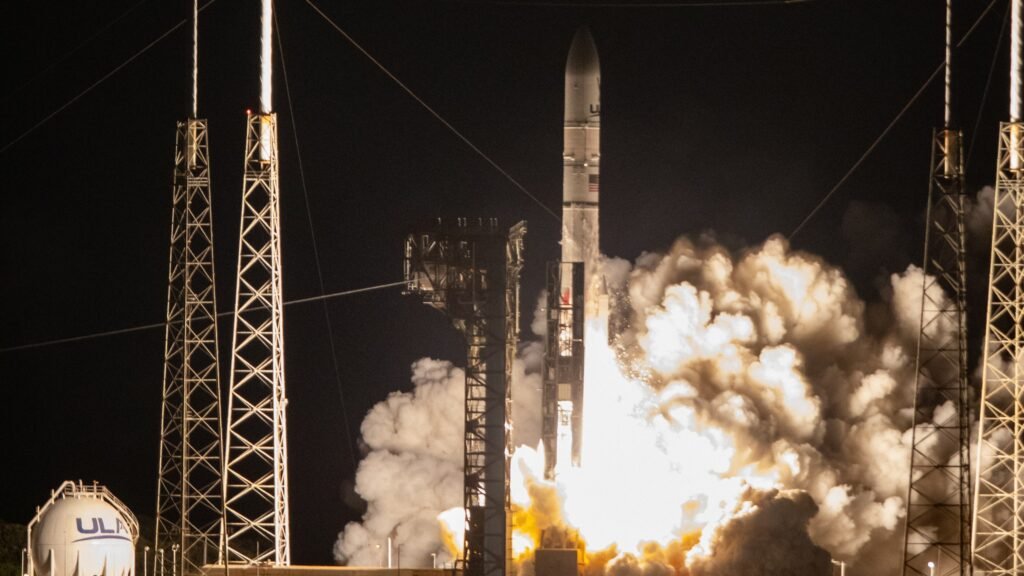
United Launch Alliance now has a preliminary suspect for Sunday’s rocket failure, which destroyed 40 of Amazon’s Leo broadband satellites — and it is not the engines. ULA said on Wednesday that inadequate fuel supply to the first stage’s two BE-4 engines starved them of thrust shortly after liftoff. It is a sharp change of story in less than 24 hours.
The Vulcan Centaur lifted off from Space Launch Complex 41 at Cape Canaveral at 12:40 p.m. ET on Sunday, 15 November, on the first of 38 Vulcan launches Amazon has bought for its Leo constellation. About 10 minutes in, telemetry was lost, and ULA confirmed roughly 50 minutes later that the rocket had “suffered an anomaly 10 minutes into the flight and failed to deliver the Amazon mission to orbit,” as Reuters reported. It was ULA’s first total mission failure since the Boeing–Lockheed Martin joint venture was formed in 2006.
The suspect flipped in 24 hours
On Tuesday, ULA blamed “low booster performance” just after liftoff, and suspicion fell on the BE-4 engines — the Blue Origin powerplants at the heart of the first stage. By Wednesday, the picture had changed. The Register reports ULA’s preliminary finding that “the low booster thrust was the result of inadequate fuel supply from the vehicle to the BE-4 engines, not from the performance of the engines.” The engines themselves may have worked fine — they simply were not fed enough fuel to do their job.
The rest of the rocket did its part. GeekWire reports that the six Northrop Grumman solid rocket boosters performed normally and the Centaur upper stage started normally, with its two L3Harris RL10 engines operating as planned — but stage separation happened too low and too slow to reach orbit, and the upper stage could not make up the shortfall. Blue Origin is supporting ULA’s investigation with BE-4 data and analysis. That matters because the BE-4 also powers Blue Origin’s own New Glenn rocket — an engine fault would have been a problem for two launch programmes, not one.
A pattern, not a one-off
Three of Vulcan’s five flights have now hit trouble: the October 2024 flight lost a solid-booster nozzle; the February 2026 USSF-87 mission suffered another booster anomaly, after which the Space Force paused national-security Vulcan launches; and now the November flight has ended in total loss. Flight by flight, the “reliable alternative to SpaceX” narrative is cracking.
The stakes for Amazon are concrete. GeekWire reports the company had 396 Leo satellites in orbit across 14 successful missions since April 2025, against a planned constellation of 3,232, all due by the FCC deadline of 30 July 2029. Vulcan is slated to carry more than 1,500 of those satellites, more than any other rocket in the programme.
The same weekend, the opposite result
The contrast with the same weekend could hardly be starker. On Saturday 14 November, SpaceX caught a Starship upper stage with Mechazilla for the first time, after a flight that had deployed 26 Starlink V3 satellites. The next day, ULA lost a rocket. Two opposite outcomes, 24 hours apart, in the Starlink-versus-Leo race — and Amazon’s fallback is already scheduled: an Ariane 6 launch of 36 Leo satellites, targeted for no earlier than 23 November from French Guiana.
Why this matters
The fuel-supply finding is genuinely good news for Blue Origin — and genuinely bad news for the idea that Sunday was a freak accident. An engine that underperforms is a component problem; a vehicle that starves its engines of fuel is a systems problem, and it raises harder questions about a rocket that has now stumbled on three of its five flights. ULA’s investigation is still preliminary, and the Federal Aviation Administration will oversee it and approve the final report. But the clock is running: Amazon needs Vulcan flying reliably to hit a 2029 deadline that does not move.
Meanwhile in Space: 22 Launches to the Moon, or 8? NASA and Musk Are Fighting Over Starship’s Fuel Math
Meanwhile in Space: Japan’s MMX Mission Heads for Mars’ Moon Phobos — and Plans to Steal a Piece of It