On Thursday, a routine NASA safety meeting turned into a public argument about the Moon program. At the Aerospace Safety Advisory Panel’s quarterly public meeting on October 22, member Charlie Precourt, a former NASA astronaut, flagged the fueling plan for SpaceX’s lunar lander as a major risk for Artemis IV, the 2028 crewed Moon mission. “I think the last estimate is around 22 flights,” he said.
Musk answered on X within hours: “That’s way too high. Actual number will be more like 6 to 8.” The exchange, reported by Teslarati from Ars Technica‘s account, is not really about arithmetic. It is about which rocket you are pricing: today’s Starship, or tomorrow’s.
A Gas Station With No Published Price List
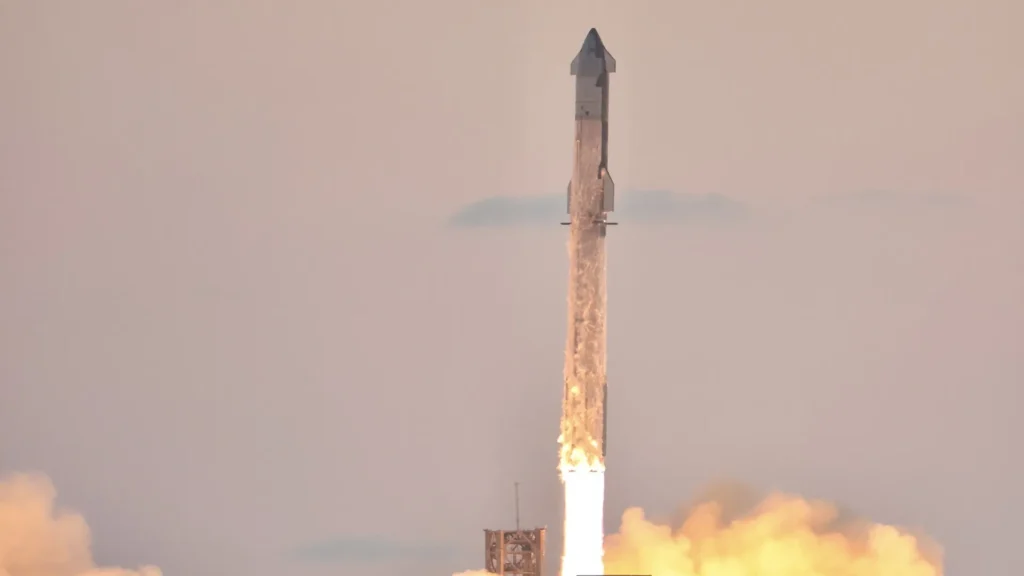
Starship cannot fly straight to the Moon. It burns nearly all of its propellant just reaching Earth orbit, so the lunar lander must refuel there. SpaceX’s answer is an orbital gas station: a depot Starship launches first, then tanker Starships launch one at a time, dock, and pump leftover liquid oxygen and methane into it. Only when the depot is full does the lander fill up and head for the Moon. Every tanker trip is a full launch of its own.
The awkward part: neither the panel nor NASA has published a breakdown of how 22 was reached, and Musk’s range comes with none either. The Artemis program’s most consequential number is two estimates with no showing of their work.
Do the Calendar Math
Turn the numbers into time and the stakes sharpen. Even at twice-weekly launches by the end of 2027, filling a depot at the panel’s number would take roughly three months, by Teslarati‘s reporting of Ars Technica’s estimate. At Musk’s number it takes about a month; at the weekly cadence targeted for early 2027, the panel’s version stretches past five months.
Time is not neutral here. The propellant is stored at extremely cold temperatures, and some slowly boils off while waiting in orbit, with more lost in each transfer. A three-month campaign means three months of boil-off, weather delays, and chances for one scrubbed tanker to stall the chain. The longer the depot sits half full, the more launches it may need to top it back up.
Why the Number Keeps Moving
The estimate has jumped before. In 2021, after a document suggested 16 launches, Musk called that “extremely unlikely,” capping tankers at eight. In November 2023, NASA officials said the “high teens,” while the landing program’s then-director said the “high single digits to the low double digits,” roughly a dozen including the depot. The pattern explains the gap: the panel prices today’s Starship; Musk prices the upgraded Version 3.
The Flight That Decides It
SpaceX plans its first double catch on Flight 15, targeted for November, with both the Super Heavy booster and the Ship upper stage returning to the tower’s arms, according to Advanced Television. It follows Flight 14 on September 28, when Starship first reached orbit and deployed 26 next-generation Starlink satellites, as Space.com reported. In-space refueling remains undemonstrated, and SpaceX says it will attempt an on-orbit refueling demo in early 2027. That demo, not the argument on X, will settle the question.
Why this matters
Artemis IV is supposed to land astronauts on the Moon in 2028, and Precourt tied the fueling count to that mission’s risk, calling it one of “a large number of firsts” reducing its likelihood of success. If the panel is right, the Moon return depends on a flawless three-month tanker campaign using a technique never demonstrated. If Musk is right, it is a one-month campaign on a rocket yet to prove its upgraded lift. Either way, the landing hinges less on a bigger rocket than on running a gas station in orbit without losing the fuel while you wait. Watch the demo, not the debate.
Meanwhile in Space: the road here began with Starship’s first orbital flight, and the Moon timeline is tracked in Artemis III’s readiness checklist.