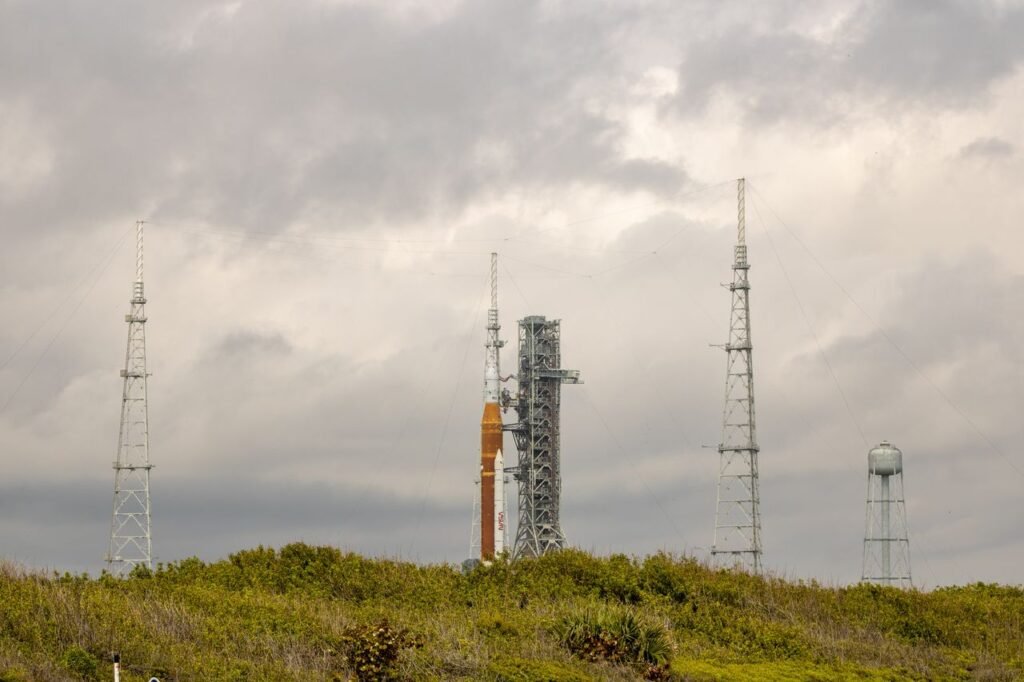
NASA’s Moon rocket got visibly bigger this week. The agency reported on October 28 that the 212-foot core stage for Artemis III now stands integrated with its twin solid rocket boosters inside High Bay 3 of the Vehicle Assembly Building at Kennedy Space Center in Florida, turning three separate pieces of hardware into one recognizable rocket, even though the mission it will fly no longer heads for the Moon.
The Lift That Turned Parts Into a Rocket
According to NASA, technicians lifted the 212-foot stage from High Bay 2 using a one-of-a-kind lifting beam designed to place it onto the mobile launcher, alongside boosters already waiting in High Bay 3. It is slow, heavy work that rarely makes headlines, and it decides whether a launch date survives contact with reality.
The core stage is the backbone of the Space Launch System, or SLS. It holds the liquid hydrogen and liquid oxygen tanks and the four RS-25 engines that power the first minutes of flight. As Space.com has noted, the stage alone stands 212 feet tall, and the fully assembled SLS with its boosters and Orion spacecraft reaches 322 feet. What now stands in High Bay 3 is the lower half of that giant, minus the spacecraft on top.
A Moon Rocket That Stays Near Earth
That missing top is the point, not an oversight. Artemis III will launch NASA astronauts Randy Bresnik, Frank Rubio, and Andre Douglas, plus European Space Agency astronaut Luca Parmitano, in the Orion spacecraft to test rendezvous and docking with commercial spacecraft from Blue Origin and SpaceX ahead of a future mission to land astronauts on the Moon.
In other words, the next crew will rehearse the hardest parts of a landing mission, docking with two different lander designs, while still in Earth orbit, where a problem means an early trip home, not a crisis a quarter of a million miles away. NASA recast Artemis III this way after concluding that the landers were not ready for a crewed landing attempt, pushing that landing to a later mission planned for 2028.
The crew list itself tells the same story. These are experienced astronauts assigned to a test flight, not a landing party. Their job is to prove Orion can meet and dock with vehicles it has never flown with, and hand the landing mission procedures already tested in orbit.
Why This Matters
Here is the detail most coverage of the stacking will skip, and it is the one that matters most for the schedule. NASA’s next step for this stack is not to add Orion. It is to roll the core stage and boosters out to Launch Pad 39B for a tanking test in which liquid hydrogen and liquid oxygen will be loaded only into the core stage, while launch teams practice countdown procedures and timelines.
That sequence is deliberate. A tanking test on a deliberately incomplete rocket lets engineers shake out fueling and countdown problems on hardware that is cheap to roll back. Finding a leak or a timing flaw now costs weeks. Finding it on a fully stacked rocket with a crew capsule on top costs months, and possibly the launch window.
It also sets up the real test of NASA’s revised plan: whether a program built around one giant rocket can still move quickly when its most complex work, docking two commercial landers in orbit, has been split across three separate launches. The hardware in High Bay 3 answers the first question, that the rocket itself is coming together. The tanking test, and then the orbital rehearsal planned for 2027, will answer the harder ones.
For now, the picture is simple. The rocket that will carry the next American crew toward the Moon, even if it stops short of landing there, is no longer parts in different bays. It stands upright, on its launcher, in the Vehicle Assembly Building.
Meanwhile in Space: NASA’s 2028 Moon landing now depends on a 2027 orbital rehearsal, and the Artemis III readiness checklist for June 2027 lays out what still has to be proven before that flight.