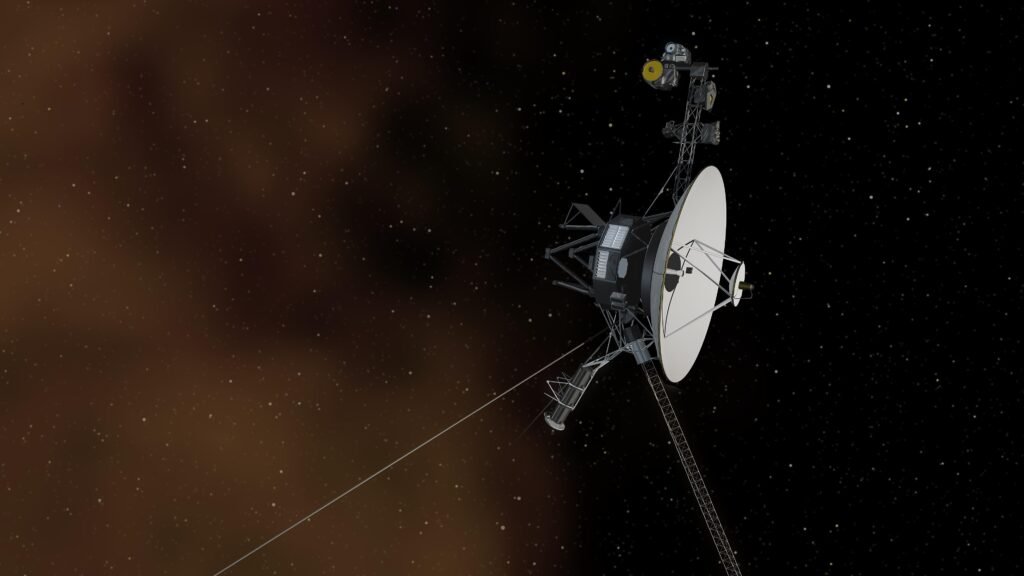
Tomorrow morning at 5:16:07 a.m. ET, Voyager 1 becomes the first human-made object ever to sit one full light-day from Earth — 16,094,799,096 miles from home. From that moment on, talking to it will take two days.
Voyager 1 has been travelling for 49 years, 2 months and 11 days since its September 5, 1977 launch, still cruising at roughly 38,000 mph through interstellar space since August 2012. NASA explains that one light-day works out to 25,902,068,356 kilometres — a number easier to think of in time than in distance.
A two-day hello
That is how Voyager project manager Suzanne Dodd frames it: “If you want to say ‘hello’ to Voyager, you send your message and then you go home and you wait two days before you finally get a response.” From Wednesday, a signal takes 24 hours to reach the spacecraft and another 24 hours for the reply — a 48-hour round trip for every command and answer.
NASA adds a caveat the straight coverage mostly skips: the milestone is symbolic, and the spacecraft will notice nothing when it crosses the line. It will keep measuring the plasma waves and magnetic fields of interstellar space with the few instruments still running.
The blackout that nearly ended it
The celebration comes barely a month after a scare that could have ended the mission. NASA’s Deep Space Network failed to detect Voyager 1 during two scheduled attempts on October 18–19, 2026; contact was restored on October 20 without any troubleshooting commands. One thruster group had gone offline and onboard fault protection had switched to backup thrusters automatically. The cause is still under investigation.
“This is the first time we’ve seen the spacecraft do something like this, but we are also at a point in the mission where we have to expect the unexpected,” said Kareem Badaruddin, Voyager mission manager at NASA’s Jet Propulsion Laboratory, in CNBC TV18’s account of the incident — a spacecraft 49 years into a mission designed to last five.
The power gamble that bought time
Power is the other slow emergency. Both Voyagers lose about 4 watts a year as their plutonium decays, and in September 2026 NASA ran an operation it called the “Big Bang”, switching off three Voyager 1 devices and replacing them with lower-power alternatives. Without it, another instrument would have had to go dark as early as summer 2027.
Voyager 1 launched with 10 science instruments; only a few still operate, among them the plasma wave subsystem and the magnetometer, per NASA’s April 2026 update. Every watt saved is another year of data from a region no other spacecraft has visited. Voyager 2 will not reach one light-day until November 2035.
How to join tonight
NASA is inviting the public to mark the moment. After sunset tonight, Tuesday, November 17, anyone can join “Shine Bright for Voyager’s Light-Day” by flashing “VGR” — Voyager’s call sign — in Morse code with a phone or flashlight. A public discussion at JPL follows on Thursday, November 19.
And then Voyager 1 keeps going, toward the star Gliese 445, more than 17 light-years away; it will pass within about 1.7 light-years of it in roughly 40,000 years.
Why this matters
The light-day is a yardstick for how far human engineering can reach — and how lonely that reach has become. Voyager 1 is the only object we have ever sent this far, and the October blackout showed how fragile the link is: one silent weekend, one thruster group, and the most distant thing humanity has built could have gone dark for good. The two-day round trip that starts Wednesday is the new reality of deep space: every command is a leap of faith, and every reply is a day old. That NASA is still squeezing years out of a 1977 spacecraft is the real story behind the milestone, and Shine Bright is a small, human way to answer a spacecraft that will take two days to hear us.
Meanwhile in Space: Artemis II astronauts watched five meteor impacts on the Moon
Meanwhile in Space: SpaceX’s Crew-13 set a record with its ISS docking