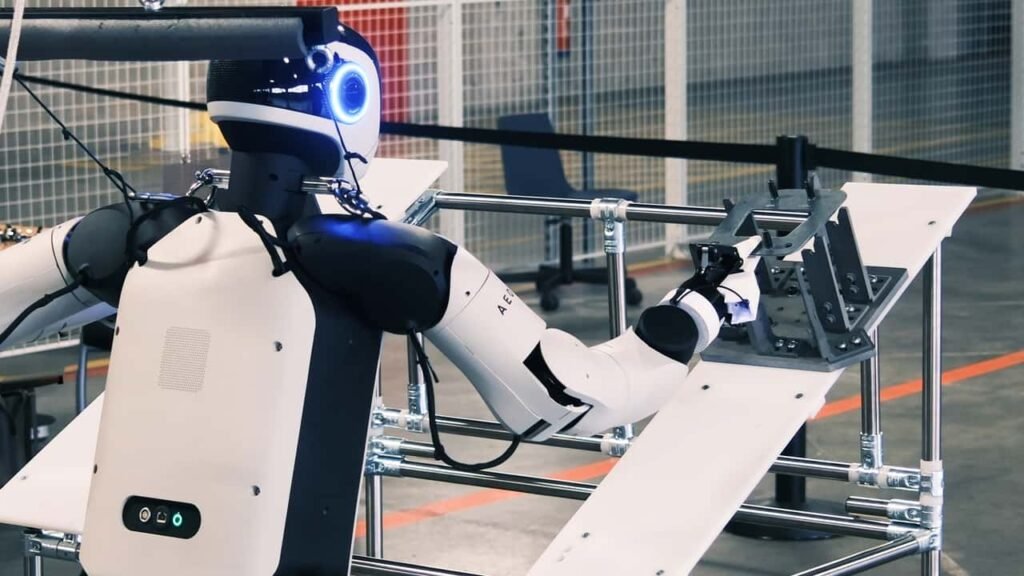
Volvo Cars has put a humanoid robot on its factory floor — and the robot has no feet. The AEON, built by Hexagon Robotics, rolls on motorized wheels instead of walking on legs, and Volvo is training it right now at its Ghent, Belgium plant, aiming for real production work from mid-2027. While Tesla, XPENG and Figure chase bipedal walking, Volvo picked the robot that rolls. That is not a compromise. It is the whole point.
The announcement came Thursday, November 26. Ghent is the first Volvo plant to try humanoid robots, and the robots are already being trained by Volvo’s own workers on real industrial tasks, according to Volvo Cars. The method is imitation learning: the robot learns a task by copying how a worker does it. The first task is placing components into two fixtures with high precision. The difficulty then scales up — multiple parts, moving around the production area, interacting with the plant’s automated systems. A factory pilot follows in the first half of 2027, with more AEON units arriving in Ghent, and the aim is real production use from mid-2027.
Why Wheels Beat Legs on a Factory Floor
AEON is 1.65 meters tall, weighs 60 kg, tops out at 2.4 meters per second — about a light jog — and carries a 10 kg payload, with 34 degrees of freedom. Its upper body is anthropomorphic; its legs terminate in motorized wheels rather than feet. On a factory floor, that is a feature, not a missing piece. Wheels are faster, more stable while carrying a load, and they need no balance breakthrough. The hardest problem in humanoid robotics — walking without falling over — simply does not exist for this robot. It can fit into production as it is today, alongside existing teams and automation.
“AEON’s humanoid design means it can fit into our production as it is today, alongside our teams and existing automation,” said Magnus Nilsson, Volvo’s chief manufacturing officer. “Our aim is for humanoid robots to take on some of the most physically demanding tasks and help make work more ergonomic for our people.” Hexagon’s Arnaud Robert put it more bluntly: “The purpose of humanoid robotics is to deliver business value to our customers.”
The 2027 Factory-Humanoid Scoreboard
Volvo is now the second automaker to put the same robot, AEON, on a real line — BMW piloted it at its Leipzig plant on high-voltage battery assembly earlier this year. That makes Hexagon the quiet winner of the factory-humanoid race so far: one robot, two carmakers, real tasks. The rest of the field is still largely in demo mode. Audi is piloting a humanoid with NVIDIA, Mercedes-Benz is working with Apollo, Tesla’s Optimus is still ramping toward production, Hyundai plans 30,000 factory robots by 2028, and XPENG’s IRON is headed for store-assistant work in 2027 — a different job entirely.
Honesty requires the gaps. Volvo has not said how many AEON units are at Ghent, how many arrive for the 2027 pilot, which vehicle lines will use them, or what task-success rate or cycle time the robots achieve. The EX30 EV is built at Ghent, but Volvo did not confirm it. The mid-2027 production target is conditional on the training and validation succeeding — Volvo’s own wording is “the aim is,” not “it will.” Treat the date as a target, not a promise.
Why This Matters
The humanoid race is splitting in two. There are the dancers — backflips, demos, viral videos — and there are the workers: wheels, fixtures, and a 2027 production date. Volvo just picked a side, and it picked the side with a business case. A robot that rolls to a fixture and places a component precisely, every time, without falling over, is worth more to a carmaker than a robot that can walk beautifully and do nothing useful. The factory floor does not care how a robot moves. It cares whether the part lands in the fixture.
Meanwhile in Robotics: Hyundai is thinking bigger than one plant — its plan puts humanoid robots across its factories by 2032. And Audi is running its own factory pilot: the Agile One SN humanoid, built with NVIDIA, is already in an Audi pilot.