Hyundai has put a date on the humanoid factory worker: 2032. At a media preview on Friday for E-FOREST Tech Day 2026 — the group’s manufacturing technology showcase running October 19–21 at its Uiwang research center — Hyundai Motor and Kia laid out a staged march toward what they call the autonomous operating factory, with roughly 200 technologies spanning automation, AI, and software-defined factory systems, Aju Press reports.
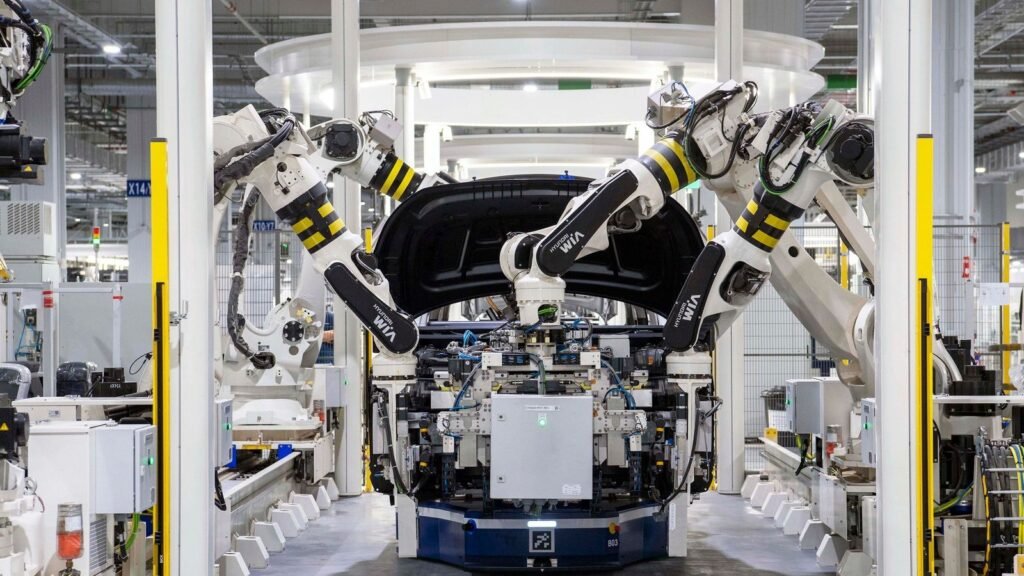
The roadmap has three beats. First, the nearer-term tools: a tunnel-type system for finished-vehicle exterior inspection, AI-based robot teaching automation targeted for completion by June 2027, a logistics-robot standardization platform, and Polaris — an AI manufacturing platform developed with Nvidia that helps workers access information and analyze production data. By 2030, the group aims to run advanced virtual-environment autonomous manufacturing at its Innovation Center in Singapore (HMGICS), the proving ground for next-generation factory tech. From 2032 onward, humanoid robots and full-scale automation arrive at future new plants. This month, notably, Hyundai’s first dedicated EV factory in South Korea — the new Ulsan plant — begins commercial operations, ET News reports.
The first humanoid jobs are specific for a reason: connecting wiring inside vehicles, supplying interior trim components, and performing paint touch-ups. These are the dexterous, fiddly tasks that conventional robots — excellent at welding and painting — still can’t do. It’s the honest version of the humanoid pitch: not a robot uprising, but machines filling the exact gaps where today’s automation stalls.
The Bet the Market Stopped Believing
The 2032 date reads cautious, and the stock chart explains why. Hyundai shares more than doubled after its US subsidiary Boston Dynamics unveiled the Atlas humanoid at CES in January, hitting a record 755,000 won (about $565) in June. They have since collapsed back near pre-CES levels, closing at 312,000 won on Friday, according to a Yonhap report carried by the Korea Times. The causes: weak earnings plus “growing concerns over potential delays in Boston Dynamics’ business plans,” including speculation about a delayed IPO — and reported cumulative losses of roughly 1.7 trillion won at the robotics unit over the past five years. “Growing concerns over potential delays in Boston Dynamics’ business plans have also fueled calls for lower valuation multiples,” iM Securities analyst Lee Sang-soo said.
Wiring Harnesses Over Moonshots
Choi Young-tae, head of Hyundai and Kia’s E-Forest Center, framed the program in deliberately un-revolutionary terms: “The purpose of automation is not to reduce the number of people, but to create a manufacturing environment where people can focus on safer and more important work.” Digital twins will validate production lines in virtual space before physical equipment moves; robot teaching automation cuts manual programming. The through line is cost and quality on real lines — the Ulsan EV plant and the Metaplant in Georgia are the near-term proving grounds — not humanoid theater.
Why this matters
Treat 2032 as the industry’s most credible conservative benchmark. Tesla talks about Optimus working in factories now; startups promise pilots this year. Hyundai — the world’s third-largest automaker, with its own humanoid subsidiary and a robotics stock saga fresh in memory — is saying the fully autonomous factory is a 2030s product. If Boston Dynamics’ losses are a speed bump, Hyundai’s caution looks like discipline. If they’re structural, 2032 may still prove optimistic. Either way, anyone promising the lights-out car factory sooner is now arguing against the company with the most to gain from believing it.
Meanwhile in Robotics: the Atlas robot’s new four-fingered hand, and Neo1, the 13-foot hydraulic giant.