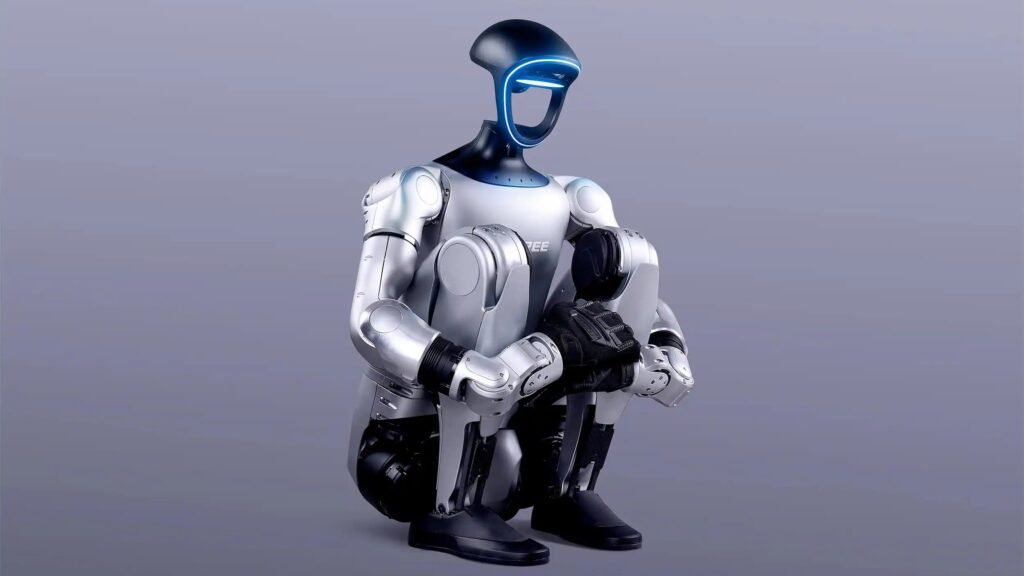
The hard part of a humanoid demo is invisible: the robot is not following a script. It is guessing — from video it has watched and practice in simulation — where things are, and where they will be a second from now. Two open releases this week show that homework.
On Monday, the Allen Institute for AI (Ai2) released RoboTrack, a benchmark and training-data suite for the vision skill robots need most: keeping track of the thing they are holding. Days earlier, Zhejiang University and Unitree Robotics researchers open-sourced Movens-5M, five million robot motions distilled from ordinary internet video. Together they answer a question the demos never do: how do humanoid robots actually learn?
The short answer: by watching us, then practicing in a world that isn’t real.
First, the Robot Has to Watch Its Own Hands
Picking something up sounds simple until you teach a machine. The robot has to follow a single point — the rim of a cup, the tip of a pipette — frame by frame, even when its own gripper covers it, the camera moves, or the object disappears behind clutter. That is point tracking, and Ai2’s RoboTrack is the first benchmark built to test it on real manipulation footage.
RoboTrack-Bench holds 307 videos and 2,522 human-verified tracks from robot and human-hand footage, covering cluttered scenes and first- and third-person views. More than half the tracked points are hidden at least once. And the scoreboard is humbling: every leading tracker Ai2 tested — CoTracker3, BootsTAPNext, AllTracker and CoWTracker — scored 3.0 to 6.6 points lower than on RoboTAP, the older, tidier benchmark. The best of them, CoWTracker, fell from 70.5 to 63.9.
Then It Practices in a World That Isn’t Real
RoboTrack’s second half is the fix: RoboTrack-15M, 15 million synthetic point tracks generated in Ai2’s MolmoSpaces simulator, where a robot arm picks up cups, plates and blocks across 300 procedurally built homes, filmed by wrist and base cameras.
That simulated practice helped on real footage. RoboTracker, a fine-tuned 17-million-parameter model, improved from 62.6 to 63.4; RoboTracker-Warp, built on the roughly 1-billion-parameter CoWTracker, rose from 63.9 to 66.0 and led four of the five benchmarks tested. The proof came in a wet lab: the tracker guided a pipette transfer in 17 of 20 trials, against 8 for object masks and 5 for optical flow.
The most useful finding may be a failure. Ai2’s first synthetic dataset produced no improvement at all, because most of its points sat on static backgrounds. Only when the training focused on the moving robot and the objects it handles did the scores move. Data volume wasn’t the lesson. Data that looks like the actual job was.
And It Learns by Watching Us
Movens-5M attacks the same bottleneck from the other side: instead of simulating practice, it mines it. According to the paper from Zhejiang University and Unitree’s joint lab, the team turned raw internet video into 5 million humanoid motion sequences — more than 10,000 hours across 297 kinds of movement — keeping only motions a robot could actually perform, verified in simulation on a Unitree G1.
Movens-Zero, the companion model, goes further: given text, speech, music or video, it generates whole-body motion for the G1, demonstrated on the real robot. The caveats: no license is stated yet, and simulation success doesn’t guarantee real-floor success.
Why This Matters
Put the week’s releases together and the humanoid race has visibly moved: the contest is no longer about who builds the most impressive body, but who teaches it best. The scarce resource is no longer actuators, it is experience — and experience is now something you can download.
That is good news for smaller labs and bad news for anyone judging robots by demo reels: RoboTrack’s scoreboard says the best robot eyes still lose track of things in cluttered rooms. The next test isn’t a video — it’s a robot that can find the pipette, keep hold of it, and not lose it halfway across the bench.
Meanwhile in Robotics: Embo raised $110M to build a robot brain that learns physics from video. Meanwhile in Robotics: Persona AI’s welding humanoid is already working in a Hyundai shipyard.