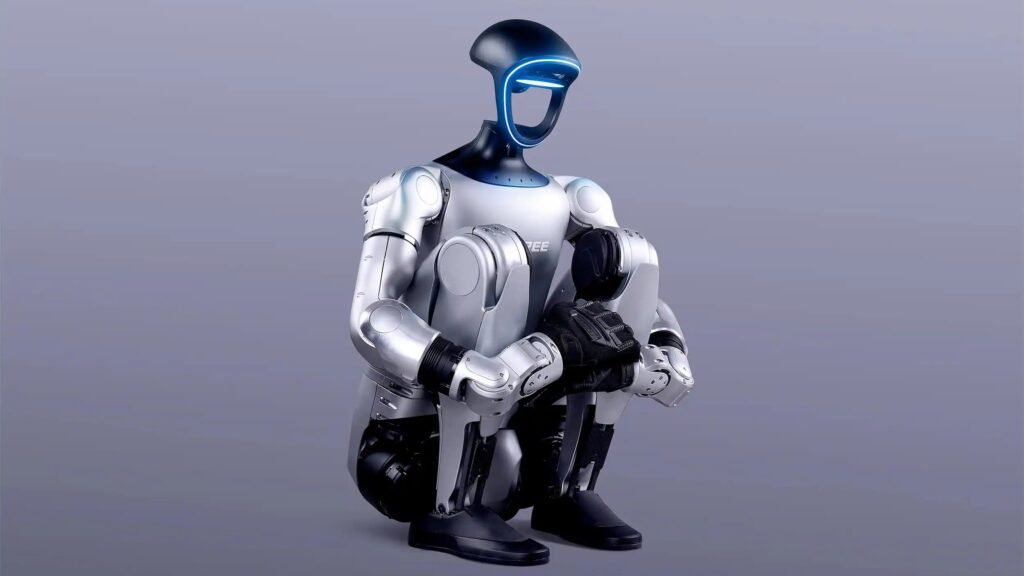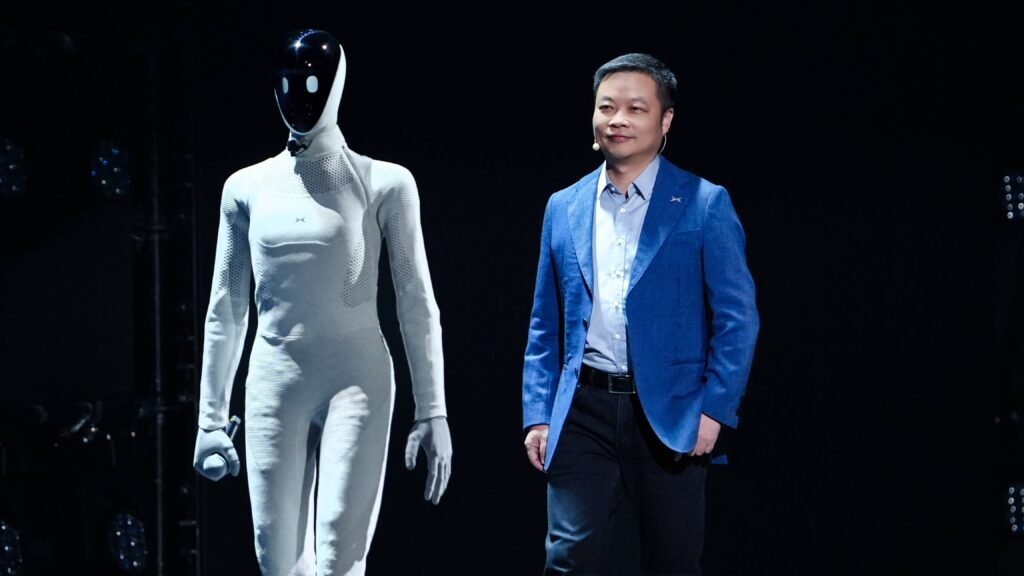
XPENG’s humanoid robot took the microphone. At AI Day 2026 in Guangzhou on November 25, the latest IRON walked on stage, addressed 2,000 guests and took part in a bilingual Q&A — and then XPENG announced the part that matters more than the performance: its first job. According to XPENG, the robot begins training as a store assistant in the company’s retail stores in the first quarter of 2027, with public release targeted for the second quarter.
The headline is the job, not the specs — though they are not modest. IRON stands about 170 cm tall, with 76 degrees of freedom including a 21-degree-of-freedom dexterous hand, and carries more than 1,500 tactile sensing points covering over 80 percent of key body areas. Three of XPENG’s own Turing AI chips deliver 2,250 TOPS of on-board computing power, and as Interesting Engineering reports, the robot navigates autonomously, takes tasks by voice or app, charges itself and reports abnormal conditions.
The Spec Sheet, and the Machine Behind It
IRON runs on XPENG’s Turing Physical AI Architecture, or VLA 3.0 — three systems at different speeds handling body control, real-time action and task planning in a continuous feedback loop. Production is as aggressive as the spec sheet: the first IRON rolled off a newly commissioned production line on September 8, 2026, and XPENG says mass production begins in January 2027. Behind it sits serious money — the robotics business raised more than $900 million in August 2026 at a valuation above $6.3 billion, the largest single private round in China’s embodied AI industry.
Retail First, Factory Later
Here is what makes XPENG’s plan different: Tesla’s Optimus and Figure’s Figure 03 are pitched at factory floors, warehouses and homes. XPENG is sending its robot to its own car showrooms first — customer reception, product guidance and other retail service work. A store is a controlled environment with defined tasks, a far kinder first workplace than a factory line.
It is also a deployment channel no rival owns: XPENG already has the stores, the foot traffic and the product. If IRON can greet customers and guide them around a showroom, XPENG learns how its robot behaves around real people — and every interaction becomes training data for the next job.
The timeline comparison is stark: Figure’s home trials completed about 56 percent of chores across 30 unseen homes, and Tesla is targeting its first Optimus customer deliveries for the end of 2027. XPENG has dated mass production: January 2027, weeks away, with its first customer — itself — lined up.
The Robot That Had to Prove It Was Real
XPENG knows the skepticism every humanoid demo invites. At last year’s AI Day, the company cut open one of IRON’s legs on stage to show the mechanics inside — its answer to “is there a human in there?” The doubt flared up again this month, when Elon Musk argued that humanoid demonstrations are generally staged and pre-programmed, and Figure’s CEO answered with a video of its Figure 03 robot picking up an apple after someone moved the table. The honest test is the one XPENG has scheduled for itself: a robot greeting real customers in a real store early next year.
Why This Matters
The humanoid race has spent years arguing about whose robot walks best. XPENG just changed the question to whose robot works first — and answered it with a date, a place and a job description. A store assistant is not the most glamorous first job in robotics, but it is the most honest: a real task, with real people who notice immediately if the robot gets it wrong.
For American buyers, the significance is indirect: XPENG is dual-listed on the NYSE, sells cars in Europe, and opened public assisted-driving test rides at a Paris retail store in November. The retail-first playbook it is testing in China is the one it will export — and the next time a humanoid greets you in a showroom, it may not be a demo.
Meanwhile in Robotics: Tesla’s next chip skips cars entirely — AI5 goes to Optimus while your Tesla stays on AI4, and Persona AI’s welding humanoid is already working in a Hyundai shipyard.