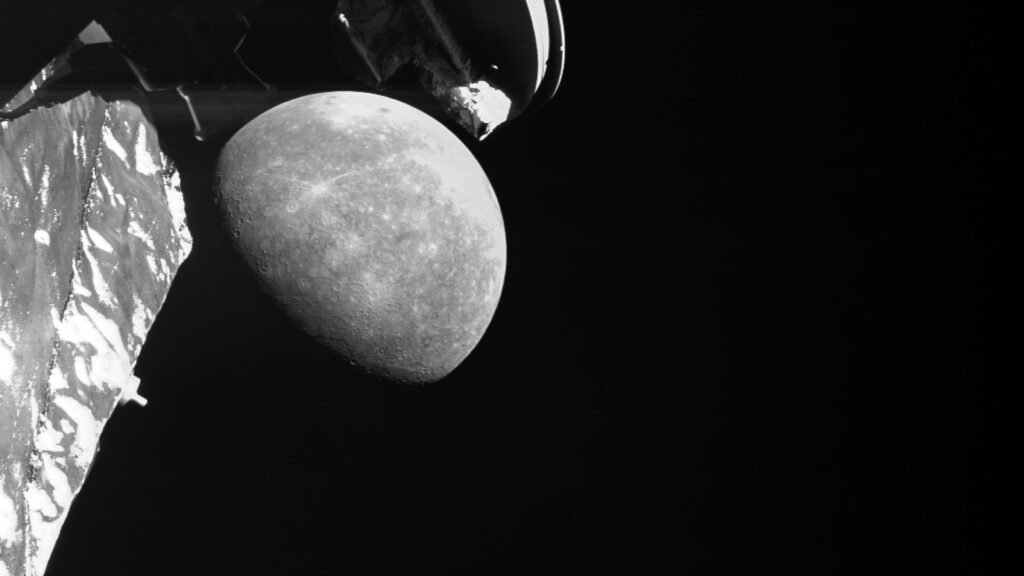
Four years ago, NASA deliberately crashed a spacecraft into an asteroid to see if it could be pushed off course. This week, we finally saw what the crash did — and it was stranger than anyone predicted. The European Space Agency’s Hera spacecraft has revealed the first close-up images of Dimorphos, the asteroid NASA’s DART mission hit in 2022, and the struck face of the little world is now a crater the size of a sports stadium.
The images were unveiled on Wednesday, November 25, in the dinosaur hall of Berlin’s Museum für Naturkunde. “Sixty-six million years ago, an asteroid impact changed the course of life on Earth,” mission manager Ian Carnelli said. “Today, for the first time in history, humanity is validating how to prevent such an event from happening again.” Neither Dimorphos nor its larger companion Didymos threatens Earth; this is a rehearsal, not an emergency.
All Three at Once
Hera went to answer three questions: did DART leave a crater, reshape the asteroid, or change nothing? “Much to our surprise the answer turns out to be all three at once!” said principal investigator Patrick Michel. “The face struck by DART has been flattened into an impact crater the size of a sports stadium, which extends across the asteroid’s entire width.” Dimorphos is only about 151 meters across; Didymos is about 730 meters. The crater covers the whole struck face, with an elongated, cigar-shaped structure near its center, while the far side looks unchanged from DART’s own 2022 images.
“The side impacted is now completely covered by a crater, with the visual impression that a piece of the asteroid was cut off by the impact,” ESA mission scientist Michael Kueppers told Reuters. “We do not see evidence for major changes on the site opposite to the DART impact. The combination of those two observations is surprising.” The images were taken on November 7 from 29 kilometers away, at 2.7 meters per pixel.
The 33-Minute Mystery, Solved
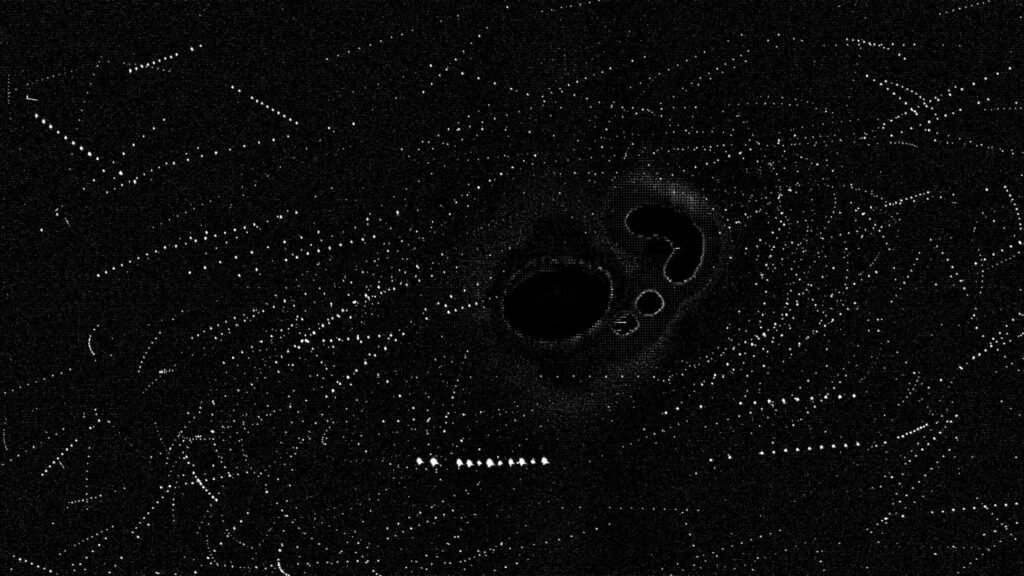
The crater explains the number that has puzzled scientists since 2022. DART — a 570 kg spacecraft hitting at about 22,530 km/h on September 26, 2022 — shortened Dimorphos’s orbital period by 33 minutes, from 11 hours 55 minutes. Simulations had predicted about 10. The extra violence is now visible: DART flattened a whole face, knocked the moonlet into a chaotic tumble, and threw hundreds of boulders into orbit. “Dimorphos is now tumbling in a chaotic way. There are hundreds of boulders floating around in the system,” Kueppers said. A long-exposure composite from Hera’s HyperScout-H instrument shows those boulders as dot trails — a navigation hazard Hera must track as it moves closer.
But a crater photo is not a deflection formula. As ESA’s release notes, Hera’s real job is still ahead: measuring Dimorphos’s mass and interior, which turns a one-off stunt into a tool humanity can trust against a real threat. The spacecraft closes to about 13 kilometers in December, and in January 2027 it deploys two shoebox-sized CubeSats — Juventas, which will attempt the first low-frequency radar probe of an asteroid interior, and Milani, which will prospect the surface and dust. The exact crater size and Dimorphos’s mass are still to be measured. The mission, about €360 million and built by OHB in Bremen, runs a six-month detailed study.
Why This Matters
More than 42,000 near-Earth objects are known and none is on a collision course — but the 20-meter rock over Chelyabinsk in 2013 injured about 1,500 people, and the 350-meter Apophis passes at 31,750 km in April 2029, closer than geostationary satellites. Planetary defense is the business of being ready before the sky gives you a deadline. DART proved an asteroid can be deflected. As ESA Director-General Josef Aschbacher put it, ESA is “now providing the detailed scientific investigation needed to understand how that deflection worked.” Hera’s crater is the first page of that investigation.
Meanwhile in Space: NASA’s crewed Moon return is moving too — Artemis II’s heat shield survived a test that would have destroyed the old design. And small-body exploration is not just an ESA story: Japan’s MMX mission is headed to bring back a piece of Phobos.