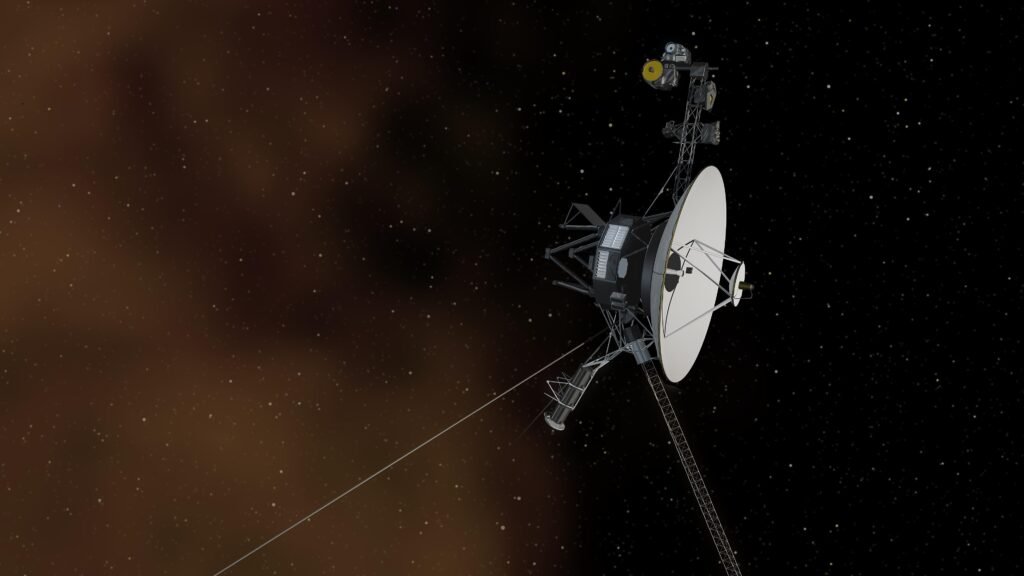
NASA’s Voyager 1 has just done something no human-made object has ever done: it has travelled one light-day from Earth. The 49-year-old probe crossed the line — about 16 billion miles (26 billion kilometres) from home — at 5:16 a.m. EST on Wednesday. NASA only confirmed it on Thursday, because the news itself took a full day to arrive.
That delay is the story. A light-day is the distance light covers in 24 hours, and Voyager 1’s radio signal obeys the same speed limit. Flight controllers at NASA’s Jet Propulsion Laboratory in California received the signal on Thursday, via a Deep Space Network antenna near Madrid, and the room broke into cheers as controller Nshan Kazaryan announced: “Voyager 1 light-day distance confirmed,” according to the Associated Press.
A phone call that takes two days
From now on, every conversation with Voyager 1 is a 48-hour affair. A command sent from Earth takes 24 hours to reach the spacecraft, and the reply takes another 24 hours to come back. Real-time control is long gone; the probe, flying at almost 38,000 mph (61,000 kph), is effectively on its own. It has been the most distant human-made object since 1998, when it passed Pioneer 10.
The probe went quiet before its big moment
The milestone arrived with a worrying subplot. According to the Associated Press, no science or engineering data has been received from Voyager 1 since Saturday. Only the carrier signal — the steady radio tone that normally carries the data — kept coming in strong, and combined with flight-path calculations, it was enough to confirm the crossing.
It is a reminder of how fragile this link has become. A mission built to last about five years has now lasted nearly 50, and Voyager 1’s instruments have been powered down to stretch its dwindling energy supply. Recent power-saving measures may keep the twin Voyagers in contact with Earth for only three to four more years, Reuters reports. The spacecraft turns 50 next year, and when the power goes, humanity’s farthest emissary goes silent for good.
Still working in the space between stars
Despite its age, Voyager 1 is still doing science. It crossed the outer edge of the heliosphere — the bubble of particles and magnetic fields blown out by the Sun — and entered interstellar space in 2012. Out there it still measures solar storms and the shock waves they send rippling outward.
Its destination, if it can be called one, is the star Gliese 445, more than 17 light-years away. If it keeps its current pace, Voyager 1 would pass within about 1.7 light-years of that star in 40,000 years. Its twin, Voyager 2, launched two weeks earlier in 1977 but on a slower path, will not reach one light-day until November 2035.
Both spacecraft carry a golden record of sounds and images from Earth. Before the crossing, NASA invited people around the world to step outside after sunset on Tuesday and flash phone lights into the sky, spelling out “V-G-R,” Voyager’s call sign, in Morse code.
Why this matters
Most distance records are numbers. This one is a condition. At one light-day, a question asked today gets its answer the day after tomorrow. And with only a few years of power left, this is very likely the last great distance milestone we will ever hear from the spacecraft.
“Traveling a light-day is a singular feat for a spacecraft, but Voyager is so much more than a distant traveler,” NASA heliophysics director Joe Westlake said in a statement, according to Reuters. “The Voyager mission would be remarkable just for what it contributed to planetary science with the Grand Tour of the outer planets.”
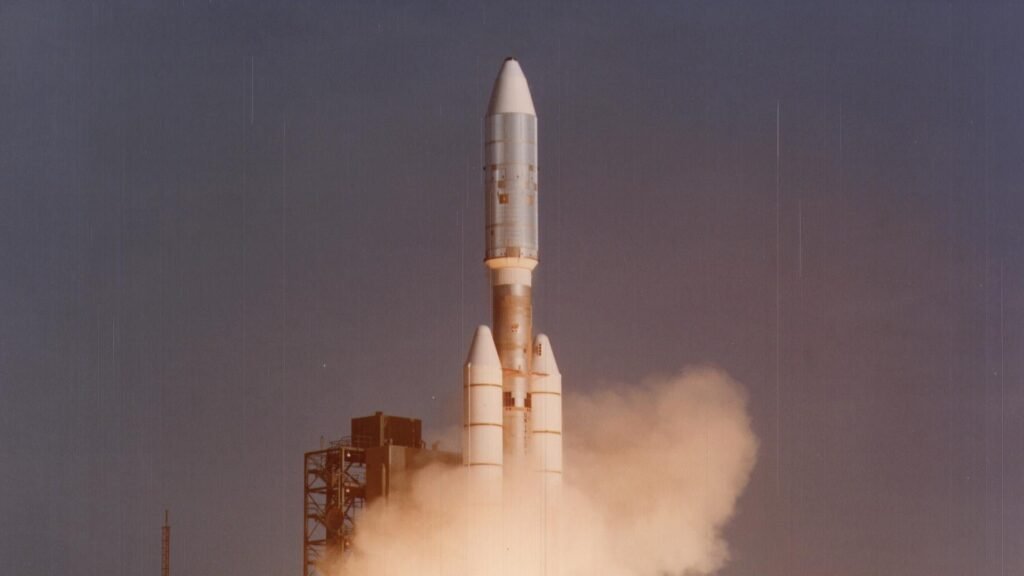
It flew past Jupiter and Saturn in 1979 and 1980, then kept going — past the planets, past the Sun’s bubble, and now past a full day of light itself. The little probe that launched on a September morning in 1977 is still flying, still phoning home, and now its voice takes a day to reach us.
Meanwhile in Space: Artemis II Heat Shield: 9 vs 103 Char Marks
Meanwhile in Space: SpaceX CRS-35: Final iROSA Solar Arrays Launch to the ISS