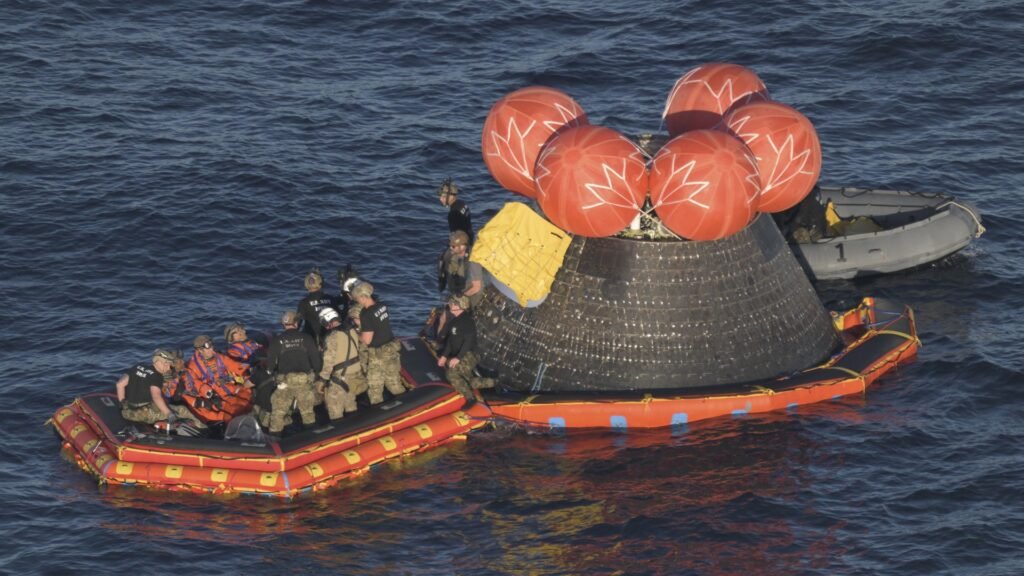
NASA has finally put a number on the question that hung over Artemis II — and the number is small. After months of inspections, x-ray scans, and sample extraction, the agency’s post-flight analysis found just nine spots of char loss on the Orion heat shield that brought four astronauts home from the Moon. Artemis I’s shield, by contrast, was pocked with 103.
According to NASA, which published the assessment on October 15 and updated it this week, the verdict closes a mystery that began in December 2022, when the uncrewed Artemis I capsule returned with unexpected charring and cracking across its Avcoat heat shield.
Nine Marks vs One Hundred and Three
The count is the headline, but the engineering behind it is the story. For Artemis II, NASA shortened the maximum downrange distance Orion could travel during reentry — cutting the time the shield spent in the temperature band where the Artemis I phenomenon occurred. The post-flight review, as SpaceNews reports, confirmed the gamble worked “without the erosion seen on Artemis 1.”
The numbers read like a precision-machining spec sheet: the capsule hit its entry interface within 192 feet of the target and splashed down 0.59 miles from the predicted point off San Diego. Outside, the shield faced more than 4,000°F at 39 times the speed of sound; inside, the cabin sat in the mid-70s. Cracking and char loss dropped by a factor of ten.
The Trajectory Trick That Worked
What stands out is that NASA didn’t redesign the shield to get here — it redesigned the flight. The dish itself, 186 unique blocks of ablative Avcoat, held up “in line with engineering predictions,” the agency said, with even the seams between blocks and the compression-pad bolts performing as modeled. The 1,300-tile backshell showed no signs of overheating either.
The analysis isn’t over. The shield now sits at NASA’s Marshall Space Flight Center in Huntsville, Alabama, where engineers have been extracting samples and running internal x-ray scans since August, comparing post-flight laser scans against pre-flight measurements to pin down exactly how much material burned away.
The People Who Rode Behind It
Four people trusted this hardware with their lives: commander Reid Wiseman, pilot Victor Glover, Christina Koch, and Canada’s Jeremy Hansen. Speaking at the Starmus Festival this week, Wiseman described the moment he thought it might not be enough. Watching the distance readout climb past the planned maximum of 219,667 nautical miles — over the Moon’s dark side, out of radio contact — he felt, in his words, “real fear.” When the crew finally splashed down, he asked to see the ship’s chaplain and, as UNILAD reports from The Telegraph’s coverage, ended up “bawling in his arms.”
Why this matters
Every outlet covering this story reported the analysis. Almost none said what it unlocks — and that is the actual news. The heat shield was the last open technical asterisk on the entire crewed Artemis program: the one piece of hardware whose behavior NASA couldn’t fully predict when it put people aboard. A 9-vs-103 count isn’t just a better number; it is the quantitative closeout of that asterisk.
That closeout lands at a telling moment. NASA’s Artemis III Orion — the one meant to carry astronauts toward an actual lunar landing — already has its upgraded shield attached, its crew and service modules joined, and its first power-up behind it. Administrator Jared Isaacman briefs the press on the Artemis acceleration plan on October 23, per Douglas Messier. As we reported in our Artemis III readiness checklist, the schedule math only works if the shield question is settled. Now it is.
Meanwhile in Space: the full Artemis III readiness checklist, and when the Artemis II crew watched five meteor impacts on the Moon.