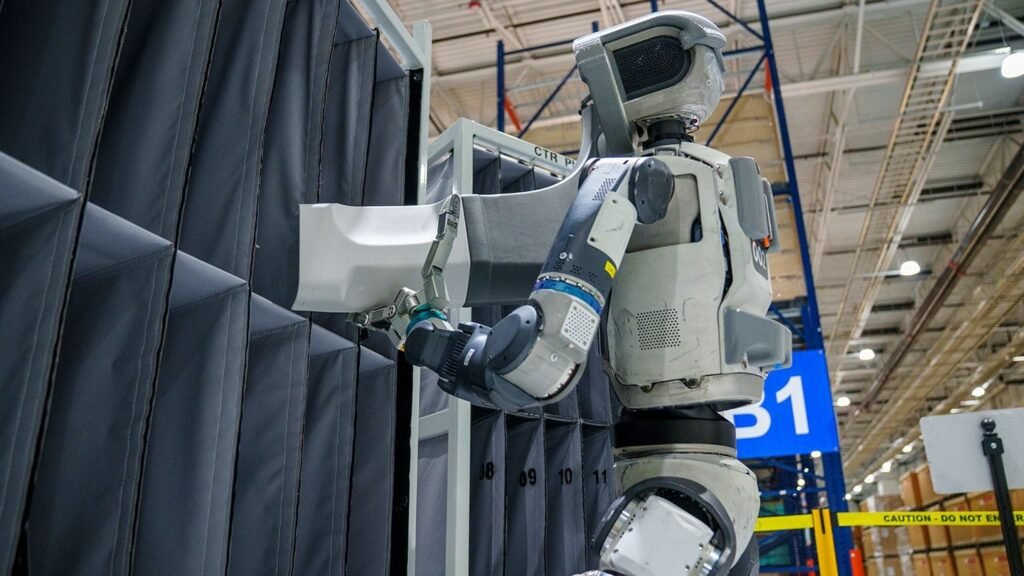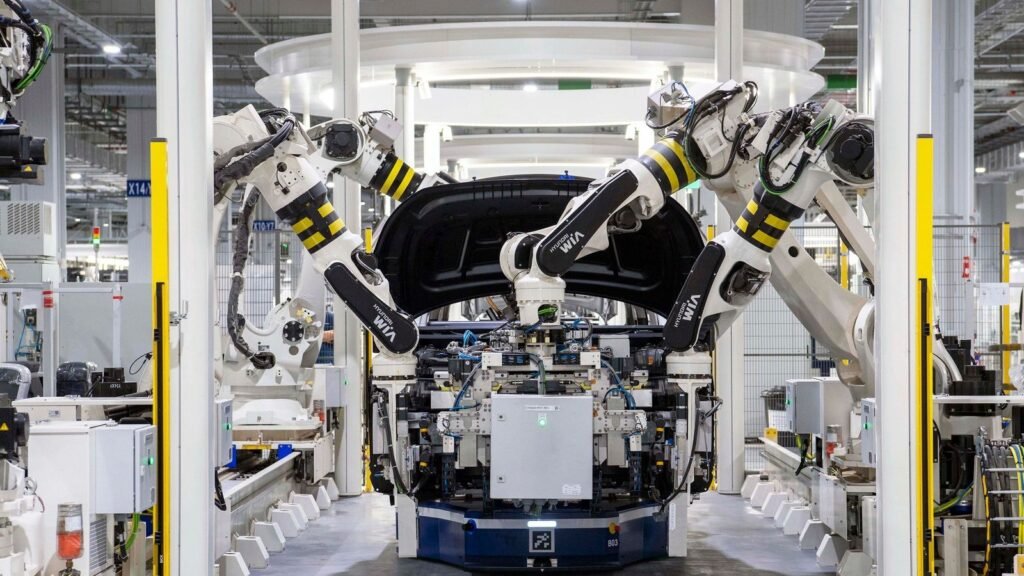
Robots still aren’t very good at picking things up. Despite billions of dollars of investment and endless hours of video fed into deep learning models, the simple act of grasping an unfamiliar object — firmly enough to hold it, gently enough not to crush it — has remained one of robotics’ most stubborn problems.
That may be about to change. According to TechCrunch, Eka Robotics has just closed a $150 million Series A round that values the startup at $1.45 billion post-money, led by venture funds a16z and F-Prime. The company was founded by MIT professor Pulkit Agrawal and former Google DeepMind researcher Tuomas Haarnoja, and its pitch is strikingly different from the rest of the field: its robots learn to feel, not just to see.
The Last Millimeter Problem
Eka’s system pairs a force-sensitive gripper with a new kind of deep-learning model the company calls vision-force-action. Where the dominant vision-language-action models learn the relationship between language, images, and movement, Eka’s model learns the relationship between language, force, and movement. Co-founder Agrawal put it bluntly: “Vision is not the primary way in which you close this last millimeter problem. Vision tells you roughly where the object is, what the pose is, but the actual grabbing, the actual searching is happening through forces.”
The results are turning heads among veteran roboticists. The robot picks up about 1,500 objects weighing up to 1 kilogram per hour, compared with roughly 600 for a human, and Eka says it succeeds more than 95% of the time. University of Illinois professor Kris Hauser told TechCrunch the demo had a “wow factor” — the robot adapted to a large number of different objects without retraining, and kept retrying after failures with what he called “a humanness, creepy humanness.”
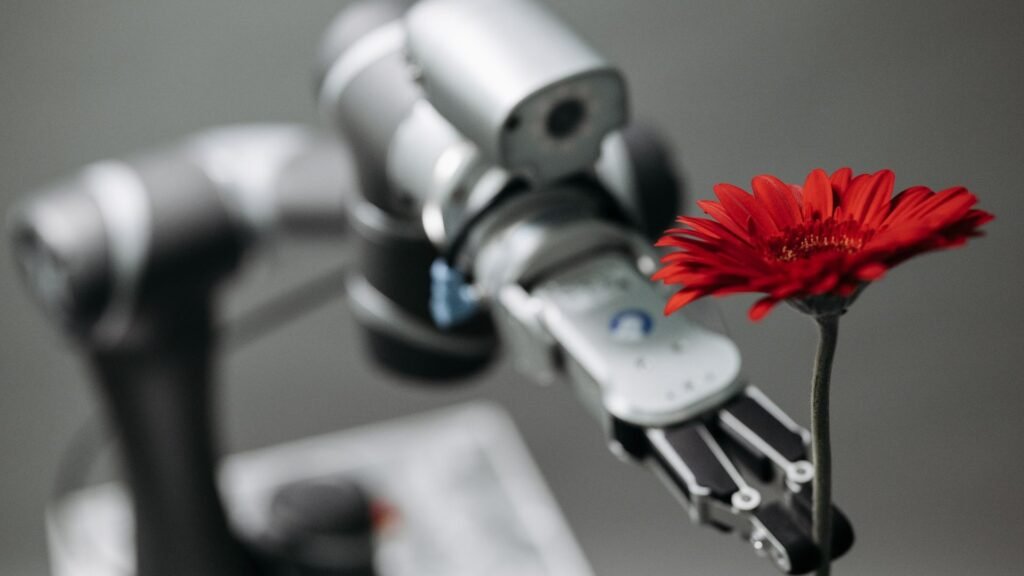
The most telling moment came when a visiting roboticist handed the robot a raspberry — the lab’s favorite test item. A big, heavy arm rushed toward the visitor’s arm, slowed just in time, and touched them gently without crushing the berry. That is the whole thesis in one gesture: force feedback is what makes a gripper safe around fragile things.
Why Force Beats Video
Eka’s approach challenges the industry’s orthodoxy. Most of the field builds from the top down: start with a general AI model that plans, then push that intelligence toward the physical. Eka builds from the bottom up, mastering the physics of contact first. Its training method: a physics simulator models the forces each grasp will encounter, creating a reinforcement-learning environment that runs at scale. Eka says it can generate thousands of hours of robot experience in minutes.
That matters because of what Agrawal calls the generality-performance gap: the most general physical AI models attempt many tasks but do them poorly, while single-task models may not justify their cost. Eka argues it bridges that gap — a general model decides what to do, a force-aware model handles the physicality. The AI Insider reports the funding will support broader task capabilities and expanded deployments.
The Honest Caveats
None of this is proven on a factory floor yet. Eka is running secretive pilots in pick-and-place and wire handling, but Hauser’s warning is the one to remember: “What’s going to be a big challenge is when they work with integrators on real assembly lines, and it needs to run without breaking for an entire year.” The sub-$1,000 gripper is rated for 5 million duty cycles — well short of the 20 million-cycle bar for standard industrial arms.
Why This Matters
Most funding coverage will read as a $1.45 billion bet on robots. The more useful read is as a bet on an architectural split the whole field is watching. If force-first models prove out, the winners in warehouse automation may not be the companies with the biggest language models, but the ones whose robots can be trusted not to break what they hold — at a gripper price and duty-cycle rating that closes the business case.
Meanwhile in Robotics: the physical-AI wave is already reaching factory floors, from AI cobots tending machines to warehouse robots rented by the month — and Eka’s funding round raises the stakes for all of them.