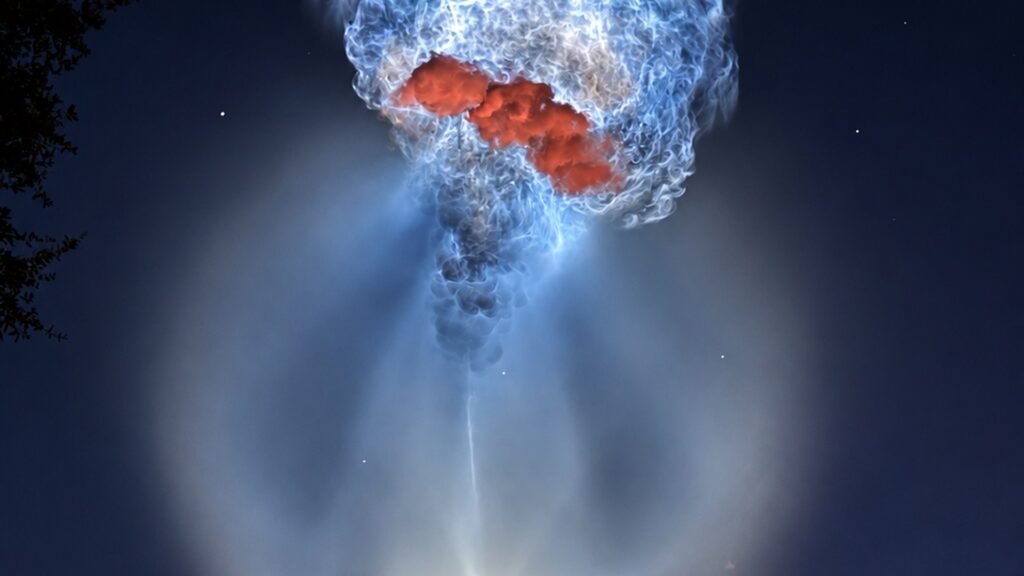
A Falcon 9 rose over Cape Canaveral in the pre-dawn dark on Tuesday carrying 32 payloads into orbit — and two of them were built to come back down. SpaceX’s Bandwagon-5 rideshare mission lifted off at 7:04 a.m. EDT on October 20, and one of the last passengers to separate from the rocket was the company’s own Starfall reentry capsule, flying for only the second time.
According to Space.com, Starfall debuted this past June on a dedicated demonstration mission designed to prove the capsule could fly in a controlled fashion and survive the harrowing trip back through Earth’s atmosphere. This time it rode as one payload among dozens — and it wasn’t even the only return capsule on the manifest.
The Disc That Comes Back
Most capsules look like gumdrops. Starfall looks like a giant hockey puck. According to a Federal Aviation Administration environmental assessment published in May, the disk-shaped vehicle is about 2.5 feet tall and 10.2 feet wide, weighs roughly 4,600 pounds, and can bring up to 2,200 pounds of payload back down to Earth.
SpaceX has said remarkably little about the program. In one of its few public statements — a June 23 X post — the company said Starfall “will enable affordable, routine access to the microgravity environment for scientific research and in-space manufacturing.” As Spaceflight Now reports, the company didn’t say what, if anything, this Starfall is carrying on its way down, or when it will attempt the return.
The Other Capsule on the Same Rocket
Sharing the Falcon 9 was Varda Space Industries’ W-Series 7 spacecraft, an orbital “mini-factory” designed to host production experiments in microgravity and then return the results to Earth. Spaceflight Now notes that W-7 is about three times smaller than Starfall — and despite the name, it will be Varda’s ninth reentry capsule to fly, with W-8 and W-9 having launched earlier this month on the Transporter-18 mission.
W-7 carries a particularly pointed experiment: the cancer drug Protac. Varda wants to find out whether microgravity changes how the molecule crystallizes. “In microgravity, molecules can crystallize differently than they do on Earth, potentially producing crystal forms with improved properties, including better solubility,” the company wrote before launch. “If successful, the experiment could help turn powerful protein-degrading molecules into more practical and effective cancer treatments.”
A Business Built on Coming Down
Put the two capsules side by side and the shape of an industry emerges. Starfall is the platform play: a big, mass-producible downmass vehicle that any researcher or manufacturer can rent space in. W-7 is the application play: Varda’s own drug pipeline, flying on someone else’s rocket, optimized for one high-value experiment at a time.
The contrast is what makes this flight worth watching. SpaceX has spent two decades perfecting the trip up; Starfall is its first hardware purpose-built for the trip back — and it launched on a booster, B1085, making its 19th flight, which touched down on the droneship A Shortfall of Gravitas for what the company counted as the 672nd Falcon booster landing. The company that turned “flight-proven” from a novelty into an industry standard is now trying to do the same for “routine return.”
Why this matters
The commodity coverage of this launch treated Starfall as a curiosity — a mysterious second flight, a one-day weather delay, a booster that keeps flying. Nobody put the two capsules in the same frame. But one Falcon 9 carrying SpaceX’s downmass platform and Varda’s pharma factory, separating hours apart over the same ocean, is the first visible head-to-head of the in-space manufacturing race: two different answers to the same question, which is what it actually costs to make something in orbit and get it back.
And SpaceX’s silence is itself data: the company announced nothing about Starfall’s cargo or its reentry date. Whether that quiet means the business model is still being worked out, or that the customers are, is the question to watch. Either way, the up-mass era has a new sibling: the down-mass era just flew its second test.
Meanwhile in Space: the full Artemis III readiness checklist, and how Crew-13 set a record docking with the ISS.