The War Room: Hyundai’s New RX Team
Hyundai Motor Group has created a dedicated RX Business Strategy Team to oversee its global robotics push, DigiTimes reports — a structural move that says more than any keynote. Companies do not build war rooms for science projects. The team, operating under a “Robotics Everything” banner, is tasked with accelerating the mass production and sale of the Atlas humanoid robot built by Hyundai’s US subsidiary, Boston Dynamics.
It lands days after Hyundai’s E-Forest Tech Day laid out a 200-technology roadmap, and it reframes that event’s headline date — humanoids at new factories from 2032 — as the conservative public timeline while the real acceleration happens inside the org chart.
The Software Nervous System
Hardware gets the keynotes, but Hyundai’s quieter buildout is software. The Korea Economic Daily reports that Hyundai AutoEver, the group’s software affiliate, is positioning itself as the connective tissue between increasingly automated factories and the robots entering them — the systems that tell a humanoid what the plant is building and where parts are stored.
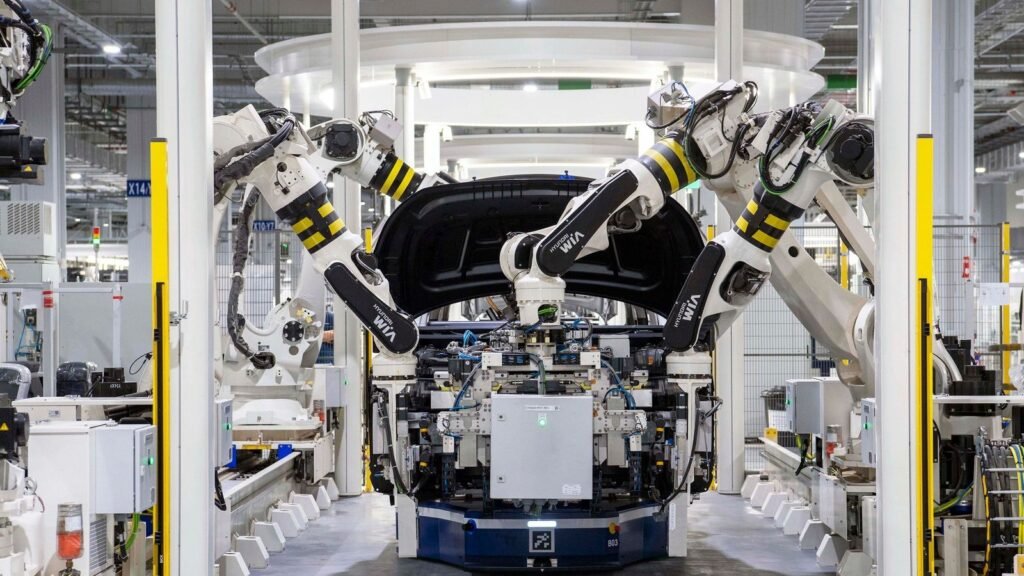
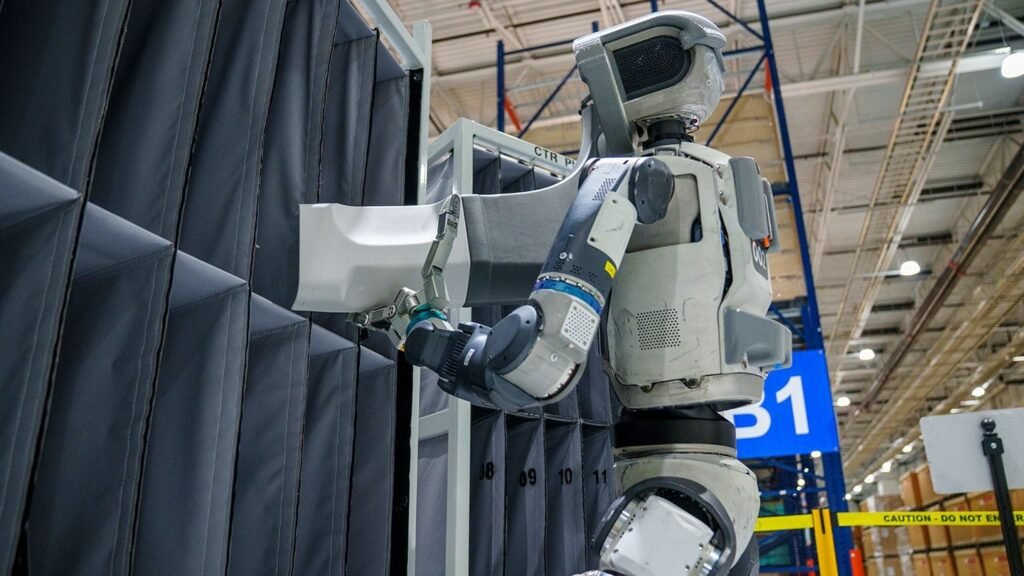
At a media event at its Uiwang R&D center on October 14, Hyundai showed the physical-AI layer taking shape: AI-powered factory systems and logistics robots, automated vehicle-inspection tech, and computer simulations that auto-generate movement paths for industrial robots, due by June 2027, Kyodo News reports. The group is also building Polaris, an AI manufacturing platform, with Nvidia, and Boston Dynamics says Atlas is already field-testing real-world sequencing tasks inside a Hyundai customer facility. The message: before Atlas walks the line, the line itself is being rebuilt around it.
The Money Problem
All of this is happening while the market votes no. Hyundai’s shares more than doubled after Boston Dynamics unveiled the new Atlas at CES in January, hitting a record 755,000 won in June — then collapsed to 312,000 won by last Friday, nearly back to pre-CES levels, as doubts about when robotics pays off set in, according to Kyodo News. Boston Dynamics has reportedly burned through around 1.7 trillion won in cumulative losses over five years, and speculation about a delayed IPO is not helping.
“Growing concerns over potential delays in Boston Dynamics’ business plans have also fueled calls for lower valuation multiples,” iM Securities analyst Lee Sang-soo told Kyodo. Hyundai’s answer to the skepticism is to spend more: about 8 trillion won ($5.4 billion) for a vast AI and software research complex on Seoul’s southeastern edge, on top of a $6.3 billion AI, robotics, and hydrogen hub announced earlier this year.
The Union Veto
But the underpriced risk is not technical or financial — it is labor. The Korean Metal Workers’ Union has blocked Atlas from entering any Hyundai factory floor without a formal labor-management agreement, Tech Times reported earlier this year — and that standoff still stands. Hyundai says Korean plants have no timeline yet, but the union’s logic is simple: once Atlas proves itself in Georgia in 2028, Korea is next.
It is a genuinely novel bargaining chip: the union is not fighting automation in the abstract but holding a veto over the specific machine its employer spent billions building, before that machine has done a single shift. Every other humanoid maker is racing engineering timelines; Hyundai is the first to discover the deployment timeline has a second signature on it.
Why This Matters: 2032 Was Never the Real Date
Read the last week as one story and the 2032 headline dissolves. A dedicated strategy team, a software affiliate rewiring factories for robots, a $5.4 billion AI hub, a Uiwang physical-AI buildout with 2027 deliverables, and Atlas already field-testing sequencing tasks — that is not a company waiting six years. The 2032 date was for greenfield plants; the actual plan, disclosed to investors in May, is 25,000 Atlas robots across Hyundai and Kia factories starting with Georgia in 2028.
The specs back the seriousness: Boston Dynamics lists 50 kg instant lift capacity, a 4-hour swappable battery, and a -20°C to 40°C operating range for the production Atlas. But specs do not sign labor agreements. Hyundai is simultaneously building the most credible humanoid deployment machine in the industry and discovering its hardest constraint is not actuators — it is people. Watch the union talks, not the keynotes: that is where the 2028 date lives or dies.
Meanwhile in Robotics: yesterday’s Hyundai 2032 roadmap breakdown, and Atlas’s new four-finger hand.