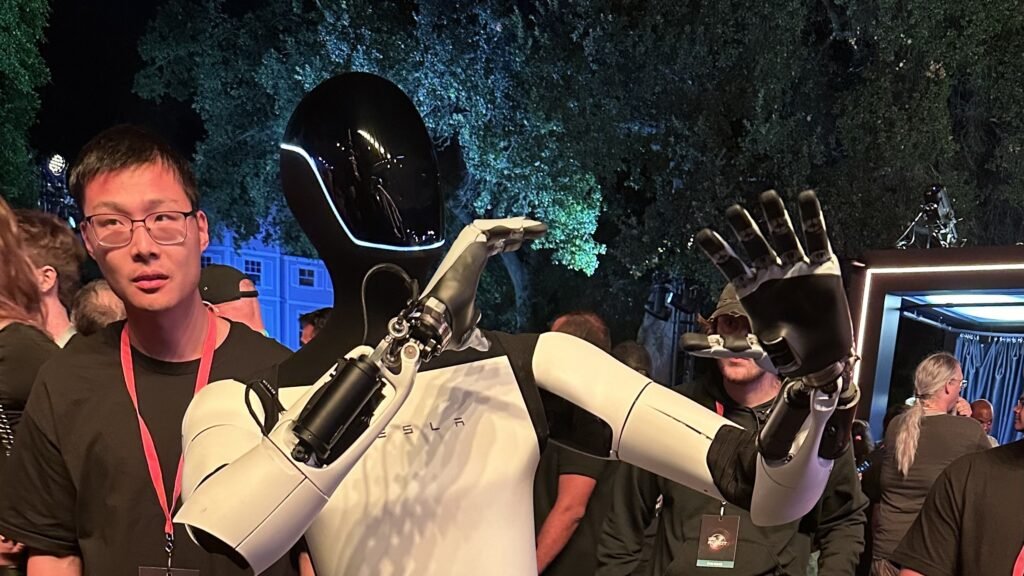
Elon Musk just admitted, in public, that Tesla can’t build enough of its own AI chips to feed its humanoid robot program — so it’s making the chips weaker. The memory in Tesla’s next-generation AI5 chip has been cut from 144 GB to 72 GB of LPDDR5, and the AI6 chip loses a third of its planned memory, dropping to 144 GB of LPDDR6. “This was the only way to get enough volume for Optimus production,” Musk wrote on X, as wccftech reported on Thursday. “And greatly reduces cost.”
The Brain Gets Smaller So the Body Can Ship
Musk insists the downgrade won’t matter: memory bandwidth — how fast data moves between chip and memory — is the real performance limiter, and that stays unchanged, so he expects a “negligible effect on Optimus performance.” A day later he walked back part of the cut anyway, bumping AI5 to 96 GB after noting Tesla would otherwise be “the only company using the min RAM version of LP5,” as Tesla Hubs reported. So AI5 ships with roughly a third less memory than planned, AI6 with a third less — a quiet acknowledgment that in the middle of an industry-wide memory crunch, even Tesla can’t brute-force its way to volume.
Context makes the move more telling. AI4 computers in today’s Teslas ship with 32 GB of GDDR6; AI5 was supposed to leap to 144 GB. DRAM prices are, in Musk’s own July description, “insane.” When the company that designs its own silicon has to de-spec it for supply, it says something about how tight the global memory pipeline has become — and one estimate cited by analysts puts a full humanoid robot’s memory needs around 200 GB, well above what Tesla will now ship.
The Factory Floor Reality Check
Meanwhile, reporting from The Information, as summarized by GNN this week, puts numbers on why Tesla is so desperate for volume: the company produced only “several hundred” Optimus robots a week last month — after repurposing its Model S and Model X production lines for the robot earlier this year. Musk’s stated goal is 20,000 robots a week. At several hundred a week, Tesla is running at roughly two percent of that target.
The same reporting explains the gap. Optimus parts are far smaller than car parts and must fit together far more precisely; in the current V3 robots, the hands and forearms contain more than 100 screws and tiny components that workers still assemble by hand. The V3 units are lighter and carry more cameras than earlier versions, but a “sensing glove” that would make touch sensors easier to service is still in development. The robots are currently used only internally, in limited areas, for specific tasks — not in general use, and not with remote teleoperation. Tesla plans to lease the robots first, harvesting training data before it sells a single unit.
Why this matters
The chip cut and the production numbers are the same story told two ways: the humanoid robot race is no longer about demos, it’s about supply chains. Nobody in the industry has solved humanoid manufacturing yet — Agility’s factory ramp, Figure’s leasing program, and Tesla’s hand-assembled V3 hands all point to the same bottleneck. Tesla’s move is the most honest admission yet that winning the humanoid race means winning at procurement: cheaper chips in higher volume beats the perfect chip you can’t build. If Optimus really does ship thousands of units next year on de-spec’d silicon, it will prove the bet. If memory supply stays tight and the hands stay hand-built, the 20,000-a-week dream stays a dream.
Meanwhile in Robotics: Tesla isn’t the only humanoid game in town — Agility’s Digit competitor the OB7 AI cobot is bringing physical AI to machine tending. And Boston Dynamics just gave Atlas a new four-finger hand.