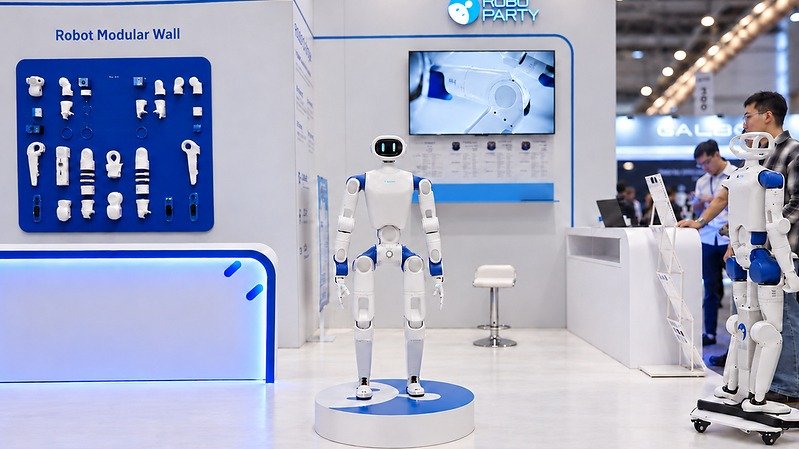
The humanoid robot race has a new entry, and it is playing a different game than everyone else. At IROS 2026 in Pittsburgh, RoboParty unveiled RP1 — “ROBOTO 01” — a bipedal humanoid the company describes as the world’s first high-performance, full-stack open-source bipedal humanoid. Note the attribution: “RoboParty says.” This is a company press release, not independent journalism — no tier-1 outlet has covered RP1 yet. But the idea is worth taking seriously on its own terms, because the pitch is the one that changed every other industry it touched.
According to the company’s announcement, RP1 pairs a high-performance hardware platform — 160 N·m of peak joint torque — with PartyOS, RoboParty’s own operating system, and UFO, its AI training framework. The “full-stack” claim is doing real work here: the company says it is progressively opening the hardware design, motion control, simulation, SDKs, training tools, and PartyOS itself, with more of the stack going open later this month.
What “open source” actually means for a robot
Here is the explainer nobody in the press-release echo wrote — and the concrete element this story needs, because it is the entire argument for RP1’s existence.
A closed humanoid — Tesla’s Optimus, Figure’s machines, Boston Dynamics’ Atlas — is a black box you buy access to. You run its software, you operate within its API, and when its walking controller does something you want to study, you are studying through a keyhole. With RP1’s model, a university lab or a startup can do the things open source made normal in software: open the hardware design and build a modified leg, retrain the motion policy on your own data with UFO, fork PartyOS to add your own behaviors, and push fixes back to a shared codebase. RoboParty points to its existing community as evidence this works — its earlier RPO project has more than 2,500 GitHub stars and a 5,000-developer community, and the company says mass production of RP1 begins in Q4.
At the Pittsburgh booth, where the robot debuted September 28, the demo was a “Kick Me” live disturbance-recovery show — the humanoid equivalent of a stress test, proving the balance controller in public rather than on a spec sheet. As reported in this week’s syndication of the announcement, the open-source roadmap continues later in October.
Why this matters
Humanoid robotics has a structure problem: the most capable platforms are the least accessible to the researchers who would improve them. Every closed robot is a walled garden; every lab without a nine-figure budget is a spectator. Linux did not win because it was the best operating system on day one — it won because thousands of people could improve it, and the improvements compounded. If RP1 can do a fraction of that for bipedal hardware, the timeline of humanoid capability changes shape.
The skepticism is fair and should be stated plainly: open-source hardware is harder than open-source software, “progressively open” is not yet “open,” and a press release is a promise, not a product. But the niche this occupies is real. Researchers who cannot get near Optimus or Atlas can get near RP1 — and in robotics, as in software, the platform with the builders usually outruns the platform with the budget. That is the Linux bet, applied to legs.
Meanwhile in Robotics: The OB7-AI cobot watches your CNC machine’s screen so your operators don’t have to.