The Third Secret Launch in 16 Days Just Lit Up the California Coast
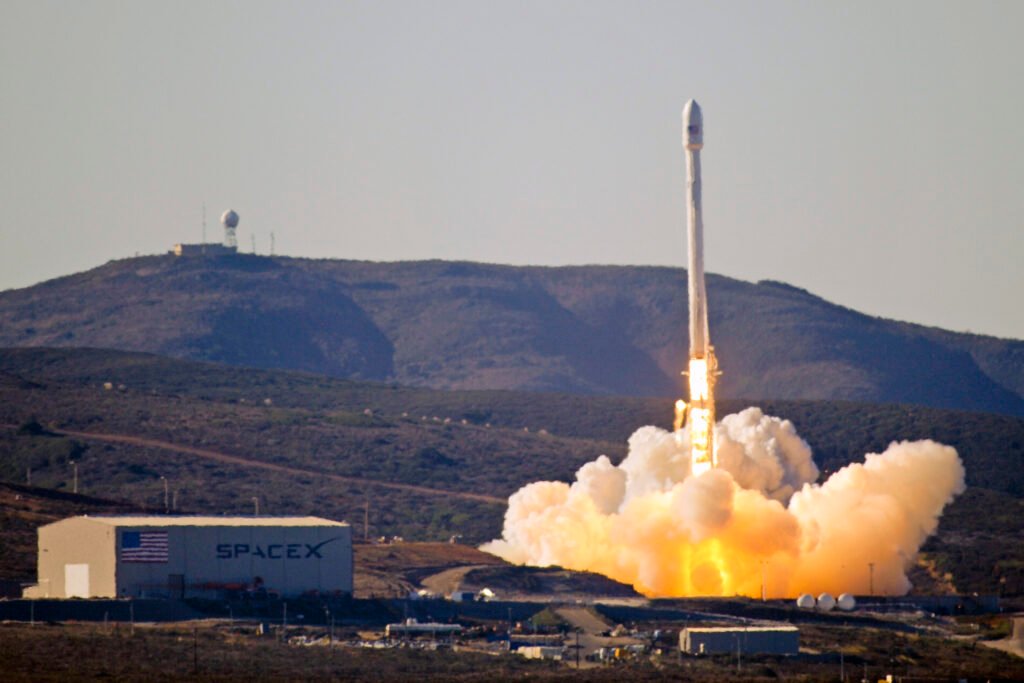
Before sunrise on Saturday, a SpaceX Falcon 9 lifted off from Vandenberg Space Force Base in California on yet another mission nobody is allowed to talk about. The rocket punched through dense fog at 7:00:54 a.m. PDT, carrying the classified USSF-385 payload for the U.S. Space Force — and, roughly eight and a half minutes later, its booster touched down on the droneship Of Course I Still Love You in the Pacific for its tenth flight.
According to Spaceflight Now, the rocket took a southerly trajectory off Space Launch Complex 4-East, and SpaceX showed no views of the payload or second stage at the request of its customer. That cut webcast is now standard procedure: nothing leaves the pad in view of the public once a national security mission is underway.
The Tell: Four Launches, One Pattern, 63 Counted Satellites
Here is what makes USSF-385 more than a routine mystery launch. It is the fourth classified Space Force flight from the same Vandenberg pad in about six weeks — USSF-366 on August 15, USSF-153 on September 10, USSF-259 on September 17 — and independent trackers have been counting what went up.
After the first two flights, the Space Force cataloged 23 new satellites in orbit each. USSF-259, headed to a different orbital plane, appeared to carry 17. The payload of USSF-385 itself is officially unidentified, but launch analysts believe all of them are deploying satellites based on Starshield, SpaceX’s government version of the Starlink bus — an inference built from stage drop zones and orbital profiles, Spaceflight Now reports, not from anything the Pentagon has said. The Pentagon has said nothing at all.
That is the strangest detail of this whole campaign: the mission is classified, yet the evidence is public. The sonic booms woke up residents across three California counties, the launch itself was visible for a hundred miles, and Space.com confirmed the flight in its launch coverage. SpaceX can cut the webcast, but it cannot hide the rocket.
Why This Matters: The Pentagon’s Spy Fleet Is Becoming Too Big to Kill
This is where the constellation-buildup reading of the campaign matters — and it is the part the straight launch coverage mostly skips. The old American spy-satellite doctrine rested on a handful of huge, expensive, exquisite spacecraft. Adversaries like China and Russia built anti-satellite weapons around exactly that assumption: blind a few eyes in the sky, blind the intelligence picture for days.
A proliferated fleet of dozens of small satellites across multiple orbital planes breaks that math. No realistic anti-satellite campaign can destroy enough of them fast enough to open a meaningful gap in coverage. Every classified dawn launch from Vandenberg is another brick in that wall — and with the count already at 63 confirmed satellites across three flights plus whatever USSF-385 carried, the wall is getting tall.
There is a second signal in the manifest. Booster B1100 just flew its tenth mission, its ninth and tenth flights only 35 days apart, following the NROL-95 national security mission and eight Starlink launches. Classified military payloads now ride on routinely reused hardware with airline-style turnaround times. And Vandenberg hosted six of SpaceX’s seven September Falcon 9 launches — the West Coast pad is becoming the company’s workhorse site while Cape Canaveral shifts toward Starship operations.
The secrecy, then, is almost theatrical at this point. Everyone can see the launches. Everyone can count the satellites. What remains hidden is only the part everyone already guesses: what exactly they do up there.
Meanwhile in Space:
→ SpaceX Starship Sept 28 orbital flight article | → SpaceX spy satellites delivered to orbit article.