Every humanoid robot launch video ends the same way: the machine waves, the crowd claps, the clip goes viral. Nobody films what happens months later, when an actuator starts grinding and a factory floor waits on a specialist flying in from another continent.
A tiny Tokyo startup thinks the industry is selling the wrong thing. The product isn’t the robot. It’s the repair.
The Pitch: Build the Robot Around the Breakdown
O-ID was founded in Tokyo last year by CEO Stian Jakobsen, from Norway, and CTO Simon Gormuzov, from the Netherlands — engineers who met at Waseda University. According to Humanoids Daily, the pre-seed round was led by Chicago-based TAWANI Ventures, with Hustle Fund, Techstars, and angels including the founders of Humanoid Guide, early backers of robotics company 1X.
The architecture is a repairability manifesto: joints, limbs, and compute units swap individually, on the factory floor, in minutes. Onboard AI sensors monitor component wear and flag parts approaching failure, so a replacement ships before the breakdown happens.
Jakobsen described the workflow in written answers: an elbow actuator shows signs of wear, the system detects it, notifies the customer, and triggers a replacement shipment. A floor worker powers the robot down, swaps the module, loads its stored calibration, and runs readiness checks. The worn part goes back to O-ID for refurbishment. “They don’t need one of our engineers to fly in,” Jakobsen said. “When you’re thinking about hundreds of thousands of robots, keeping them working has to be as scalable as building them.”
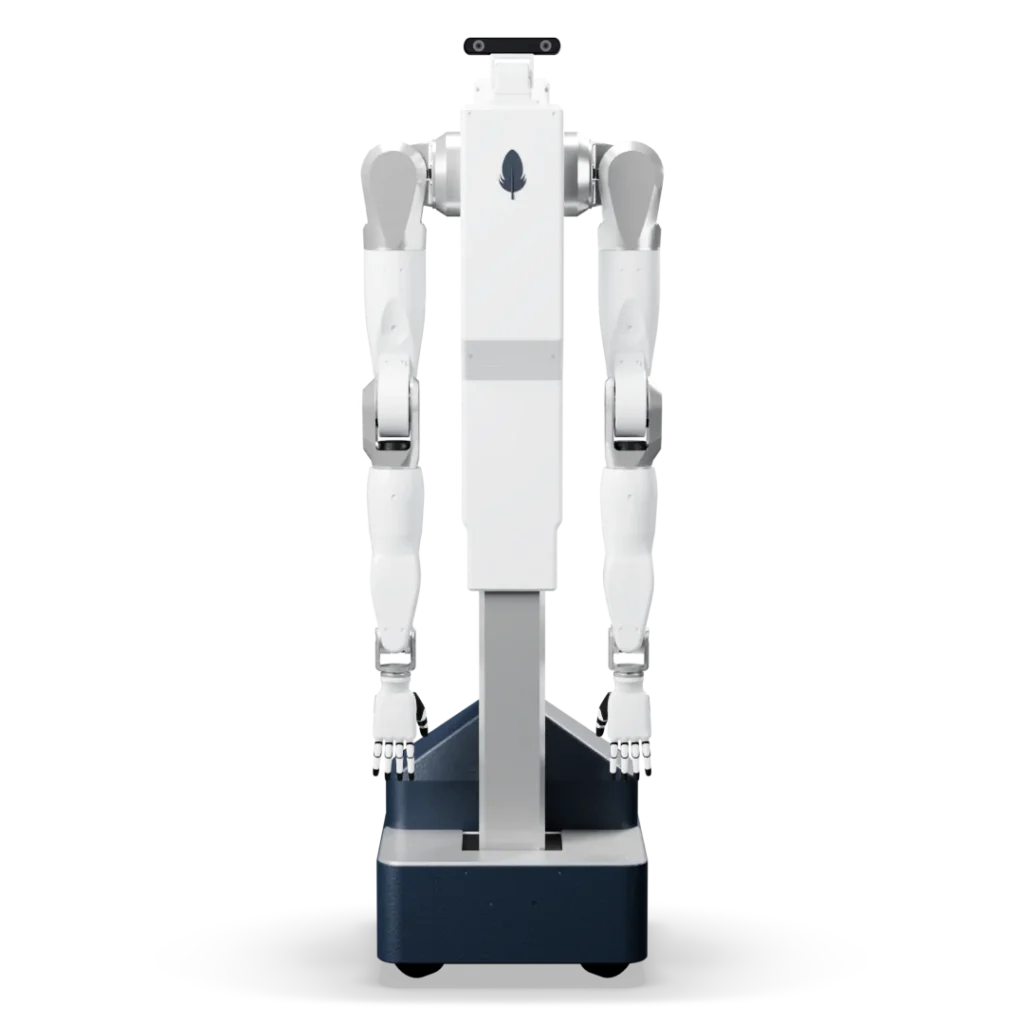
On paper, the machine stands 172 centimeters tall, weighs 70 kilograms, carries a 16-kilogram payload, and offers 30 degrees of freedom across more than nine modules on a holonomic base. One wrinkle: the advertised platform includes a wheeled configuration, so “humanoid” shouldn’t be read as a promise of a walking biped.
Why This Matters: The Downtime Math Nobody Puts in the Demo Reel
Here is the number that matters more than the $1.2 million. In large automotive plants, an hour of downtime costs roughly $2.3 million, Robotics and Automation News reports. A general-purpose humanoid with one failed component can sit dead for months — while the industry’s demos keep racking up views.
The robotics world keeps score on spectacle: backflips, boxing matches, conga lines. It doesn’t keep score on uptime. O-ID’s wager is that at fleet scale, the company that keeps its robots working wins the contract, even with a boring demo reel. Bold claim in a hype cycle where Reuters reports only about 7,000 humanoids were sold worldwide last year.
The timing also lines up with Japan’s labor math. A Recruit Works Institute forecast projects a shortfall of roughly 11 million workers by 2040, and Japan announced a ¥10.5 trillion (about $65.1 billion) public-private push for “physical AI,” targeting 10 million AI-equipped robots by 2040. O-ID starts with automotive manufacturing and logistics in Japan, building domestically — with machines designed to meet US National Defense Authorization Act requirements as it eyes the American market later.
The Catch: The Best Parts Are Still Plans
Credit where it’s due: O-ID’s story comes with clear guardrails. The company has not supplied measured replacement times or reliability results — and its modularity video is a product animation, not a filmed trial. The letter of intent with Sumitomo Electric Industries is exploratory, with no supply contract or factory deployment.
The next version is slated for an unveiling at CES 2027, with first factory pilots in early 2027. Plans, not deployments. Until then, it’s a bet on a good idea — aimed at the exact problem the demo reels ignore.
Meanwhile in Robotics:
Modularity is having a moment. Feather Robotics is pitching its $30,000 humanoid as the “Android of robotics” for developers — the same serviceable-hardware logic, aimed at software people instead of factory floors. Feather Robotics $30,000 humanoid article. And the software layer these robot arms run on just got a silicon sugar daddy: Qualcomm agreed to acquire PickNik, the company behind the open-source MoveIt framework. Qualcomm-PickNik article.