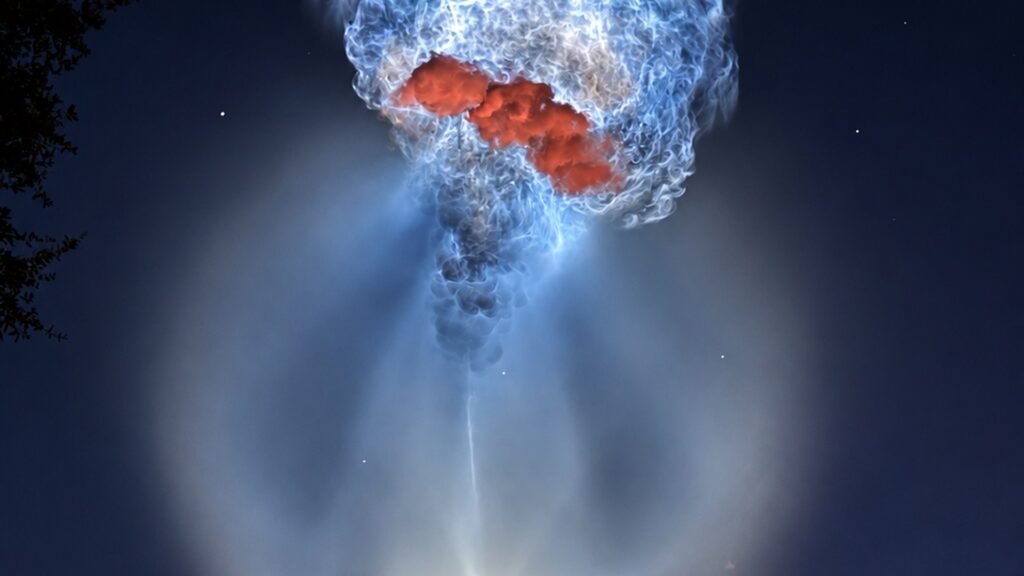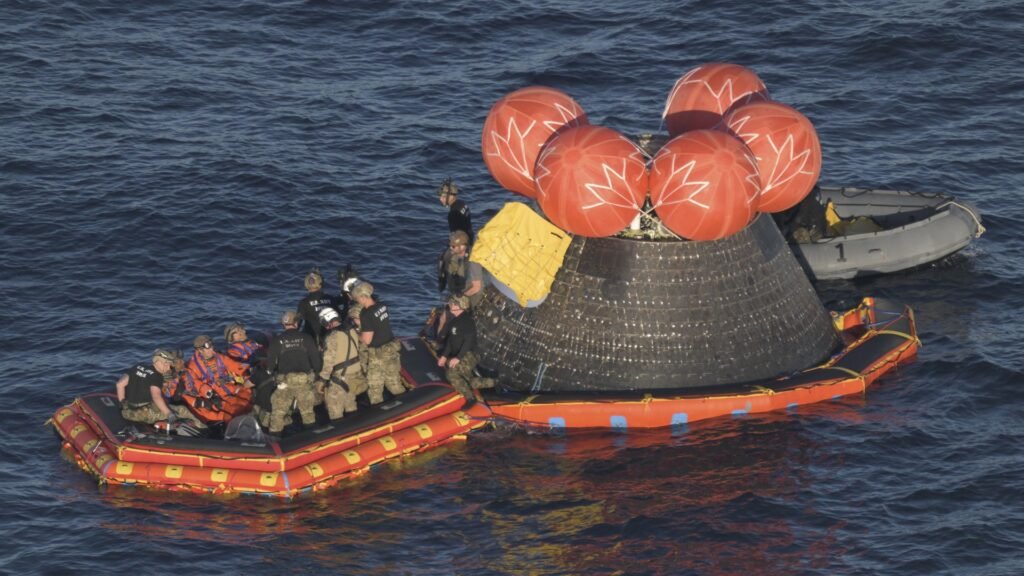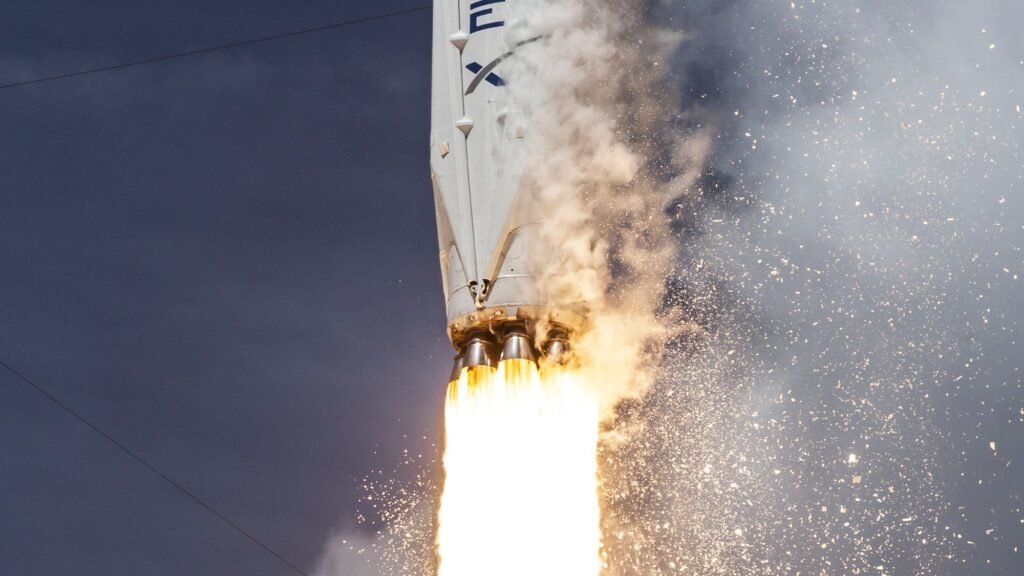
While the headlines from Tuesday’s Falcon 9 rideshare belonged to the capsules coming home, the quieter half of the manifest may matter more. Riding inside Portal Space Systems’ desk-sized Starburst-1 spacecraft were two technologies flying for the very first time: a suit of armor designed to stop space debris, and a superconducting magnet powerful enough to steer a spacecraft without burning fuel.
According to GeekWire, Starburst-1 lifted off at 7:04 a.m. EDT on October 21 from Cape Canaveral Space Force Station aboard SpaceX’s Bandwagon-5 rideshare mission, separating from the Falcon 9 about 57 minutes later. Within hours, the Bothell startup reported the craft had established ground communications, stabilized itself, and deployed its solar array to become power positive.
The Armor That Refuses to Become Shrapnel
The headline payload is Atomic-6’s Space Armor, a set of composite shielding tiles built with a proprietary fiber-to-resin manufacturing method. According to PR Newswire, the tiles flew to orbit for the first time aboard Starburst-1, moving from ground-based hypervelocity testing to their first operational deployment in space.
The problem they address is not theoretical. Dead satellites, spent stages, and fragments from past collisions circle the planet above 17,000 miles per hour, where even a paint fleck can punch through a spacecraft, and every collision creates more fragments, feeding the cascading chain reaction known as Kessler Syndrome.
Atomic-6’s twist is what its armor does not do. As CEO Trevor Smith put it, the company has proven its tiles can withstand debris traveling at extraordinary speeds without generating harmful secondary fragments. Most shielding that shatters on impact simply trades one projectile for a cloud of them. Tiles that absorb a hit intact break that cycle, and the same composite also forms the first composite radome, a protective shell that lets communications signals pass through while still resisting impacts.
A Magnet That Could Replace the Thruster
Sharing the ride is an equally strange machine: Zenno Astronautics’ Supertorquer, billed as the most powerful magnetic actuator ever built and flown to space. According to PR Newswire, the device, nicknamed the Almighty Magnet, uses high-temperature superconducting tape supplied by Faraday Factory Japan to push against Earth’s magnetic field, orienting the spacecraft without spending propellant.
Propellant is the hard limit on a satellite’s life. Every maneuver burns a finite supply, and when it runs out, a healthy spacecraft becomes junk. A magnetic attitude-control system that sips electricity instead of fuel could stretch missions by years. Zenno is also testing whether the magnet’s field can shield sensitive electronics from radiation, and the company talks openly about where the technology leads next: mass drivers, magnetic radiation shields, and satellites that move without thrusters at all.
A third passenger, TRL11’s Fovea M1 camera, is along to film the whole experiment, including visual confirmation that Starburst-1’s solar array deployed.
Why This Matters
Commodity coverage of this launch reads as a startup milestone: Portal’s second orbit in seven months, up from a tissue-box-sized demonstrator in March to a free-flying spacecraft, all self-funded less than a year after the Starburst concept was unveiled in November 2025. That story is true, and it is the least interesting thing about the flight.
The real story is what the flight proves about the economics of staying alive in orbit. The satellite industry is launching thousands of spacecraft into the same crowded shells, and every one of them is a future debris source unless shielding improves and maneuvering gets cheaper. Armor that survives impacts without multiplying them, plus steering that does not consume fuel, attacks both sides of the debris problem at once. If either technology validates in orbit, it becomes standard equipment on the next generation of satellites, including the up to 16 Starburst and 12 Supernova spacecraft per year that Portal plans to build at its new 65,000-square-foot Bothell facility.
Orbital traffic is compounding, and the window for testing defenses is while collisions are still rare accidents rather than routine events. Starburst-1’s quiet payloads bet the industry would rather armor up before the cascade starts than clean up after it.
Meanwhile in Space:
- SpaceX’s Starfall Flew Again — and Shared Its Falcon 9 With a Rival Capsule
- Google’s Project Suncatcher Takes AI Computing to Orbit on SpaceX