In 1999, the Hubble Space Telescope stared at a dying star and found something it could not explain: roughly 100 chemical features in the light of the white dwarf HS 0209+0832 that matched nothing in any database. The data sat there, unsolved, for a quarter century. According to Space.com, that cold case has finally cracked — and the answer is a planet that rose from the ashes of the very star it orbits.
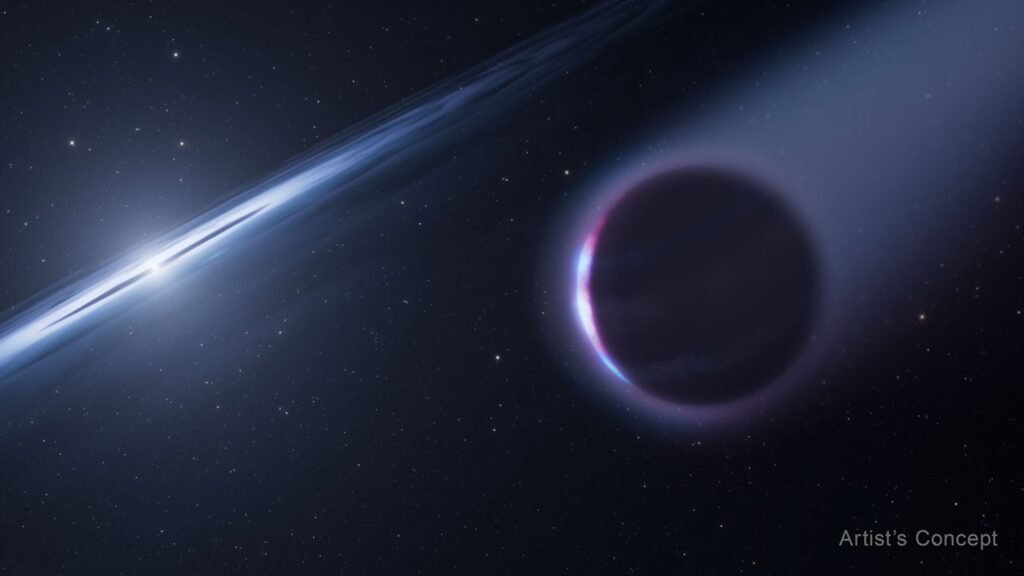
The suspect is a gas giant about the size of Jupiter, circling the dead star every 4.4 days at just 4 percent of the Earth–Sun distance. Per reporting from Reuters, it would be the first suspected second-generation planet ever found around a white dwarf: a world built not from the leftovers of its star’s birth, but from the debris the star flung off as it died.
The Niobium Fingerprint
Every planet in our solar system is first-generation — it formed from the same swirling disk as the Sun. This one is different, and the proof is chemical. A team led by doctoral student Jamie Williams at the University of Warwick re-examined Hubble’s 1999 spectra with modern atomic databases and found the white dwarf’s atmosphere laced with niobium at more than 1,000 times the solar abundance, plus elevated copper and zinc — while nickel outweighs iron by at least two to one, the reverse of the solar, terrestrial, and meteorite pattern.
That combination is the giveaway. Niobium and its heavy-element companions are forged by the slow neutron-capture process inside stars bloated in their red-giant death throes; no ordinary first-generation planet should carry that signature. As NASA put it in announcing the find, diligent re-analysis of the old Hubble data uncovered the chemical clue that solved the case.
Meanwhile in Space: Artemis III could still launch by June 2027 — if SpaceX and Blue Origin clear these milestones.
A Planet That Needed an Accomplice
Here is the twist the straight-news versions skip: forming this planet should have been nearly impossible. A single dying star sheds its mass roughly symmetrically, which cannot easily build the flat disk of material a planet needs. The team’s conclusion is that HS 0209+0832 probably had a gravitational accomplice — a companion star that pulled the ejected material back into orbit instead of letting it escape. That is part of why second-generation planets are so rare.
And the story is not over. The white dwarf is still young and blisteringly hot, so its ultraviolet radiation is boiling the planet’s atmosphere away; that escaping gas streams back onto the star, forming the disk whose chemistry Hubble detected in the first place. In other words, the star is actively devouring the world it helped create — which is precisely how astronomers caught it.
Why This Matters
The wires give you the phoenix metaphor; here is what they leave on the cutting-room floor. First, the method: niobium is now a signpost. The team found none in 33 other metal-polluted white dwarfs they checked, which means astronomers can run the same forensic-chemistry test across more dead stars to hunt for additional reborn worlds. Second, the stakes: the Sun will leave behind a white dwarf roughly the size of Earth in about 6 billion years. This system is the first hard evidence that new planets can form from a star’s own death — a preview of what the solar system’s afterlife might look like.
Meanwhile in Space: NASA has opened final bidding for the commercial stations meant to succeed the ISS — another story about what comes after the current era, on a rather shorter timescale.