Two Weeks of Watching From the Fence Line
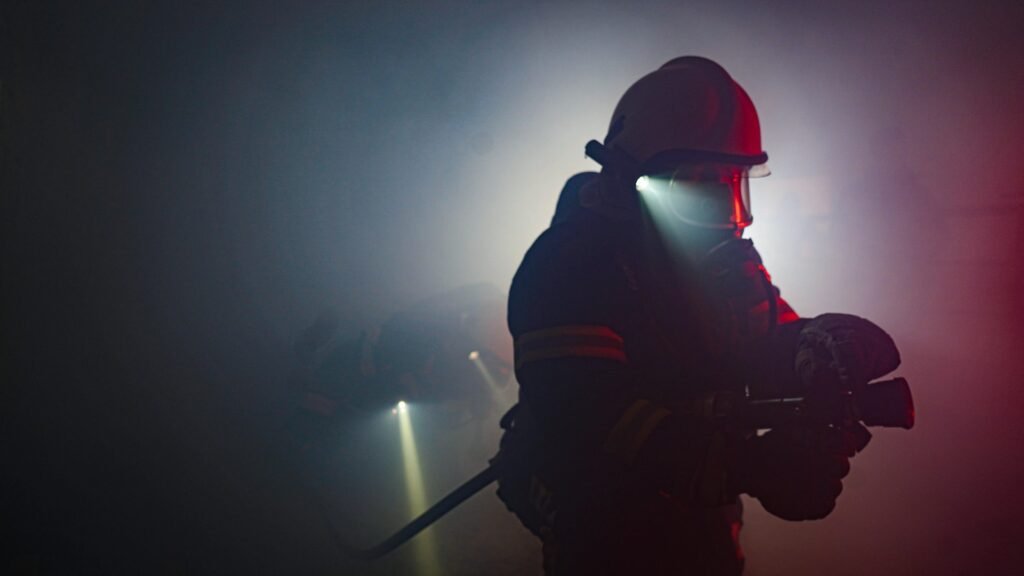
When fire broke out at a military battery storage facility in South Chungcheong Province in August, the building’s defenses did their job. Reinforced concrete walls and automated sprinklers contained the blaze before the structure was lost. But the victory created a crisis nobody could walk into: roughly 210,000 lithium batteries sat inside, scorched and heat-baked, each one a potential trigger for secondary thermal runaway — a chain reaction that can end in a massive explosion.
For nearly two weeks, firefighters could only watch from behind the exterior perimeter. Standard rescue hardware was disqualified by physics: heavy treads and four-legged robots press on the ground as they move, and a single misstep against one delicate cell could have detonated the room. According to The Korea Times, crews were completely barred from entering the hazard zone while the stockpiles lingered on the brink.
The Robot That Grows Instead of Walking
The breakthrough came from softness, not strength. Emergency officials turned to an inflatable “vine robot” developed by professor Yoo Ji-hwan and his team at the Korea Advanced Institute of Science and Technology (KAIST), working with the National Fire Research Institute. Instead of rolling or stepping, the device extends using compressed air, unfurling through tight spaces the way a plant grows — which means it exerts virtually zero mechanical pressure on the floor as it moves.
Operating from behind reinforced blast shields in a designated safety zone, specialist crews fed the pneumatic device directly into the volatile facility. It grew through tight corridors and completed a full visual reconnaissance of the interior without disturbing a single battery unit, the Times reports.
From One Fire to Every Battery Depot
The mission’s data is already becoming doctrine. Officials plan to use the findings to draft new safety manuals for military depots and industrial battery plants — and the deployment is feeding an international defense effort too. KAIST and the fire investigation team are submitting the reconnaissance data to the Lincoln Program, a US security research initiative led by MIT’s Lincoln Laboratory. “We are systematically assessing how disaster robots navigate complex environment challenges,” National Fire Research Institute director Kim Yeon-sang told the Times. “By applying real-world fire demands to robotics, we are advancing technology that keeps emergency crews safe.”
The stakes are national, not theoretical. Battery safety has become an urgent focus in South Korea since a thermal runaway explosion at a lithium battery factory in Hwaseong in June 2024 killed 23 people and destroyed the facility.
Why this matters
The firefighting-robot story is usually told as an arms race: bigger machines, hotter tolerances, heavier platforms with water cannons. The vine robot inverts the formula — it won the job by being the lightest, gentlest machine in the room. That is a genuinely new design principle for disaster robotics: when the hazard is the floor itself, the answer is not better feet, it is no feet at all.
It also marks a crossing point for soft robotics. Vine robots have lived mostly in university labs; this one just did real-world reconnaissance inside a live explosive hazard, and its data is now shaping military safety manuals on two continents. Korea, meanwhile, is assembling a robot-first fire response playbook — Hyundai’s unmanned firefighting robots were deployed at a factory blaze in Eumseong earlier this year, as Interesting Engineering reported.
Meanwhile in Robotics: Minerva’s $10M bet on humanoids for hazardous jobs shows the other end of the same wager.