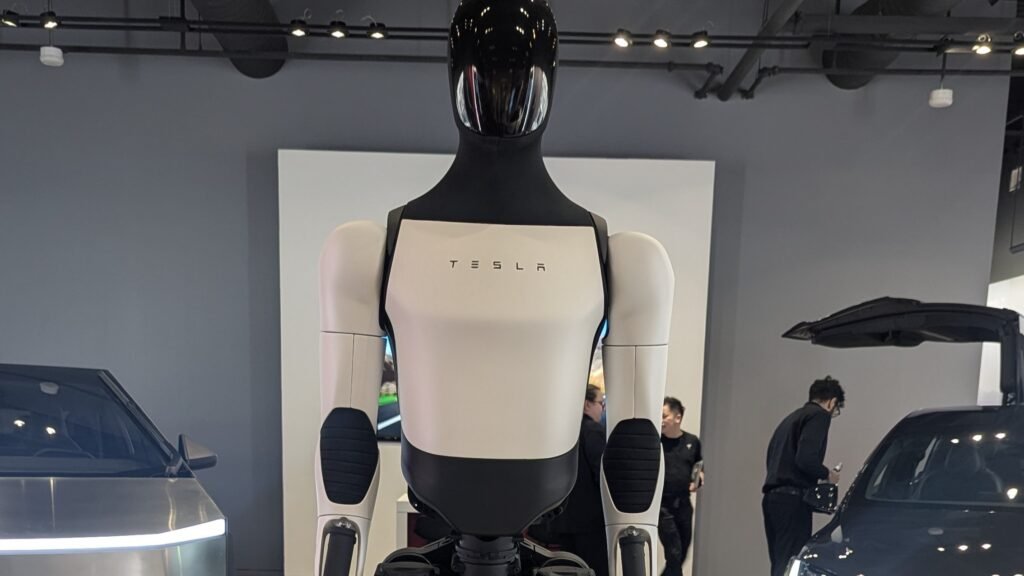
Tesla’s humanoid robot has graduated from stage demos to a real production line, in factory space that used to build cars. The company announced Wednesday that Optimus production has started at its Fremont, California, plant, calling the robots coming off the line its first production-quality units. According to TechCrunch, Tesla told shareholders it has proven its current manufacturing process is suitable for a commercial product.
That sentence matters more than it sounds. For years Optimus has been a prototype shown walking, dancing, and sorting objects at Tesla events. A production line means Tesla believes it can build the same robot repeatedly, to a standard, outside a demo. What it has not said is how many it is building.
The 20,000-a-Week Promise Meets a Bumpy Ramp
Elon Musk, on the earnings call, called the current phase “early production” and warned the ramp will be slow and “somewhat bumpy because it is such a radically new product.” In the same breath, he claimed Tesla will be able to make 20,000 Optimus robots per week by the end of 2027.
Do the math on that claim and the gap becomes the story. Twenty thousand a week is roughly one million robots a year, a scale no humanoid program has ever approached, promised from a line Musk himself describes as early, bumpy, and still being tweaked. He was candid about what remains unfinished: the design still needs work so the robot is safe, reliable, and durable enough that it cannot, in his words, “wear out after a month.” And, he added, “there’s still quite a lot of work to do with regard to the AI and the robot for it to be truly useful for open-ended tasks.”
A Company Paying for the Future Out of a Flat Present
The production news arrived wrapped in a weak quarter. Tesla’s total third-quarter revenue was $28.04 billion, essentially flat against $28.09 billion a year earlier, while net income fell 43% to $787 million from $1.37 billion. Electric-vehicle revenue was flat at $20 billion, deliveries of 486,532 vehicles were up about 6,000 from the previous quarter but down from a year earlier, and energy revenue fell 16% to $2.8 billion, which Tesla blamed on tariff-related customer refunds.
The one bright spot was services, including Full Self-Driving subscriptions, which grew 33% to $4.6 billion and delivered a record $734 million in gross profit. It was not enough. Spending on AI, autonomy, and Optimus, plus lower regulatory credit sales, took a large bite out of profits. Electrek’s breakdown of the filing puts numbers on that surge: operating income fell 56% to $718 million as research and development jumped 69% to $2.76 billion.
There is also a pattern in Musk’s timelines. On the April call, he said unsupervised Full Self-Driving would “probably” arrive in the fourth quarter of this year. On this call, executives said around the second quarter of next year is when the first customer vehicles could join the robotaxi fleet. Timelines slip, but that is exactly why the 20,000-a-week claim deserves a skeptical read rather than a headline repeat.
Why this matters
The milestone that actually matters is not “production started.” It is that Tesla is now converting car-making capacity into robot-making capacity, and funding that conversion from a car business whose profits just fell 43%. Fremont floor space once dedicated to electric vehicles now builds humanoids. That is a statement of identity: Tesla is telling investors it is becoming a robotics and AI company that happens to sell cars, and it is spending like it means it.
If the ramp works, Optimus becomes the largest product in Tesla’s history. If it stays bumpy, the AI stays narrow, and durability disappoints, the Fremont line becomes an expensive symbol funded by a shrinking profit pool. The number to watch is not Musk’s 20,000 a week, but the first quarter Tesla reports an actual Optimus unit count. Until then, “production-quality” is a process claim, not a scale claim.
Meanwhile in Robotics: Tesla’s robot ambitions did not arrive overnight, from the earlier Optimus production ramp to a market where humanoid robot sales are already climbing fast — and Fremont is where Tesla’s bet on that market gets tested first.