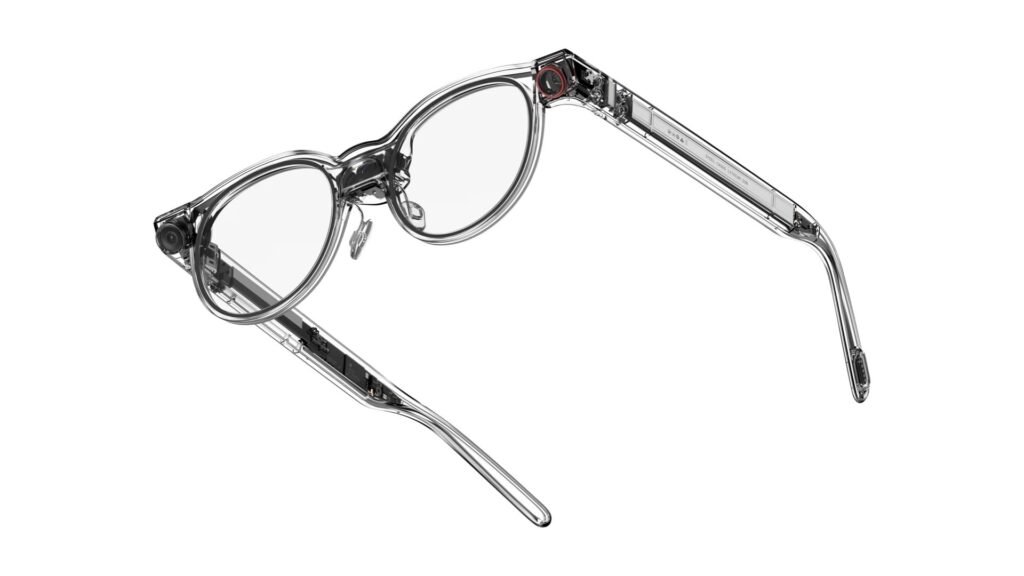
A Hong Kong startup you have never heard of is selling the most interesting smart glasses of the year — and nobody outside the company has tested them. Orrorin Glasses, announced November 25 by Savage Technology, promise full-color displays in front of both eyes and Vision Pro-style pinch controls in a 45-gram frame, for $799. That is the same price as Meta’s Ray-Ban Display glasses. The spec sheet reads like a win. The fine print reads like a warning.
The pitch is the hardware. Two MicroLED displays, 500 × 380 pixels per eye, 60 Hz, up to 1,800 nits, in a transparent frame with round lenses. “Spatial Pinch” lets you pinch with your hand down at your side — no wristband, no ring, no controller. Eye tracking fades the display when you look away. A high-speed global-shutter camera, two inward-facing IR eye cameras, four microphones and dual piezoelectric audio round it out. Battery life is claimed at up to 10 hours from dual steel-shell cells totaling 450 mAh, with a 15-minute magnetic fast charge. Savage says the glasses are about 25 times lighter than a Vision Pro.
Same $799. Very Different Glasses
Put Orrorin next to the Meta Ray-Ban Display at the same price and the trade-offs are stark. Meta gives you a screen for the right eye only (600 × 600, 90 Hz, up to 5,000 nits, 20° field of view), requires the Neural Band wristband for gestures, weighs 69 g, and has 2 GB of RAM. Orrorin gives you two screens, no wristband, and 45 g — but lower resolution, 60 Hz, 1,800 nits, and just 64 MB of memory. Meta’s specs are reviewed and shipping. Savage’s are promises.
And the promises have holes. There is no 6DoF positional tracking and no SLAM spatial mapping, so virtual windows cannot be anchored in a room — Savage’s own FAQ confirms it. There is no video recording; the cameras are for sensing and hand tracking only. The open SDK the company pitches to AI coding-agent users is not public yet — the developer program is insider-only, and the SavageOS GitHub repository returned a 404 when checked on November 26.
The Deposit Question
Reservations are open now: $29 Early Bird (estimated ship May 2027), $49 In Line (July 2027), and $199 Founder Edition (March 2027). Deposits count toward the $799, and the Early Bird and In Line deposits are fully refundable. But the hardware is still in engineering validation. No reviewer outside the company has tested the pinch controls or the displays. As MacRumors reported, this is a first product from a new company, and the gap between a render and a shipping product is where smart-glasses startups go to die.
There is also a privacy gap worth knowing about. TechTimes noted on November 26 that Savage’s published privacy policy does not mention eye-tracking, motion or microphone data — even though the glasses collect all three. The company promises that raw camera and audio data stays on device and that “no person, third-party app, or organization — including Savage — can access your raw camera images or audio recordings.” The promise is strong; the policy does not yet match it.
Why This Matters
The display-glasses race now has a real price anchor — $799 — and the company fighting for it may be one nobody has heard of, or it may ship nothing at all. Apple’s first smart glasses are reported for unveiling at WWDC in June 2027, with no display at all — speakers, microphones and Siri only. Orrorin is pitching display glasses a year before Apple enters the category. Our verdict: the $29 Early Bird deposit is a cheap lottery ticket on a genuinely interesting design, and it is fully refundable. The $199 Founder deposit on unproven hardware from an unknown startup is a bet, not a purchase. Wait for an independent hands-on before you pay more than the minimum.
Meanwhile in Gadgets: Meta’s own glasses line is the comparison point — its Ray-Ban audio glasses now work as hearing aids, no camera required. And the race is wider than two companies: Samsung’s intelligent eyewear is coming too.