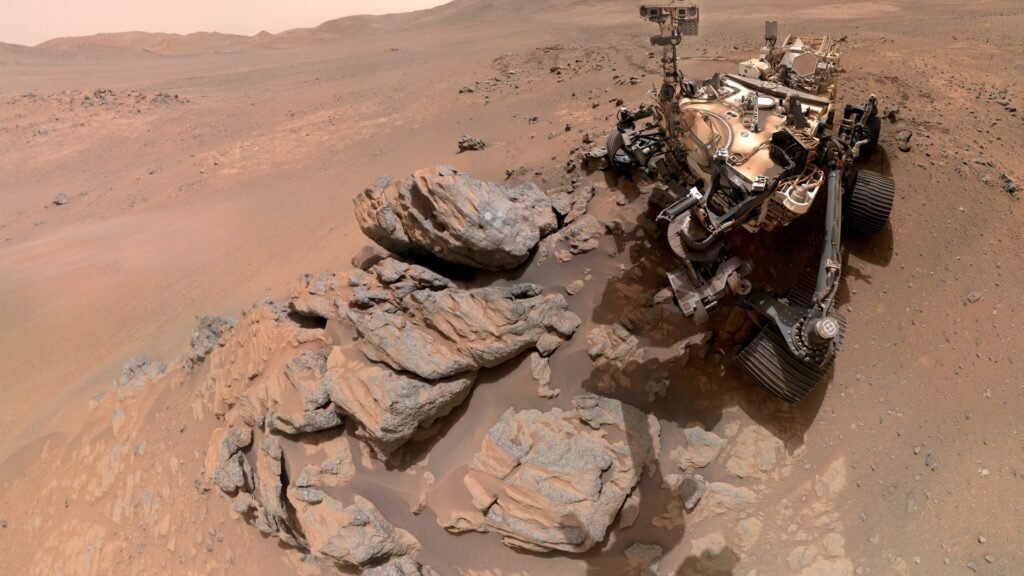
On October 11, NASA’s Perseverance rover clicked past 28.10 miles on its odometer — 45.22 kilometers — and took the off-world driving crown from Opportunity, whose 28.06-mile (45.16-kilometer) record had stood since the older rover fell silent eight years ago. The margin of victory? About 200 feet. Perseverance covered in five and a half years a distance Opportunity needed nearly 15 to travel.
A 200-Foot Margin, 15 Years in the Making
Opportunity landed on Mars in January 2004 for what was supposed to be a 90-day mission. It kept going for 5,111 Martian days — almost 15 years — before a planet-wide dust storm choked off its solar panels in 2018, fittingly, in a spot called Perseverance Valley. Its 45.16-kilometer mark stood as the farthest any vehicle had ever driven on another world.
According to Fox Weather, Perseverance reached the mark on the 2,006th Martian day of its mission, and the milestone also closes out three full decades of NASA rover operations on Mars. “The original mission called for no more than 12.4 miles of driving,” Steven Lee, project manager for the Curiosity and Perseverance rovers at NASA’s Jet Propulsion Laboratory, said. “We’ve blown well past that, and with all mobility systems fully operational and favorable extended-ground-life test results, we expect Perseverance to keep adding to this record for many years to come.”
The Autopilot Did It
The real story isn’t the mileage — it’s how the miles were logged. Perseverance has driven more than 90% of its total distance using its autonomous navigation system, AutoNav, compared with about 5% for the first-generation system on Spirit and Opportunity. In 1997, the tiny Sojourner rover assessed all of 20 terrain measurement points per look, on a processor slower than one megahertz. Perseverance processes roughly 600,000 points every time it surveys the ground, with a second processor plus an FPGA for the extra image work.
As IEEE Spectrum reported in an interview with Mark Maimone, the JPL engineer who wrote the self-driving software for every NASA Mars rover since Sojourner, the latest upgrades teach Perseverance to “steer less and roll more,” checking its position against orbital maps mid-drive. A new capability called Mars Global Localization shrinks the rover’s uncertainty about where it is — the thing that used to force long safety pauses. Last year, the team even let Anthropic’s Claude AI plan a 400-meter drive from orbital images; humans reviewed the route, made a couple of tweaks, and the rover executed it. “We built the software, tested it, ran millions of simulations,” Maimone said. “It hasn’t steered us wrong yet.”
The Oldest Rocks on the Itinerary
The record fell while Perseverance was rolling toward an area called Idubi, off the western rim of Jezero Crater, in a region the science team nicknamed “Lac de Charmes.” The terrain there may be some of the oldest ever explored in the solar system — rocks so ancient that their equivalents on Earth were erased long ago by erosion and plate tectonics, which Mars never had. The team is hunting for traces of ancient hydrothermal systems, the kind of environments where life might once have gotten a foothold.
Perseverance has now also left behind every lunar driving record, including the Soviet Lunokhod 2’s roughly 39 kilometers. No machine has ever traveled farther beyond Earth.
Why this matters
Most coverage treated this as a trivia stat — rover goes far, record broken. The 200-foot margin is the tell: this record was never about endurance, and Perseverance didn’t beat Opportunity by being tougher. It won by being smarter. The autonomy stack that made this possible — onboard hazard mapping, self-corrected positioning, AI-assisted route planning — is the same technology stack future human missions to Mars will depend on, when a 20-minute radio delay makes joystick driving impossible. The odometer record is a proxy for something bigger: robots on Mars can now largely drive themselves. Expect the next records — 50 kilometers, then a full marathon and beyond — to fall much faster than this one did.
Meanwhile in Space: read our Artemis III readiness checklist for the 2027 Moon return, and what went wrong on Starship’s 14th test flight.