The Early Arrival
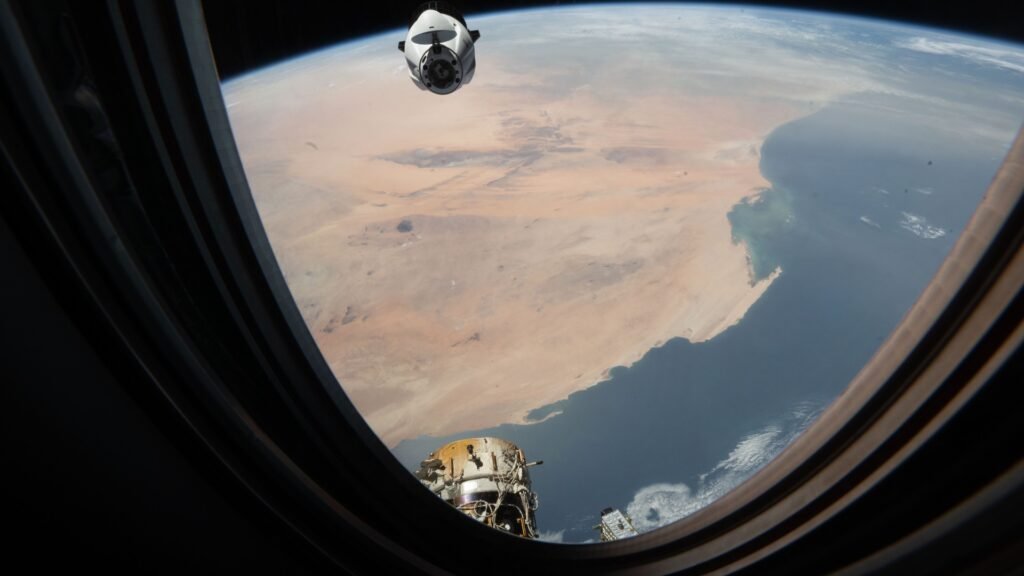
At 10:27 a.m. EDT on Thursday, a SpaceX cargo Dragon slid into the space-facing port of the International Space Station’s Harmony module — 33 minutes ahead of schedule, fully on its own. NASA confirmed the autonomous docking of the CRS-35 mission, which is delivering more than 6,300 pounds of food, supplies, and equipment to the Expedition 75 crew.
The spacecraft had launched two days earlier, at 6:33 a.m. EDT on Tuesday, aboard a Falcon 9 rocket from Cape Canaveral’s Space Launch Complex 40. Inside the station, NASA astronaut Anil Menon and Canadian Space Agency astronaut Joshua Kutryk monitored the final approach. Once the hatches opened, the crew — joined by NASA’s Jessica Watkins and Luke Delaney — began unpacking Dragon while five spacecraft sat docked at the outpost at once.
The Station’s Last Major Upgrade
The headline payload is the fourth and final pair of International Space Station Roll-Out Solar Arrays, built by Redwire Space. Once astronauts install them during spacewalks planned for later this fall, the station’s power grid augmentation will be complete — eight roll-out wings in total, each good for more than 20 kilowatts of electricity.
That framing matters. NASA describes the arrays as supporting research, operations, and the station’s planned safe, controlled deorbit. In other words: this is the last big hardware upgrade the ISS will ever receive. Everything from here on is about keeping the lights on through the station’s final years.
What’s in the Box: Mini-Organs and Artificial Eyes
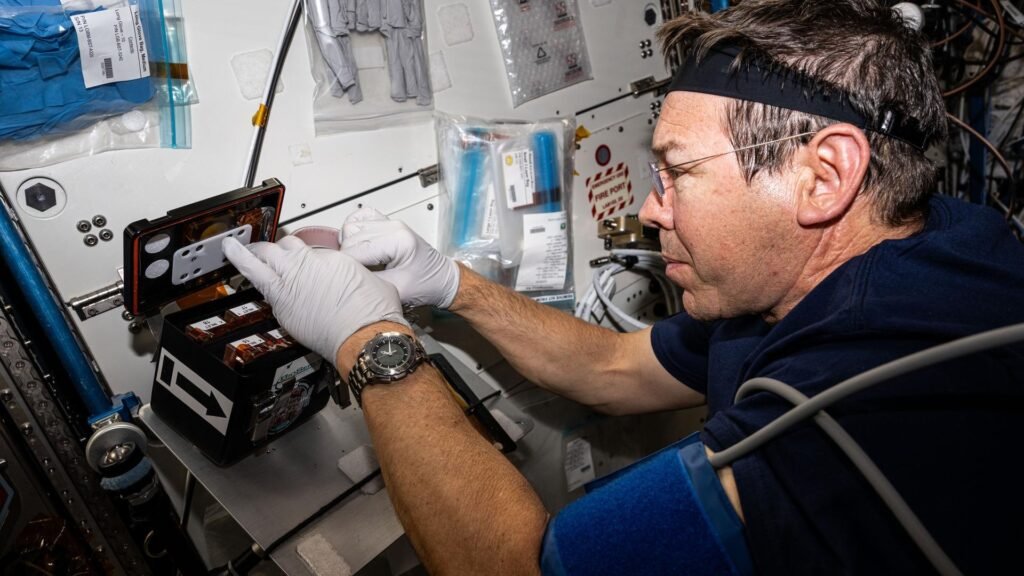
Buried under the solar wings is the science that will outlive the station itself. Dragon’s pressurized cargo includes LambdaVision-1, hardware for manufacturing artificial retinas in microgravity — work that could one day help restore vision for people on Earth. There’s also Stellar Spheroids: three-dimensional heart tissue models that researchers plan to use to test large numbers of potential drugs on future missions.
The manifest gets stranger from there. The MINDS experiment carries brain organoids grown to hunt for treatment targets for neurodegenerative diseases — Alzheimer’s, Parkinson’s, and multiple sclerosis. And ELF-Unconventional Glass 2 will study how a new type of glass forms without gravity’s interference, research that could reshape how we manufacture materials on Earth.
Dragon will stay docked for about a month. When it departs in mid-November, it will splash down off the California coast carrying time-critical research results and hardware bound for refurbishment — the only cargo vehicle in service that can bring significant mass back down.
The Veteran Capsule
This particular Dragon, designated C211, is on its fourth flight, having previously flown CRS-26, CRS-29, and CRS-33. The Falcon 9 first stage that launched it, tail number B1096, completed its eighth trip to space and back, landing at Landing Zone 40 minutes after liftoff. A capsule flying its fourth mission to deliver the station’s final upgrade is about as routine as spaceflight gets — and that’s the point.
Why this matters
Most coverage of CRS-35 treated it as logistics: a truck run to orbit, docking time noted, solar panels mentioned. The real story is what this flight closes. The ISS is being deliberately finished — its power system topped off, its research manifest pivoting hard toward medicine that pays off on Earth, its hardware aging gracefully toward a planned demise. Meanwhile, the vehicle doing the work is a four-time-flown capsule launched on an eight-time-flown booster, which would have been science fiction a decade ago and is now the boring part of the schedule.
Meanwhile in Space: read our coverage of SpaceX’s CRS-35 launch carrying the ISS’s final solar arrays, and SpaceX Crew-13’s record docking earlier this month.