No spacecraft has ever landed on a moon of Mars, let alone brought a piece of one home. On Monday afternoon, US time, Japan will try to do both at once.
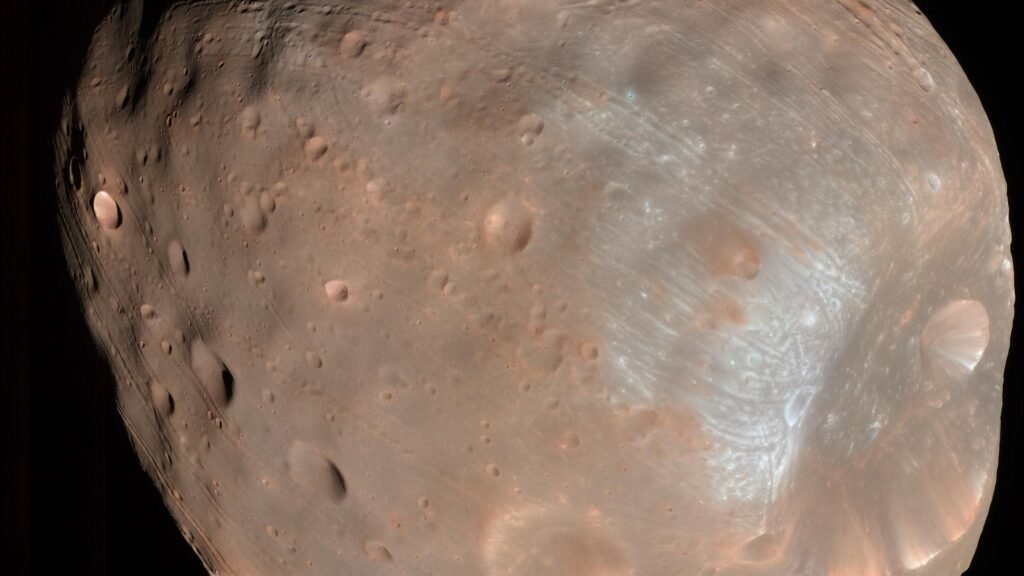
The Japan Aerospace Exploration Agency is launching its Martian Moons eXploration mission — MMX — on a seven-year round trip to Phobos, the larger and closer of Mars’ two moons. If it works, a capsule carrying at least 10 grams of Phobos soil will parachute back to Earth in 2031: the first sample ever returned from anywhere in the Mars system.
The First Round Trip to the Mars System
Liftoff is set for 4:41 a.m. Tuesday Japan time — 3:41 p.m. Monday Eastern for viewers in the US — from the Tanegashima Space Center aboard H3 Flight 10. The launch window runs through November 7, so a weather or technical slip of a day or two won’t end the mission.
Space.com reports MMX reaches Mars in August 2027, orbits Phobos from September, spends a year mapping a landing site, touches down no earlier than December 2028, and heads home in 2030.
A planned 2024 launch slipped after H3 rocket problems — and since Earth-Mars windows open only about every 26 months, this is a window Japan cannot afford to miss.
How Do You Scoop Dirt on a Moon With Almost No Gravity?
Phobos is just 14 miles wide, and its gravity is roughly one two-thousandth of Earth’s. You can’t exactly push a shovel into ground that barely holds you down — so MMX will cheat.
One of the lander’s legs carries a pneumatic sampler that fires bursts of high-pressure nitrogen gas into the surface, kicking dust and pebbles up into a collection chamber. A second, JAXA-built corer drives a hollow cylinder a few centimeters into the ground. The Associated Press reports the mission targets at least 10 grams of material — about a third of an ounce.
The gas sampler is partly American: its mechanism was developed by Honeybee Robotics, a Blue Origin company, as a NASA technology demonstration. NASA also built the MEGANE gamma-ray and neutron spectrometer, which will map Phobos’ elemental composition from orbit, and its Deep Space Network will track the spacecraft for the entire journey. NASA briefed reporters on its contributions on October 15.
MMX also carries a passenger: Idefix, a 55-pound French-German rover to be dropped onto Phobos in 2029, where it will weigh about 15 grams — a first for such a tiny world, and a test of whether wheels even work at such low gravity.
Why This Matters
Phobos and its smaller sibling Deimos are the solar system’s most important unclimbed mountains. Nobody knows where they came from — a century-old mystery. Their dark, carbon-rich look suggests captured asteroids; their nearly circular orbits hugging Mars’ equator point to debris thrown up by a giant impact.
Ten grams of dust could settle it. Impact debris should carry Mars’ chemical fingerprints; captured asteroids should look like material from elsewhere in the solar system. NASA program executive Tom Statler put it plainly: the moons “may be the remains of a massive impact on Mars.” And the answer reaches far beyond one moon — it tells us how water and organic compounds reached Earth and the other inner planets.
America has a direct stake in the payoff. NASA will receive and curate about 15 percent of the returned sample at the Johnson Space Center’s astromaterials lab in Houston, where it will be preserved for research for decades.
Japan has earned this shot. Russia’s Phobos-Grunt failed shortly after launch in 2011, and two Soviet probes failed in 1988. JAXA, by contrast, has already brought home asteroid samples twice — Hayabusa from Itokawa in 2010 and Hayabusa2 from Ryugu in 2020.
Meanwhile in Space: follow NASA’s Artemis II crew tracking lunar meteor impacts, and read how NASA is planning the ISS’s commercial successor.