The SEC Just Cleared the Runway
Agility Robotics is one shareholder vote away from the Nasdaq. The company announced Tuesday that the Securities and Exchange Commission declared effective its joint Form S-4 filing with Churchill Capital Corp XI, the SPAC taking it public — the regulatory green light that starts the final countdown.
According to the company’s announcement, Churchill XI has set November 2 for its shareholder meeting to approve the combination, with closing expected later in November. The combined company will trade on the Nasdaq under the ticker AGLT — billed as the only US-listed pure-play humanoid robotics company with real commercial deployments.
Securities.io reports the deal is expected to deliver more than $620 million in gross proceeds: roughly $424 million of cash sitting in Churchill XI’s trust account plus about $200 million in a private investment led by Foxconn. The June deal valued Agility at $2.5 billion pre-money. Agility says it will spend the money fulfilling customer orders, expanding deployments, and scaling production of its next-generation Digit 5 robot.
What $620 Million Is For
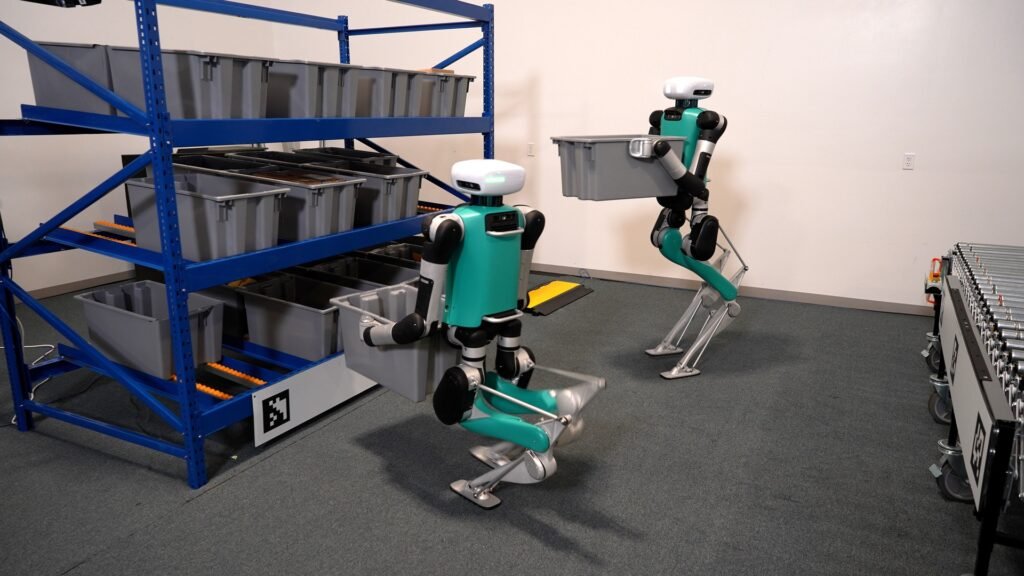
Digit 5, unveiled in September, is Agility’s bet that humanoids can work beside people without safety fences. It lifts 50 pounds — 40% more than its predecessor — runs 90 minutes on a battery that fast-charges in nine, and carries NVIDIA’s Halos safety system as the industry’s launch partner. Agility says it has more than $300 million in committed multi-year orders for the robot, though the fine print notes those orders depend on hitting contractual milestones and product specs.
The case for scale rests on real deployments, not demos: earlier Digit generations have logged more than 65,000 hours of operation with customers including GXO, Schaeffler, and Toyota Motor Manufacturing Canada, which signed a robots-as-a-service agreement after a pilot. Agility wants to grow its pipeline from 30-plus active prospects to roughly 100 and its committed facility deployments from nine to as many as 25 by the end of 2027, fed by RoboFab — its Salem, Oregon factory designed to build up to 10,000 humanoids a year.
Why This Matters
A public listing changes what we get to know about the humanoid business. Venture-funded robotics startups can run for years on renders and pilot announcements; a Nasdaq company has to file audited numbers. Quarterly earnings will show what robots-as-a-service contracts are actually worth, what a Digit costs to build, and whether the margins survive contact with reality. That is the first genuine reality check the humanoid hype cycle has ever faced — and it is coming with Agility’s own fingerprints on it.
The Foxconn angle deserves attention too. The world’s largest electronics manufacturer doesn’t lead a $200 million PIPE for the story — it leads one for the factory math. Between Foxconn’s check and the RoboFab capacity target, Agility’s public pitch is that humanoid manufacturing is a solved-enough problem to scale like consumer electronics.
Two caveats travel with the headline numbers. The $424 million trust figure assumes Churchill XI shareholders don’t redeem their shares — SPAC investors can pull their cash, and redemption waves have hollowed out bigger deals than this. And the $300 million in Digit 5 orders is conditional on Agility delivering the promised features. The listing will be a milestone either way; the numbers behind it are still earning their keep.
Meanwhile in Robotics: Firefly Robotics took the direct-listing route to the Nasdaq last week — Agility chose the SPAC path with a capital raise attached. And RobCo’s $1 billion secondary sale shows the valuations clustering around warehouse robotics.