Starship’s Biggest Test Yet Is Days Away
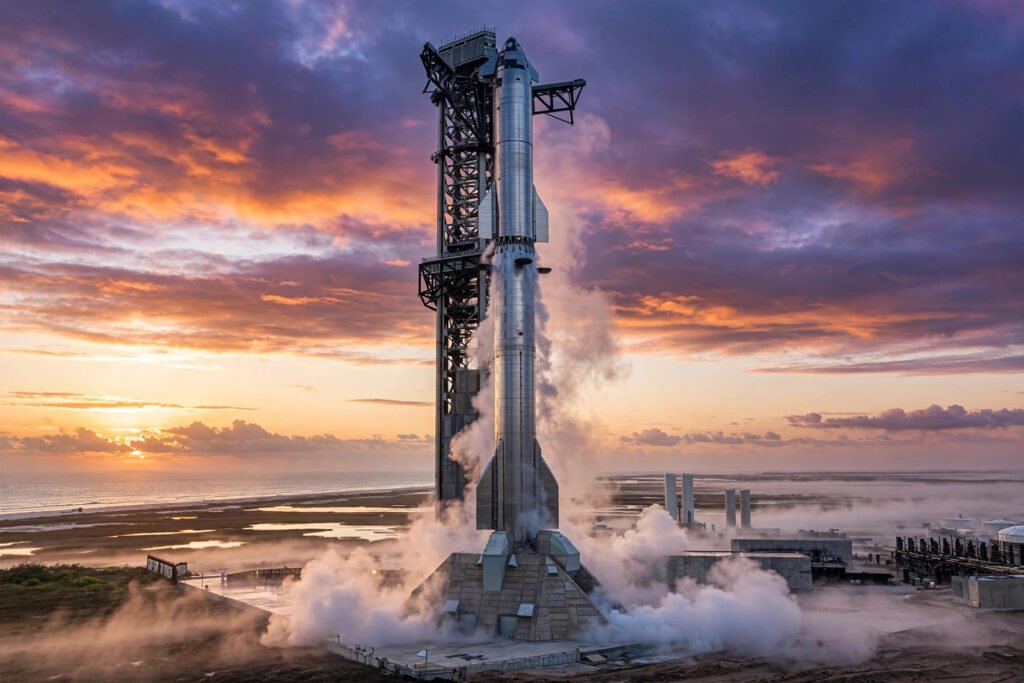
SpaceX has assembled the tallest rocket ever flown on its Texas launch pad, and it is days away from doing something Starship has never done: staying in space.
Booster 21 and Ship 41 are now fully stacked on Pad 2 at Starbase, and SpaceX says Flight 14 is on track for no earlier than Monday, September 28, pending regulatory approval. A 75-minute launch window opens at 8:15 a.m. Eastern Time. According to Reuters, the 14th Starship test flight is expected to send the vehicle into orbit for the first time and deploy the first batch of next-generation Starlink V3 satellites.
All 13 of Starship’s previous flights followed intentionally suborbital arcs. This time the plan calls for a true orbital mission: about six loops around Earth at roughly 275 kilometers (171 miles), with the whole flight lasting nearly 10 hours.
What Flight 14 Will Attempt
The mission’s headline job is reaching orbit. Once there, the upper stage will deploy 26 operational Starlink V3 satellites, the first of the new generation meant to stay in space and serve customers. Three of those satellites will carry cameras to photograph the ship’s heat shield after deployment, giving engineers a close look at its condition before reentry.
Each V3 satellite is a step change in capacity. Engadget reports each one supports 1 Tbps of downlink, roughly 10 times today’s V2 satellites, and 160 Gbps of uplink, about 22 times more.
Recovery plans are deliberately conservative for an orbital debut. SpaceX will not attempt to catch either stage with the launch tower’s arms. The booster is aimed at a splashdown in the Gulf of Mexico minutes after liftoff, while Ship 41 will fire a single Raptor engine for its deorbit burn and splash down in the Pacific Ocean west of Chile. SpaceX is even flying reused hardware: two heat-shield tiles recovered from Ship 40 after Flight 13 have been reinstalled on the new upper stage, the program’s first tile reuse.
Ship 41 was lifted onto Booster 21 overnight on September 23, and a wet dress rehearsal of the fueling systems is expected before liftoff. The FAA has a temporary flight restriction in place at Starbase through October 7, but has not yet issued final launch approval.
From Test Flights to Real Payloads
Flight 14 is the moment Starship starts being a working rocket. Flight 13 in July proved the vehicle could reach space and come back intact; this one has to prove it can operate in orbit and deliver working satellites. Elon Musk underlined the point Monday, writing on X that “in 7 days, the first Starship launch to orbit will be carrying Starlink V3 satellites intended for operational use.” The stakes extend beyond Starlink: NASA is counting on Starship as the lander for its Artemis moon program.
Why This Matters
Thirteen suborbital hops proved Starship can get to space and come back. None proved it can operate there. A 10-hour, six-orbit mission with 26 working satellites will stress-test everything short hops never touch: long-duration thermal control, power management across day-night cycles, and a payload deployment at altitude.
For Starlink, it is the on-ramp to the next decade. The constellation already tops 11,000 active satellites, but every one is an older design. V3 hardware, built around Starship’s enormous payload bay, is how SpaceX plans to multiply network capacity, and none of that works until Starship can reach orbit.
There is no guarantee Monday happens. The launch still needs FAA sign-off, and SpaceX moved the target once already, from September 22 to September 28, without a public explanation. But with the full stack standing on the pad, fueling tests underway, and operational payloads loaded, the gap between intention and liftoff has rarely been narrower.
Meanwhile in Space:
AstroForge put an AI in command of its next spacecraft — with zero orders from Earth — a glimpse of the autonomous future SpaceX itself is chasing, with 26 Starlink V3 satellites riding on this first orbital Starship test.
Meanwhile in Robotics:
Skild AI’s Skild Brain aims to give very different machines one shared robotic mind, the kind of generalization push that keeps robotics moving from demos to real deployment.