The ID.4 Name Is Dead. Long Live the Tiguan.
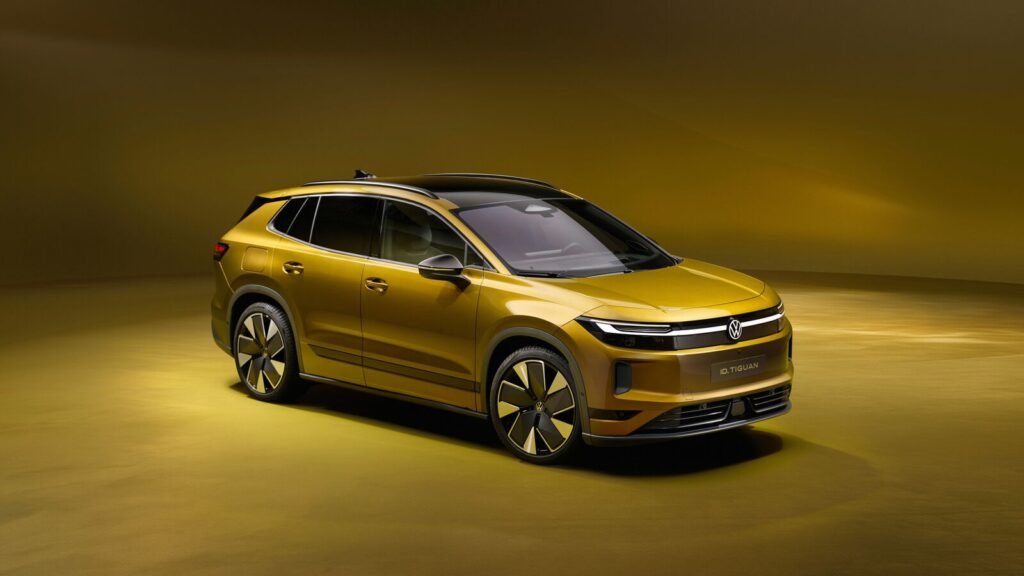
Volkswagen pulled the cover off the ID. Tiguan at a world premiere on Friday, and the biggest news is not the battery — it is the badge. According to Electrek, the electric SUV will replace both the ID.4 and the ID.5, and after the European launch in early 2027 it will take over from the ID.4 in North America too. Pre-sales open Monday, October 13 in Germany and other European markets, starting at €42,695 (about $47,800).
The specs land squarely in the segment’s sweet spot. Electrek reports three MEB+ powertrains: a 140 kW (190 hp) rear-drive model with a 58 kWh battery, a 210 kW (286 hp) rear-drive version with the 77 kWh pack, and a 220 kW (299 hp) 4MOTION all-wheel-drive variant on the larger battery. WLTP range tops out at 600 km — roughly 372 miles — towing hits 2,000 kg (4,400 lb) with the big pack, and the cargo setup pairs a 534-liter trunk with a 32-liter frunk. Vehicle-to-load comes standard.
The Buttons Are Back — and That Is the Real Headline
After years of customer complaints about the ID. lineup’s touch sliders, Volkswagen walked it back. As Globe TV detailed, the ID. Tiguan restores physical controls across the cabin: a button bar for climate functions, redesigned window switches, real buttons on the steering wheel instead of touch pads, and a dedicated rotary controller for volume. The digital cluster even offers retro dials modeled on the blue-and-red instruments of the fourth-generation Golf. Three screens carry the infotainment load — 10-inch driver, 15-inch center, and an optional 12-inch passenger display with a privacy filter.
The shape is deliberately un-radical — a boxier, more upright SUV in VW’s Pure Positive design language — built at Emden while the petrol, diesel, and hybrid Tiguan continues in Wolfsburg.
Why the Name Matters More Than the Battery
The ID. Tiguan is the third Volkswagen to trade anonymous EV numbering for a badge people actually know, following the ID. Polo and ID. Cross, as just-auto noted. The arithmetic is hard to argue with: more than 8.3 million Tiguans have been built, the Tiguan and its Tayron sibling topped one million deliveries last year alone, and the outgoing ID.4 and ID.5 cleared 950,000 units since 2021. Brand CEO Thomas Schäfer called it bringing the company’s best-selling nameplate and its most successful EVs together as one story.
Strip away the polish and this is Volkswagen conceding the “EVs live in a separate universe” experiment failed. The ID.4 was never a bad car — it was an anonymous one, sold in a lineup where buyers had to decode numbering to know what they were looking at. Tying the electric model to the Tiguan tells mainstream buyers this is simply the electric Tiguan, not a science project.
Why this matters: VW’s first answer to the post-credit US market
For American buyers, the ID. Tiguan is the first concrete answer to a real question: what does Volkswagen’s EV lineup look like without the $7,500 federal tax credit? The outgoing ID.4 starts around $45,000 with up to 291 miles of EPA range; the new model’s extra WLTP range points to 300-plus miles on the EPA scale. US pricing and timing are still “in due course.”
Here is the read: if Volkswagen holds the line near the ID.4’s price while delivering 300-plus miles, real buttons, and a cabin people can operate by feel, the ID. Tiguan becomes the most credible mainstream electric SUV Europe has aimed at the American driveway. The risk is timing — the ID.4 keeps selling through early 2027 while buyers wait for a car they now know is coming, and every month of delay is a month Hyundai, Kia, and Tesla spend locking up the same customers.
Meanwhile in Cars & EVs:
Also this week: Tesla’s China-built EV sales accelerated in September, up 5% as Europe’s rebound did the heavy lifting — the market the ID. Tiguan will have to fight for.
And: Rivian’s R2 is betting on software subscriptions to stay affordable — a very different answer to the same affordability question.