NASA’s Orion spacecraft is about to do something it was never designed to do: fly to the Moon backward. Under NASA’s revised Artemis plan, the crew capsule will travel with its European Service Module at the top of the stack, pushed toward the Moon by SpaceX’s Starship. Orion flies backward to the Moon because Starship’s docking configuration leaves no other way, according to Ars Technica, which interviewed Kirk Shireman, Lockheed Martin’s Orion program manager.
Orion was built to feel about 0.1 to 0.15 g during the burn that sends it toward the Moon. Pushed by Starship, it would face roughly 0.8 to 1 g in the opposite direction. Its structure must now be certified to survive loads it was never built for.
Then there is the fuel: in the reversed orientation, liquid propellant in the European Service Module’s tanks would drift toward the gas inlets instead of settling where it belongs. “When you push it the other way, the liquid goes to the gas end of the tank, and you don’t want the liquid in the gas part,” Shireman told Ars Technica. “Bad things can happen to you.” The European Space Agency and its contractor Airbus are now modifying the tanks for the Starship missions.
A capsule built for deep space, stuck in low orbit
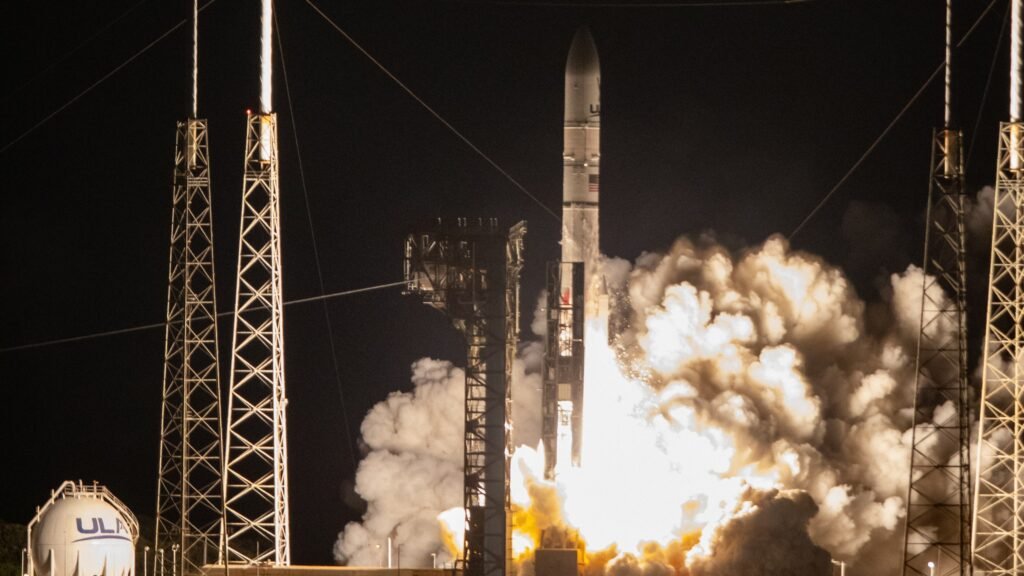
Before any crew flies to the Moon this way, NASA will rehearse the dance close to home. Artemis III, targeted for summer or fall 2027, is now a roughly two-week mission in low Earth orbit, not a lunar landing. Blue Origin launches a Blue Moon test lander on its New Glenn rocket first; Orion docks and the crew spends about two days aboard, testing life support and hatch procedures. Then SpaceX launches a Starship test article from Kennedy Space Center’s Launch Complex 39A, and Orion docks with it for about two hours — without anyone boarding.
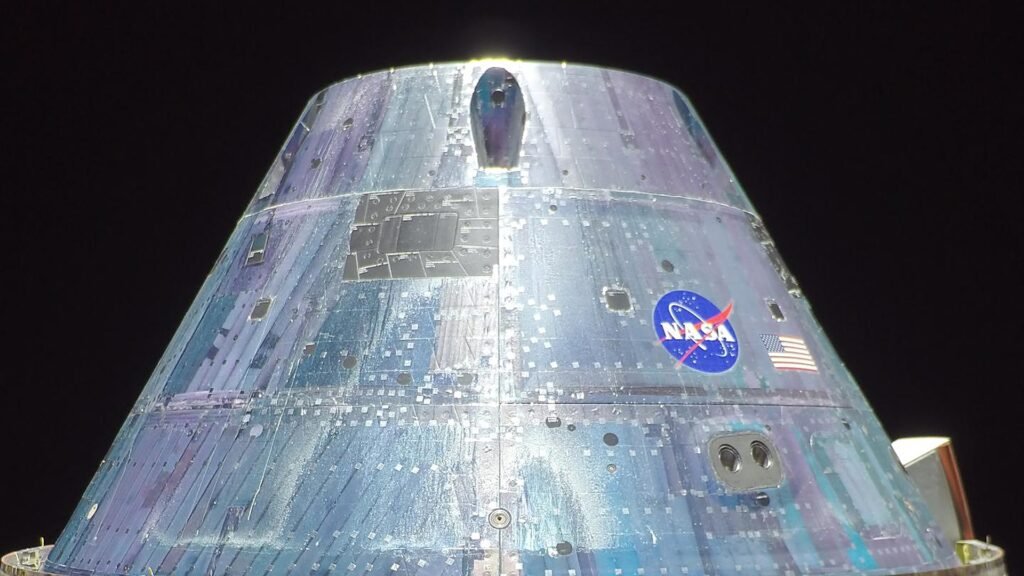
NASA named the crew earlier this month: commander Randy Bresnik, pilot Luca Parmitano of the European Space Agency, and mission specialists Frank Rubio and Andre Douglas. Orion was designed for the cold of deep space, not two weeks circling a few hundred miles above Earth, so engineers are stripping off some of its silver exterior tape to manage the heat, and a debris-risk assessment — low orbit is far more crowded than deep space — is due by January. Lockheed Martin is working three shifts to hold the 2027 schedule.
The trade NASA made
The rework, announced in February and detailed by NASA in October, gave the two commercial lander builders more room. SpaceX will fuel its Starship lander in low Earth orbit, dock with Orion in high Earth orbit, and push the pair toward the Moon; two of the four astronauts will then transfer into Starship for the landing. Blue Origin’s Blue Moon will now meet Orion in lunar orbit rather than Earth orbit.
That flexibility has a price, and Orion is paying it. Starship still has to prove orbital refueling, with a propellant-transfer demonstration between two Starships scheduled for early next year. Until that works, the lunar lander cannot do its job.
Why this matters
The plan change was widely covered. What it does to the only crewed vehicle in the program was not. Orion flies backward to the Moon not because anyone planned it that way, but because the shortcut NASA chose to hold its 2028 landing date left the capsule holding the complexity the landers shed. The first crewed landing now depends on recertifying a spacecraft for forces and orientations it was never designed to handle — and the debris and heating answers are not due until January.
If the fixes hold, Artemis III becomes the most complicated crewed mission NASA has ever flown in Earth orbit, and the path to the surface in 2028 stays open. If they do not, NASA will have traded a foreseeable delay for a redesign it is still discovering. Either way, the Moon is no longer the hard part of this plan — Orion is.
Meanwhile in Space: Artemis II Heat Shield: 9 vs 103 Char Marks
Meanwhile in Space: Voyager 1 Is Now One Light-Day From Earth — and Every Reply Takes 48 Hours