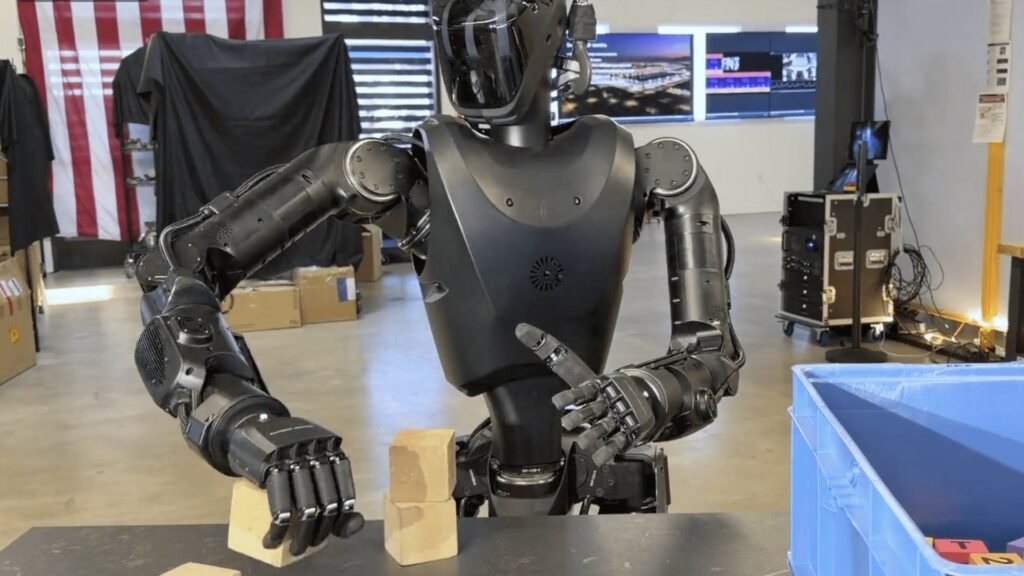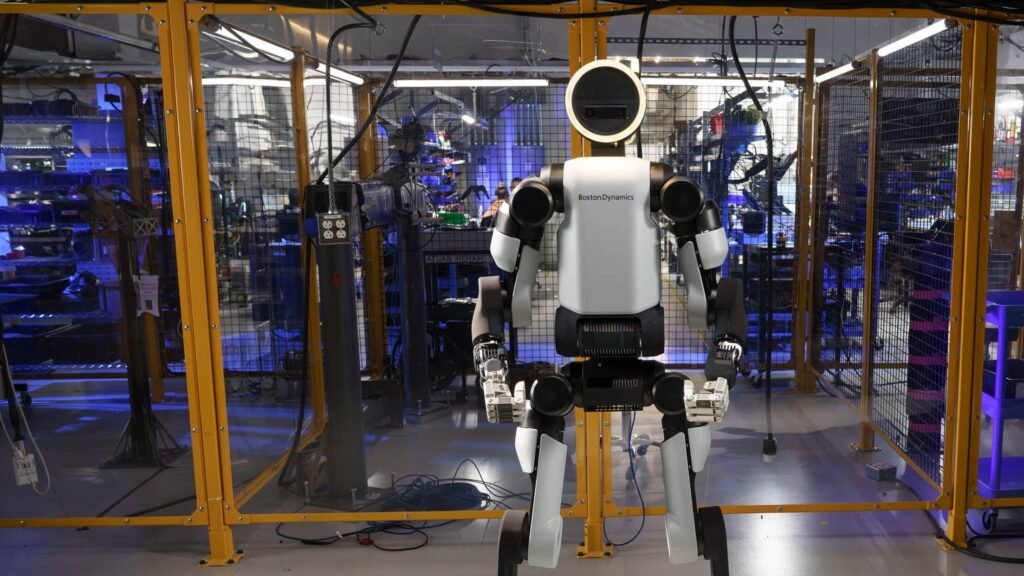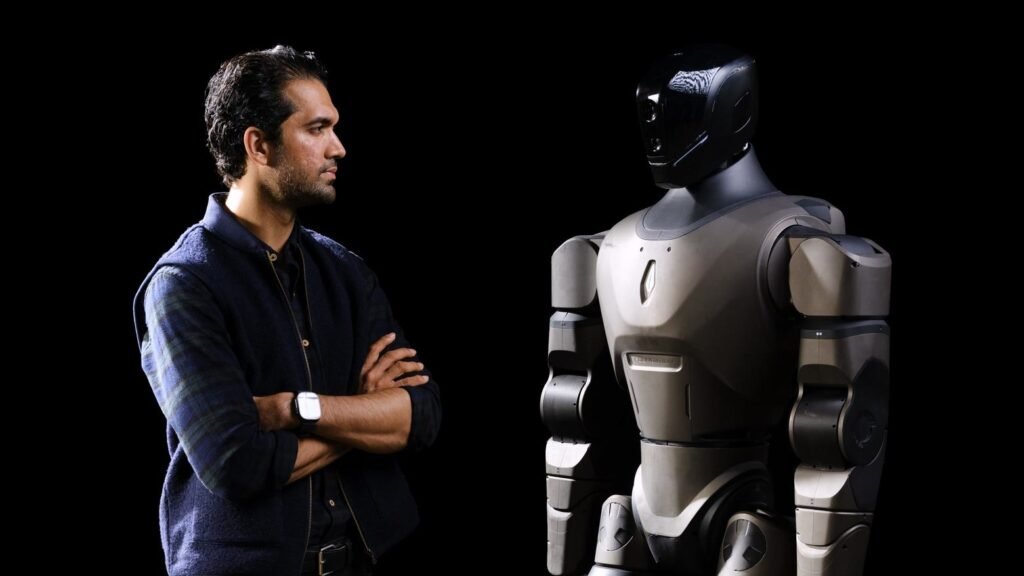
Foundation Future Industries has a new robot, a new claim, and the same unanswered question. The Phantom MKII, unveiled November 18, is the San Francisco startup’s second-generation humanoid — a machine its maker says can walk while carrying 200 pounds through rain, snow and dust. It arrives the same week diplomats in Geneva debated limits on autonomous weapons — and its chief executive will not rule out putting a weapon in its hands.
Foundation founder and CEO Sankaet Pathak told Fast Company the company would consider arming its machines if the US military asked. “We’re not anti-weaponization and warfare,” he said. “That’s not something we have a blanket policy of just saying we’re not going to do.” For now, he says, the defense work is logistics, not combat — but ground robots could mean “less drones, less air strikes, more precision,” he argues.
A robot rebuilt for the rain, not the showroom
The Phantom MKII is a ground-up redesign of the Phantom MK-1, built to fix what field trials exposed: short battery life, poor weather sealing, weak lifting. Its joints are about three-quarters the size of its predecessor’s with more than 1.5 times the performance, Pathak says, and the company claims it has halved the bill-of-materials cost. Weather-resistant joints and field-replaceable parts are meant for construction sites and factories — the jobs Pathak calls its ideal first use.
The battery runs up to six hours, though heavier payloads cut that figure. The new Cortex II AI system learns physical tasks by watching humans — as few as 60 demonstrations for some jobs, rather than extensive custom programming. Production starts in early 2027 in the Bay Area, with several hundred units ramping to a few thousand by year’s end, built mostly from US or allied-country parts. Foundation will not sell to non-allied countries.
The 200-pound claim nobody has verified
The headline number deserves a closer look. At maximum capacity, the Phantom MKII can walk while carrying 200 pounds, Pathak says — roughly three to four times the 50 to 60 pounds the first-generation robot could manage. But no independent test has surfaced in public reporting, and Fast Company’s account gives no ingress-protection rating, no battery capacity, and no speed, duration or terrain for the 200-pound walk. A claim that big is a promise until someone outside the company measures it.
That record is part of the story. The launch comes one day after Reuters reported that South Korean conglomerate Base Group is preparing a $150 million investment in Foundation — a company that missed its October 30 payroll and has raised only $11 million to date, according to PitchBook. The Phantom MKII is, in effect, the product that lifeline would pay for. The SF Standard reports the first-generation robot leases for $100,000 a year with a 100-unit minimum, and the MKII is expected to lease for $75,000 a unit. Foundation has announced no price.
Why this matters
First, the timing: it was unveiled while the United Nations Review Conference on the Convention on Certain Conventional Weapons met in Geneva to debate autonomous weapons — the exact question Pathak answered with “we’re not anti-weaponization.” The Financial Times reported earlier this month that co-founder Mike LeBlanc was in talks with the Israel Defense Forces to supply up to 1,000 first-generation robots for tunnel operations in Gaza; Pathak calls them “very early exploration conversations” with “literally nothing actively going on.”
Second, what it represents: most rivals build for warehouses and factory floors; Foundation is openly building a dual-use machine for heavy industry and the battlefield, pitching fleets for mining, materials processing and construction — Pathak figures they could cut a $1 million home to $60,000–$80,000. He is even open to policing roles. Whether it can actually do the work is now a testable question, with production starting early next year and a $150 million rescue on the line. The 200-pound walk is the claim to watch — and the one that most needs an independent check.
Meanwhile in Robotics: Unpaid and Unplugged: Robot Soldier Startup Foundation Lands a $150 Million Korean Lifeline
Meanwhile in Robotics: Hyundai’s Humanoid Robots Are Headed for Its Factories by 2032