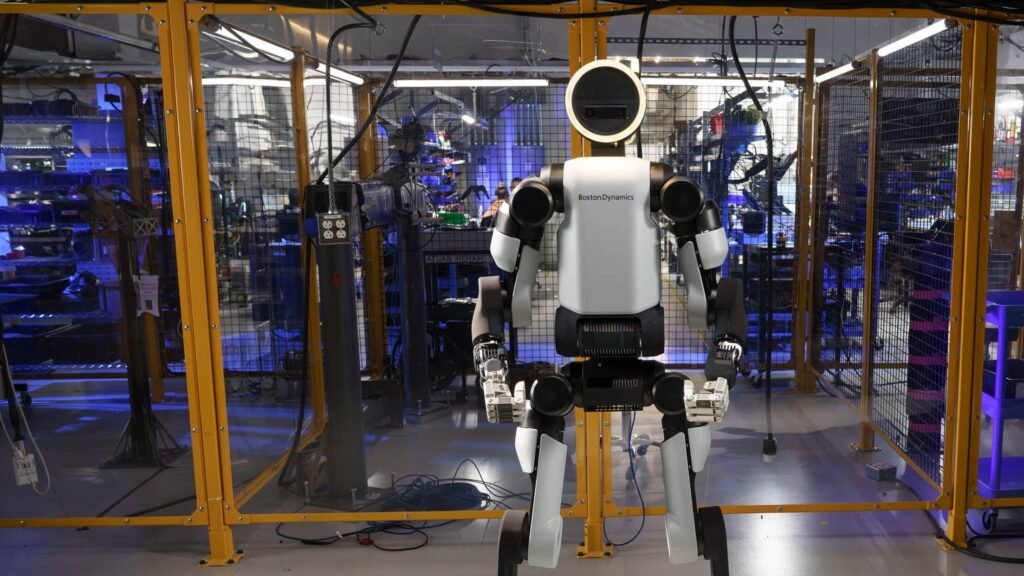
Boston Dynamics’ Atlas humanoid is about to trade the car factory floor for the chip fab. Boston Dynamics announced on 17 November that GlobalFoundries will become the first customer outside the automotive industry to test Atlas, with on-site trials starting in early 2027 — and the chipmaker is expanding its fleet of Spot quadruped robots across its plants at the same time.
The deal covers GF sites in Malta, New York; Burlington, Vermont; Dresden, Germany; and Singapore — the first time Atlas, long associated with Hyundai’s car plants, will be tested in semiconductor manufacturing.
Not a deployment — a test
Before anyone pictures a humanoid running a fab, it is worth reading the announcement carefully. The early-2027 work is explicitly a skills-development workshop, not Atlas doing productive fab work. According to Boston Dynamics, the program will “evaluate potential humanoid use cases, assess customer readiness and integration needs, and begin early testing and training for specific task execution.” Atlas is, the company notes, “currently in early production.”
The first tasks are modest by design: transporting and organizing parts within the plant, and learning to move wafers and other components. Whether Atlas graduates from those trials to real fab work depends on what the evaluation finds — the feasibility question is the whole point of the program.
Spot earned the seat
Atlas is not walking into GF cold. It follows Spot, the quadruped robot GF has run at its Burlington plant for more than four years. Two Spot robots have traveled nearly 900 kilometers and completed more than 90,000 inspections in sub-fab areas since April, achieving a 99% mission success rate. GF also redeployed 875 routine inspections to Spot in just two weeks, with a roadmap to more than double that number.
“Spot has helped us shift from reactive to predictive maintenance, collecting data across thousands of inspection points to prevent downtime and keep our fabs running more efficiently,” said Pradip Singh, chief manufacturing officer at GlobalFoundries.
The money story behind the handshake
There is a commercial clock ticking behind this announcement. Boston Dynamics posted a loss of 528.4 billion won last year and a net loss of 626.6 billion won through Q3 2026, and an IPO is expected around next year. Hyundai plans Atlas mass production in 2028 at 30,000 units a year, and 25,000 Atlas units at its global Hyundai and Kia plants.
GF is the proof point Boston Dynamics needs before that IPO: the first paying customer outside the car industry, and the first test of whether a humanoid can earn its keep anywhere but an auto plant. If Atlas can handle the precision, cleanliness and uptime demands of a chip fab, its market suddenly looks a lot bigger than car factories alone.
It was a busy day for physical AI more broadly: Agility Robotics announced leadership appointments as it scales commercial deployments of its Digit humanoid, and NXP launched a unified robotics platform — a day when physical AI went to work.
Why this matters
Most coverage of this announcement reads as a deployment story. It is not — and that distinction is exactly what makes it interesting. A skills-development workshop in a chip fab is Boston Dynamics asking the hardest question about its own product: can Atlas work where the environment is unforgiving, the tolerances are microscopic and downtime costs a fortune? A car plant is a controlled testbed with a friendly owner. A chip fab run by an outside customer is the first real exam.
The exam matters because of the numbers behind it. A company that lost 528.4 billion won last year, with an IPO expected around next year and mass production planned for 2028, cannot afford Atlas to be a car-plant curiosity. GF is the first customer that can prove otherwise — or the first to show the limits.
Meanwhile in Robotics: Hyundai Just Built a War Room for Its Humanoid Robots — but the Union Gets a Veto
Meanwhile in Robotics: Hyundai Sets 2032 for Humanoid Factory Robots as Boston Dynamics Losses Mount