The payload was secret. The stopwatch was not. SpaceX launched a batch of classified satellites for the National Reconnaissance Office early on Sunday morning — 32 hours, 3 minutes and 21 seconds after another Falcon 9 left the very same pad — the fastest turnaround between launches from one pad in the company’s history, Space.com reports.
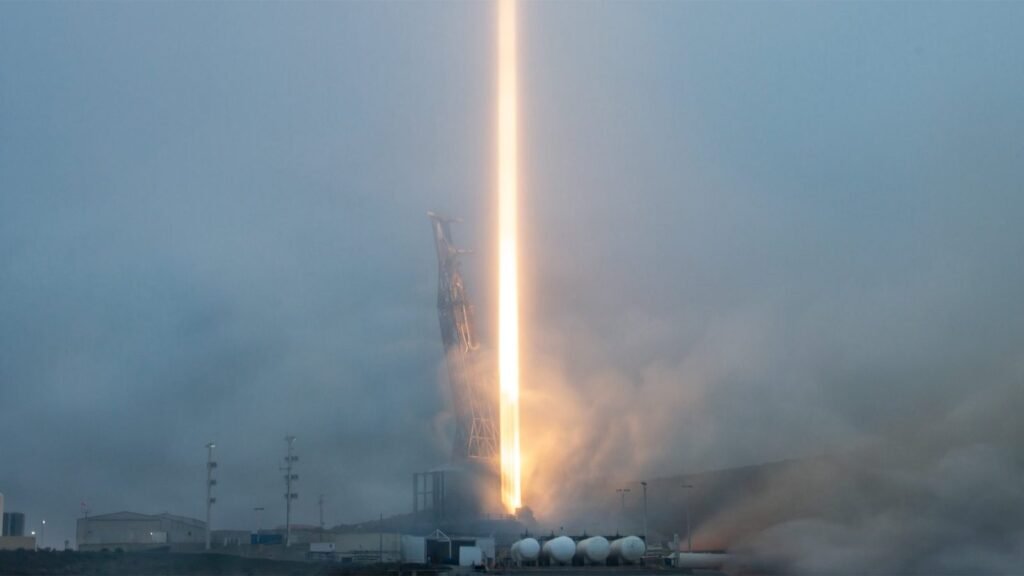
The mission, designated NROL-136, lifted off from Space Launch Complex 4E at Vandenberg Space Force Base in California at 4:23 a.m. local time on November 22. The Falcon 9 first stage, booster B1097, was flying for the 14th time; about seven and a half minutes after liftoff it touched down at Landing Zone 4, next to the pad. The previous flight from that pad, the classified USSF-317 mission for the U.S. Space Force, had lifted off at 8:20 p.m. on November 20. Spaceflight Now reports the gap smashed the site’s previous record of 55 hours, 48 minutes and 21 seconds, set in June — and beat SpaceX’s overall pad record of 45 hours, set by back-to-back Starlink flights from Cape Canaveral in January.
The Record Is About the Pad, Not the Rocket
Two different boosters flew the two missions, for two different government customers, and neither rocket was reflown to set the record. What got faster was everything around the rocket: safing the pad, inspecting the mount, loading propellant, clearing the range, and turning the ground systems around for a second countdown. SpaceX later confirmed the 32-hour gap was its fastest turnaround between launches from the same pad, and Elon Musk reposted the milestone with the words: “32 hour launch pad recycle. Great work by SpaceX team.”
That distinction matters because the pad, not the booster, is now the pacing item in launch cadence. SpaceX has already shown a single booster can fly 14 times; what it had not shown, until now, is that a single pad can serve two national-security customers in a day and a half. Vandenberg’s SLC-4E has now done it.
Fifteen Launches Into the Spy Constellation
NROL-136 is the 15th launch dedicated to building the NRO’s “proliferated architecture” — a constellation of many small reconnaissance satellites, built by SpaceX and Northrop Grumman, that began with NROL-146 in May 2024. It was the fourth such launch this year and the sixth NRO launch of 2026, every one of them carried by a Falcon 9. The NRO has not disclosed how many satellites rode along or what they can do; the agency describes the network as a way to widen coverage and strengthen what it calls the “capability and resilience” of U.S. intelligence operations.
The logic of the proliferated approach is the opposite of the old spy-satellite model: instead of a handful of large, expensive spacecraft, dozens of smaller ones spread the risk, so losing one satellite costs little and replacing it costs a single Falcon 9 flight. Some analysts suspect the payloads are based on SpaceX’s Starshield platform, but neither SpaceX nor the NRO has confirmed that, and it remains speculation.
Why This Matters
The classified payload is the least interesting part of this launch. What matters is the tempo: SpaceX has now flown its Falcon 9 more than 120 times in 2026, and it can now turn a single military pad around in 32 hours. For the NRO, that means a spy constellation that can be refreshed almost as fast as satellites fail or threats change. For everyone else in the launch business, it is a reminder that the race is no longer about who can build a reusable rocket — it is about who can run a spaceport like an airport. The next question is whether 32 hours becomes routine, or whether this weekend was a one-off sprint. The manifest will answer that within weeks.
Meanwhile in Space: SpaceX’s Pentagon Tranche 1 launch from Vandenberg — and the classified USSF-385 launch and the Starshield question.