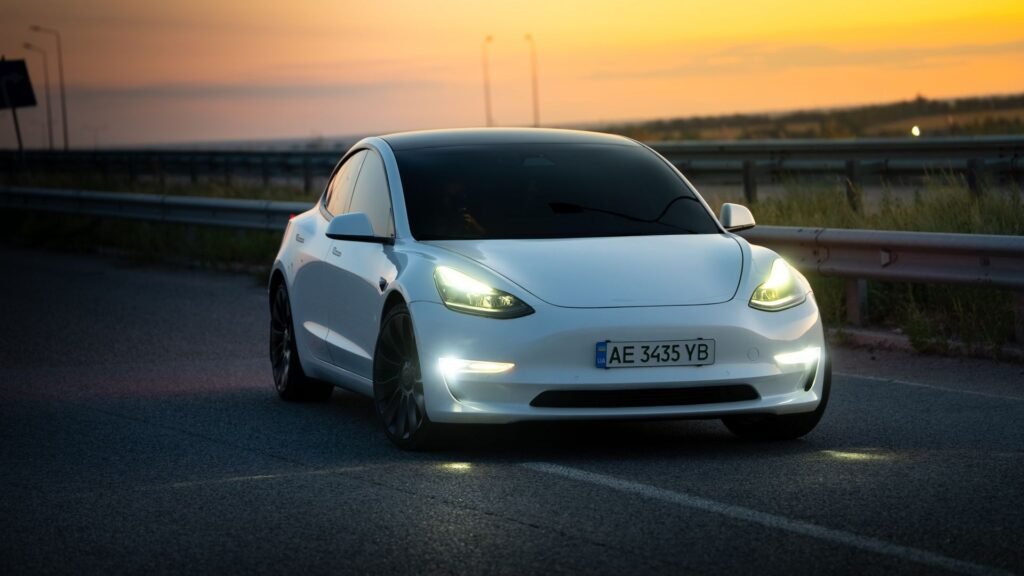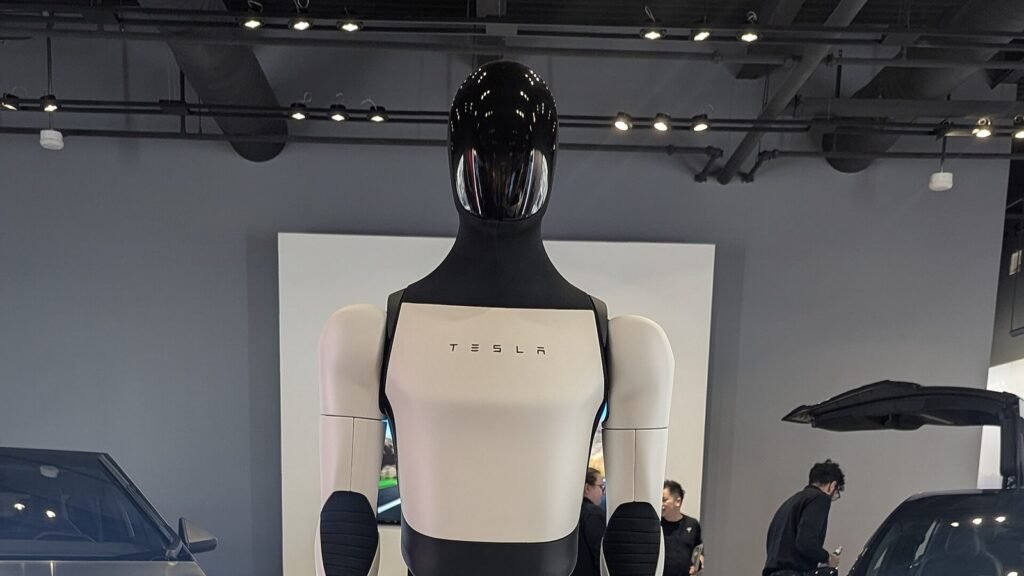
Tesla’s most powerful chip is skipping the car entirely. Elon Musk said on Sunday that the company’s next-generation AI5 computer will go into the Optimus humanoid robot, while Tesla vehicles — including the Cybercab and the robotaxi fleet — will stay on the current AI4 hardware. “It’s going to Optimus. Cars will remain at AI4. That’s enough to solve superhuman driving,” Musk wrote on X, answering an owner who asked whether to wait for an AI5 car.
The split is not new, but it is now explicit. Musk first said in April that AI5 would go to Optimus and Tesla’s supercomputer clusters first, and on the October earnings call he said the company aimed to put AI5 into Optimus “in approximately April of next year”. AI5 is, by Musk’s own description, “a gigantic improvement” — roughly 12 times the compute of AI4. It taped out in April 2026, is built on a 2-nanometre process by TSMC in Arizona and Samsung in Texas, and is expected to reach volume production in mid-2027. According to eletric-vehicles.com, Musk also described AI4.5, a revised version of the current computer with faster LPDDR5X memory, as a relatively small improvement.
What AI4 Owners Actually Get
The reassurance has substance behind it. FSD v15, which began rolling out to a first wave of owners on Saturday, runs on AI4 — and its headline feature, Reality View, is generated live by a diffusion model using just half of one AI4 accelerator, Tesla North reports. The same vision encoder is shared between FSD, the robotaxi fleet and Optimus. Tesla has told investors AI4 can run unsupervised driving, and privately owned cars could join the robotaxi fleet around the second quarter of 2027.
The HW3 Warning Nobody at Tesla Mentions
Owners have heard this promise before. Tesla told buyers of Hardware 3 cars that their computers would achieve full self-driving — then spent years walking it back as the software outgrew the hardware. Electrek has pointed out that Tesla made the same kind of claim about HW3, and it did not hold. Musk gave no timeline on Sunday for how long cars will stay on AI4, and no word on an upgrade offer for HW3 owners still waiting. “Enough” has an expiry date at Tesla, and the company has not said what happens when AI4 reaches it.
The Memory Bill Behind the Decision
Musk volunteered a reason the decision may be as much about cost as capability. “AI4 costs twice as much now due to memory and storage price hikes,” he wrote in a separate post on Sunday. It is the same memory crunch behind the Pixel 10a price rise, Apple’s MacBook Neo going from $599 to $699, and the iPhone 18 Pro’s $100 increase. Freezing the car platform on AI4 caps the damage; the robot, which needs every teraflop it can get, gets the new silicon.
Why This Matters
For anyone buying a Tesla today, the message is genuinely good news: the hardware in the car is the hardware that will drive it, with no forced upgrade cycle tied to AI5. For anyone who bought a Tesla on a promise about the future, the message is more complicated. The split reframes Tesla as a robotics company first — the best chip goes to the machine that walks, while the machines that drive get the frozen platform. If AI4 really is enough, owners win. If it is HW3 all over again, they will find out the same way HW3 owners did: slowly, and after the fact.
Meanwhile in Cars & EVs: Tesla FSD v15 brings Reality View and a 25x safety claim nobody can verify yet — and our Cybercab $29,990 true-cost breakdown.