SpaceX has spent years promising that Starship would fly like an airliner: land, refuel, and go again. Last week it proved the hardest part of that promise — and now the rocket that proved it will never fly again.
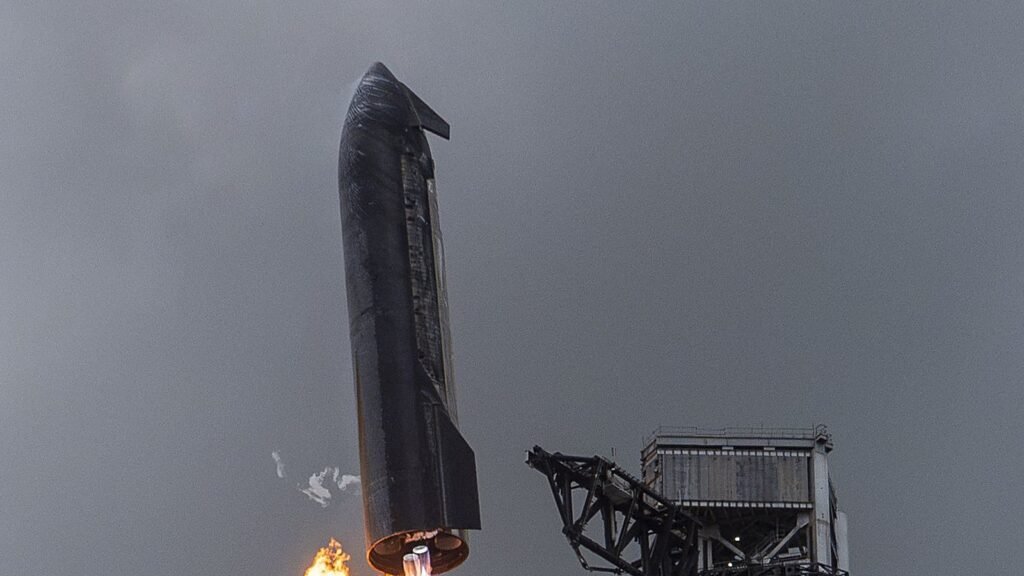
SpaceX Ship 42, the first Starship upper stage ever caught by its launch tower, is headed for public display instead of a second flight, Space.com reports, citing remarks by SpaceX founder and CEO Elon Musk. The vehicle survived its 22.5-hour orbital mission in good enough shape to fly again — and SpaceX is retiring it anyway.
The Catch That Changed Everything
Ship 42 launched on Nov. 13 aboard Starship’s 15th test flight from Starbase, Texas, and spent nearly a day in orbit, circling Earth 14 times and deploying 26 next-generation Starlink V3 satellites. Then it flew itself home. Emerging from thick cloud over the Texas coast, the 52-metre spacecraft flipped upright, relit its engines, and settled into the mechanical “chopstick” arms of its own launch tower — the first time any company has caught an orbital rocket’s upper stage.
The flight was only a partial success. The Associated Press reports the Super Heavy booster aborted its own catch attempt minutes after liftoff: its engines stopped firing too soon on the way back down, the guidance system sensed it was out of position, and the booster diverted over the Gulf of Mexico, where it was destroyed. SpaceX said only 32 of the booster’s 33 Raptor engines relit for the boostback burn, and early indications pointed to a low fuel mass alarm. Before Flight 15, SpaceX had caught a Super Heavy booster three times and reflown one twice — but never attempted a Ship catch.
A Museum Piece Instead of a Workhorse
Musk made the retirement call on Wednesday, Nov. 18, during a virtual appearance at the TomorrowX Summit in Austin, beamed in from China, where he was traveling with President Trump’s delegation. The ship, he said, “could probably be reflown with a few weeks of refurbishment.”
But, he added: “In this case, because it’s kind of an historic ship, we’re going to, I think, not take any chances with the ship and just kind of leave it for public display, because what it’s done is historic.” Musk did not name a display site, though Starbase is likeliest; SpaceX plans to shift most launches to a new Louisiana Starbase site, but construction has yet to begin on that $100 billion complex.
For Musk, the catch was the final piece of the reusability puzzle. “Everyone knew, within SpaceX, at least, how important this milestone was, and that it was really something fundamental and profound — that Starship will be the first-ever fully reusable orbital space system,” he said at the summit.
Why This Matters
Here is the part the retirement headlines skip: preserving Ship 42 has a price. SpaceX president Gwynne Shotwell told investors on the company’s October earnings call that SpaceX aims to fly a recovered Starship upper stage for the first time in early 2027, Payload reports. Ship 42 was the obvious candidate — the only ship ever caught, in reflight-ready condition. With it going to a museum instead, the first reflight now waits on another ship being caught first, on a flight SpaceX has not yet dated.
The same early-2027 window carries the other test Starship cannot skip: ship-to-ship propellant transfer in orbit, which NASA’s Artemis lander depends on and which has never been attempted. The catch proved recovery works. It did not prove reuse works, and the calendar for proving that just got tighter.
None of that dims the achievement. Before Nov. 14, the upper stage was the part of Starship nobody knew how to bring home. But the company’s own targets — weekly Starship flights in the first half of 2027, and Musk’s goal of about 10,000 Starship missions a year by 2030 — depend on catching the next one too, and then flying it again. The museum can wait. The reflight cannot.
Meanwhile in Space: SpaceX’s first Starship catch was the moment everything changed for reusable rockets — and the refueling math behind Starship’s Moon missions is still disputed.