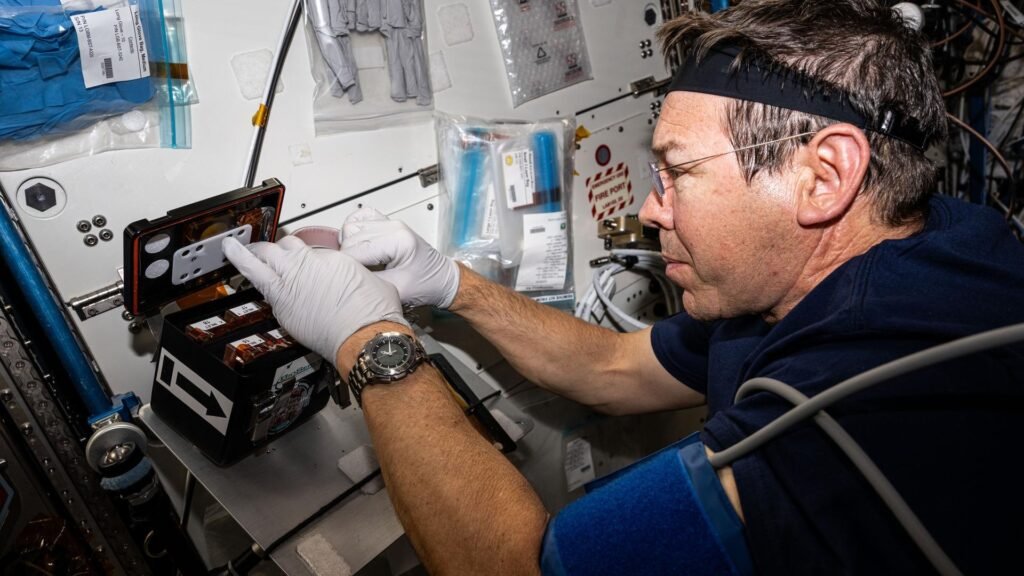
The vials of human cells that could change how we fight Alzheimer’s arrived in orbit on Thursday. A SpaceX Dragon cargo capsule docked with the International Space Station at 10:27 a.m. EDT, delivering the first-ever biological samples from Saudi Arabia as part of a new three-nation research program on neurodegenerative disease.
The program, called BioGravity-1, was announced Wednesday by the National Stem Cell Foundation, Axiom Space, and the Saudi Space Agency. The samples flew up aboard NASA’s SpaceX CRS-35 resupply mission, which lifted off from Cape Canaveral on Tuesday morning.
The first Saudi cell lines in orbit
For the first time, researchers will study cells from Saudi donors on the station, alongside cell lines from the United Kingdom derived from people carrying a mutation for early-onset Alzheimer’s. The Saudi samples were prepared with help from scientists at King Abdullah University of Science and Technology (KAUST), whose SSA-1 and SSA-2 experiments are part of the payload.
BioGravity-1 is only phase one of a longer program. This first flight establishes a baseline using samples from healthy donors. A second phase will examine disease models derived from Alzheimer’s and multiple sclerosis patients, and a third will test how those models respond to potential therapies and hunt for new drug targets — all in microgravity.
Why scientists grow mini-brains in space
The research centers on brain organoids — tiny lab-grown clusters of human brain tissue — and a puzzle that has frustrated drug developers for decades: neurodegenerative diseases progress too slowly in a petri dish to study efficiently. Previous studies have shown that brain organoids mature far more rapidly in microgravity, letting scientists observe disease-related changes that can take much longer to appear in Earth-bound labs.
This mission’s investigation zeroes in on neuroinflammation, a hallmark of Parkinson’s, Alzheimer’s, and primary progressive multiple sclerosis. Researchers will compare cellular behavior, molecular pathways, and potential therapeutic responses across organoids grown from different patient populations.
Dragon carried more than 6,300 pounds of cargo in total. Alongside the stem cell samples, it delivered the final set of ISS Roll-Out Solar Arrays for installation this fall, hardware for manufacturing artificial retinas in microgravity, and 3D heart tissue models aimed at advancing large-scale drug testing. The capsule stays docked until mid-November before returning with time-sensitive research.
Why this matters
Here is the part most coverage will skip: the diversity angle. As the foundation’s CEO Paula Grisanti put it, most neurodegeneration research has been conducted on limited patient populations — and nobody fully knows how genetic ancestry changes the way a disease progresses or a drug works. Flying Saudi and British cell lines side by side with existing samples turns the space station into a comparative trial that cannot be run on Earth, because the accelerated-aging environment of microgravity itself is the lab equipment.
There is also a quieter milestone. Axiom Space says the Saudi collaboration was enabled through its Ax-2 private astronaut mission — a commercial flight doubling as science diplomacy. As the ISS nears retirement, private platforms are becoming the actual infrastructure of orbital research, not just the ride up.
Meanwhile in Space: NASA just finalized the contracts for the commercial stations that will replace the ISS — read what the final RFP means for missions like this one.