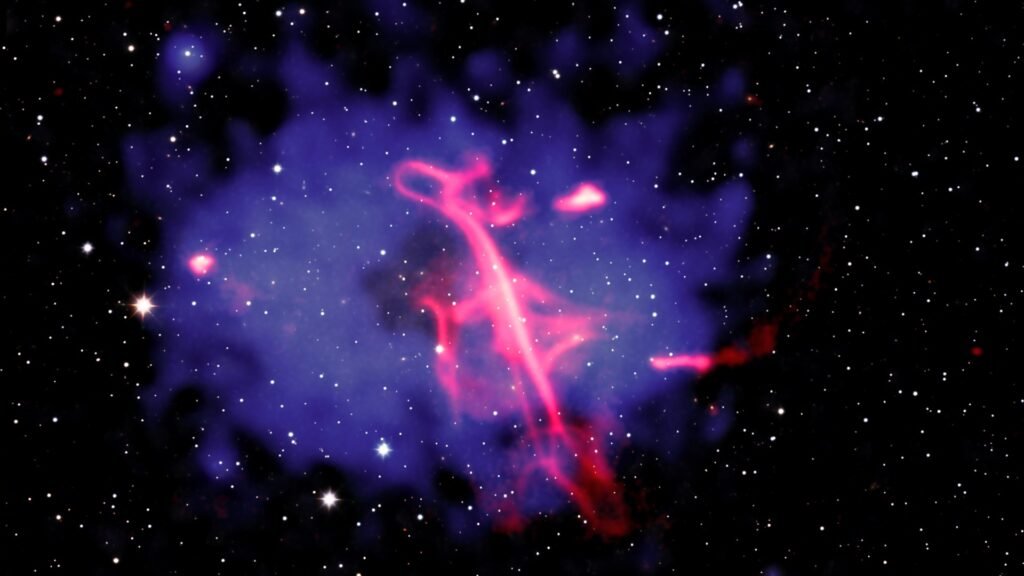
Somewhere in the sky, 1.55 billion light-years away, a musical symbol is drawn across the dark — and it took four telescopes to explain it. NASA announced this week that its Chandra X-ray Observatory has solved the origin of a bizarre radio structure nicknamed the “Treble Clef” (catalog name VLSS J0318.9+5755), a glowing pink curl that looks uncannily like the symbol at the start of a sheet of music.
The object sits almost directly behind the plane of the Milky Way. Stars, gas, and dust from our own galaxy block the optical view from Earth — which is why astronomers needed X-ray, radio, and infrared eyes to crack it, in a paper led by Andrea Botteon of Italy’s National Institute for Astrophysics and published October 14 in Astronomy & Astrophysics.
Four Telescopes, One Detective Story
The composite image is a layered map of the invisible. The blue and purple glow is multimillion-degree gas, captured by Chandra and eROSITA, the German X-ray survey telescope. The red is radio emission from LOFAR, the European low-frequency array. The white specks are infrared from UKIRT. Together, they reveal what no single telescope could: a galaxy cluster mid-collision, with a strange radio curl thrown across it.
The breakthrough came from subtraction. Most of the cluster’s hot gas forms a neat symmetrical oval — so the researchers removed that oval from the X-ray image and studied what was left. The remaining emission was brightest to the left and right of center, implying the collision ran along a left-right axis a few hundred million years ago. The two clusters are now moving apart, and the treble-clef shape is the scar of their encounter.
A Black-Hole Outburst, Then a Cosmic Fender-Bender
The structure formed in two acts. First, an earlier outburst from a supermassive black hole at the cluster’s center blasted clouds of charged particles and magnetic fields outward at near light speed, glowing brightly in radio — then fading as the energy dissipated. Second, two galaxy clusters collided, and the compression reenergized the dying cloud, making it glow in radio again. Shock waves from the collision — described as behaving like the sonic booms of supersonic jets — may have done the reenergizing.
And the resemblance to a musical symbol? Pareidolia, full stop. NASA is explicit: there is no scientific connection to musical notation. The universe does not write sheet music; it just occasionally produces shapes our pattern-hungry brains cannot ignore.
Why this matters
This is a method story as much as a mystery story. The subtract-the-oval trick — removing the symmetrical bulk of a cluster’s gas to expose the asymmetric collision signature — is a reusable tool for mapping cluster mergers, the largest gravitationally bound structures in the universe. Understanding how black-hole outbursts and cluster collisions team up to accelerate particles also feeds directly into the physics of cosmic rays and magnetic fields on the largest scales.
It is also a reminder of how much of the sky is still hidden from us. The Treble Clef sat behind the Milky Way’s dust lane for decades, visible only as a puzzling radio smudge. The sky is full of objects like it — and the telescopes to decode them are already built.
Meanwhile in Space: the Phoenix planet rising from a dead star’s ashes — another cosmic cold case, solved.