Tesla reports third-quarter deliveries today, and the number everyone expects is roughly 462,000 vehicles — a 7% drop from a year ago that would confirm what the rest of the quarter already showed: Tesla’s car business is now two different stories depending on which ocean you’re on.
The company-compiled analyst consensus, released September 29, puts deliveries at 461,974, down 7.1% year over year, with 450,712 of those being Model 3 and Model Y. The Street’s spread runs from 421,758 (Cantor Fitzgerald) to 482,000 (JPMorgan), and the cuts moved in one direction for two weeks — Goldman Sachs chopped its estimate by 55,000, JPMorgan by 34,000, Electrek reports. Context matters here: Q3 2025’s 497,000 was Tesla’s second-best quarter ever, inflated by buyers rushing to beat the September 30, 2025 expiry of the $7,500 federal tax credit.
The US hangover
The American market is where the quarter broke down. Tesla’s US sales fell 26% year over year in August to roughly 40,816 vehicles, and research firm Cox Automotive forecasts a 45% year-over-year plunge in total US EV sales for the quarter — the post-tax-credit hangover hitting the whole market, with Tesla carrying the biggest share of the pain. RBC analyst Tom Narayan notes even high fuel costs aren’t lifting EV demand the way they used to, per MarketWatch.
The European rebound nobody’s stitching together
But the global picture is splitting in a way the preview coverage isn’t combining. Tesla’s September registrations surged across Europe: up 61.9% in France, 38.4% in Sweden, and 2.2% in Norway, Reuters reported on October 1. ACEA data shows Tesla’s EU/UK/EFTA registrations up 43.3% from January through August — outpacing the broader battery-electric market’s 38.8% gain.
Analysts attribute the European revival to easy year-ago comparisons, high fuel prices, and government incentives — plus the fading drag from CEO Elon Musk’s 2024–2025 political activity. UK and Germany September figures land later this week and will decide whether this is a blip or a trend.
What investors are really watching
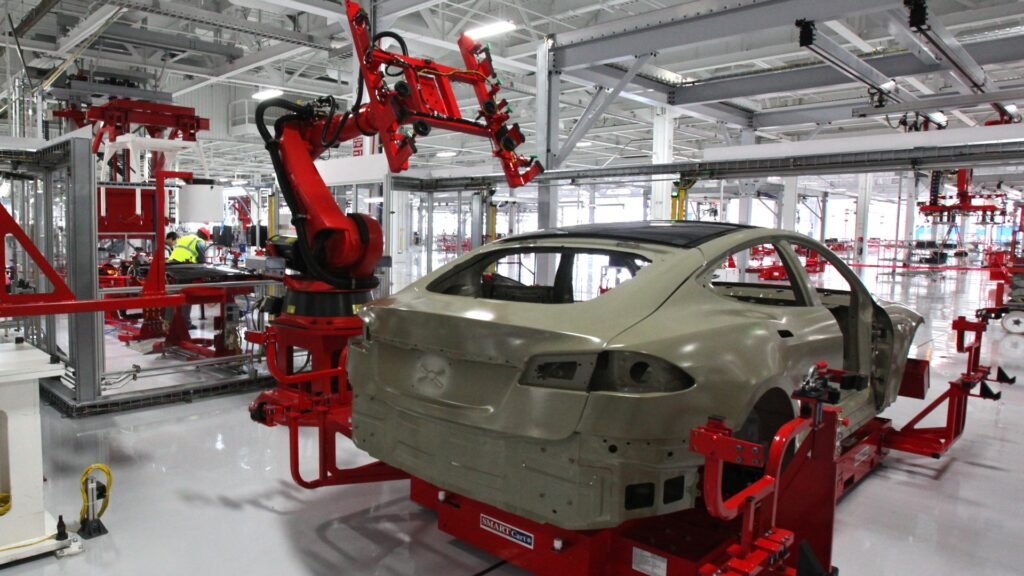
Two side stories matter as much as the delivery figure. First, Tesla’s energy-storage business is expected to hit 15.9 GWh for the quarter — up 27% year over year — and it’s quietly becoming the growth engine the car business no longer is. Second, Musk has already begun sacrificing cars for robots: Tesla discontinued the Model S and Model X to free up Fremont factory capacity for humanoid robots.
Cox Automotive’s Stephanie Valdez Streaty calls new EV sales “stabilizing” but says hybrids are “the clearest growth story” — a Toyota win, and a problem for Detroit and the pure-EV players alike.
Why this matters
The headline number will be “Tesla down 7%,” but that misses the real signal. The US decline is cyclical — a tax-credit pull-forward echoing back. The European rebound, if it holds through Germany and the UK data, suggests something structural: Tesla’s brand damage in Europe may finally be healing, and its cars are growing faster than the European EV market again.
Watch the spread between the consensus and the actual — a beat on the depressed 462,000 would matter more than the absolute number. And watch the energy line: 15.9 GWh would mean the fastest-growing part of Tesla is no longer the part with wheels.
Meanwhile in Cars & EVs: Ford’s $30K Fathom launch faces its own brutal math problem.
Meanwhile in Tech News: HPE’s $1.2B AI order shows where the industry’s real money is flowing.