The CEO Just Pumped the Brakes
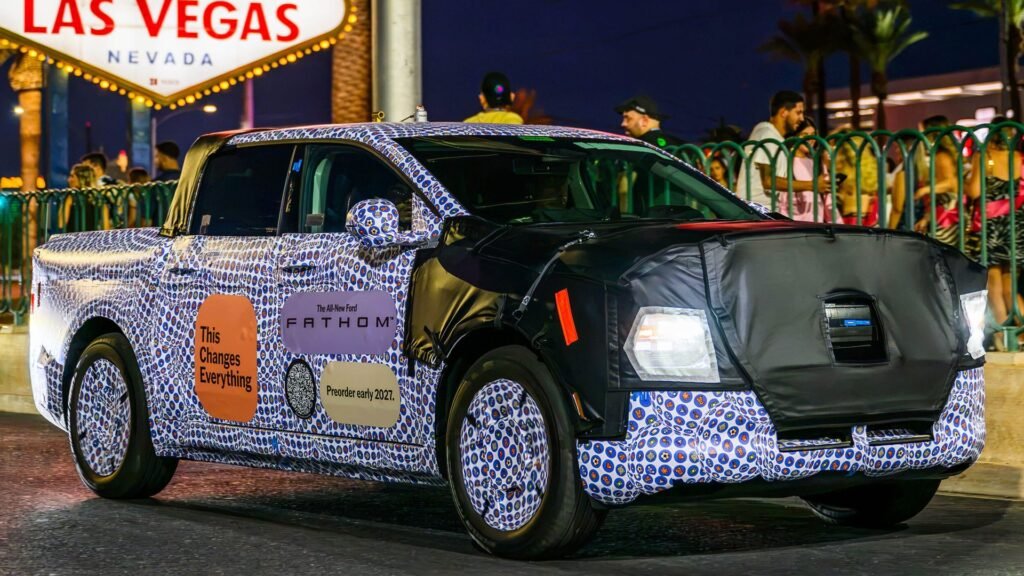
Just last month, Ford said its $30,000 Fathom electric pickup was on track to begin production in the first quarter of 2027. This week, CEO Jim Farley quietly walked that confidence back.
Speaking at the 2026 Automotive News Congress, Farley admitted Ford hasn’t “landed the plane on mass production” of its new Universal Electric Vehicle (UEV) platform — the architecture the Fathom is built on. “It’s going to be a heck of an effort to launch this at scale, at cost, on time,” he said, according to Electrek.
The Fathom is expected to go on sale in early 2027, starting at $28,350 for the standard-range model ($29,945 with destination) — until Ford says otherwise.
The 20% Gap That Started All This
Farley was unusually candid about why the launch is so fragile. At one point, he said, Ford realized a BYD EV would have roughly a 20% cost advantage over the Fathom’s battery alone.
To close that gap, Ford’s engineers reworked the motors, gearboxes, and inverters — shrinking what the battery pack needs to do. Smaller battery, lower cost. Clever on paper. But redesigning your powertrain around a Chinese cost advantage is not exactly the same thing as having a finished production plan.
Alan Clarke, Ford’s vice president of advanced development projects, has described the pricing effort as “incredibly hard,” saying the team was obsessed with cutting costs penny by penny — and had to bring in suppliers Ford had never used before. When your supply chain is brand new, your factory is being gutted and retooled, and your platform isn’t landed yet, “at scale, at cost, on time” starts to look like a wish list.
The 100,000-Truck Problem
Here’s where the numbers get uncomfortable. The Wall Street Journal reported that Ford wants to sell 100,000 Fathoms in its first year — a figure that would instantly make it one of America’s best-selling EVs outside of Tesla.
For context, the F-150 Lightning — Ford’s previous flagship electric truck — never sold more than about 33,000 units in a single year. Ford’s first-year Fathom target is triple the Lightning’s best year, from a 3-million-square-foot Louisville Assembly Plant that is still being retooled, for a vehicle that hasn’t even been officially unveiled yet. Ford has said a full reveal is coming by year-end, with preorders opening early in 2027.
Ford is putting real money behind the bet: $5 billion between the Louisville plant and BlueOval Battery Park in Michigan, with $2 billion earmarked just for retooling Louisville. The spending is serious. The question is whether it buys certainty — or just a more expensive bet.
Why This Matters
Everyone else covering this story is stuck on the timeline wobble. The real story is the arithmetic.
Ford is trying to do three things at once that almost nobody has done before: launch a brand-new manufacturing process (its “assembly tree” method), hit a sub-$30,000 price point in a post-tax-credit market, and scale to 100,000 units a year with a supply chain it just invented. The 20% BYD battery gap is the tell — Farley is pricing the Fathom against Chinese costs, but building it with American factories and first-time suppliers. Those two realities are on a collision course.
And the clock isn’t friendly. Slate’s $26,400 electric truck — cheaper than the Fathom — is racing for the same budget-buyer lane. If Ford slips into 2028, it won’t just be late. It’ll be late and second.
The Fathom was supposed to be Ford’s “Model T moment.” Right now, it looks more like a math problem Ford hasn’t finished solving.
Meanwhile in AI Tech: OpenAI’s GPT-6.1 Is Out — and So Is the Price Tag
Meanwhile in Tech News: Trump Summons AI CEOs to the White House: Guardrails vs. Speed