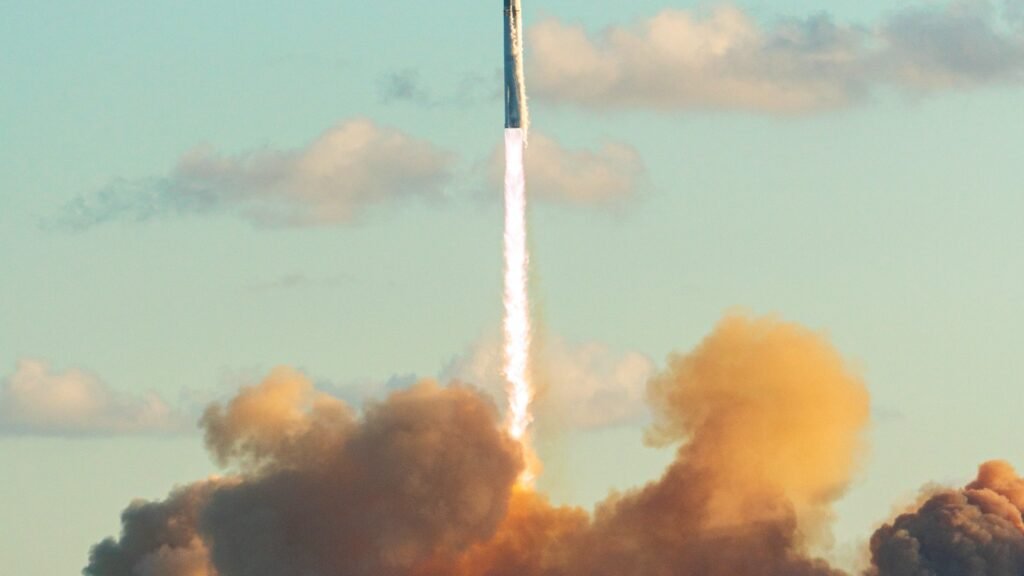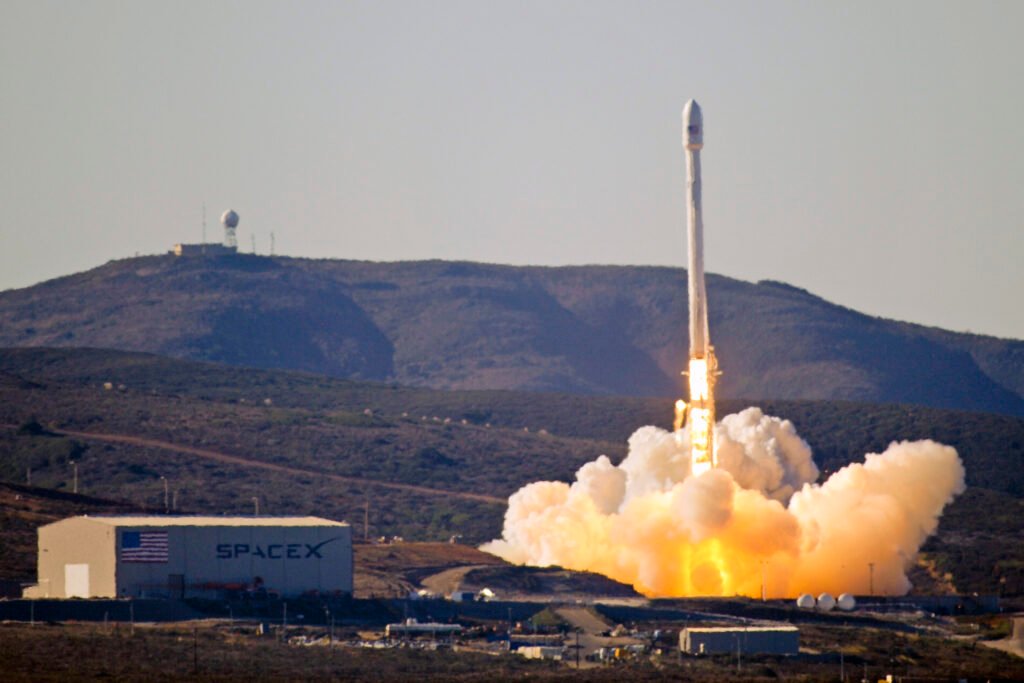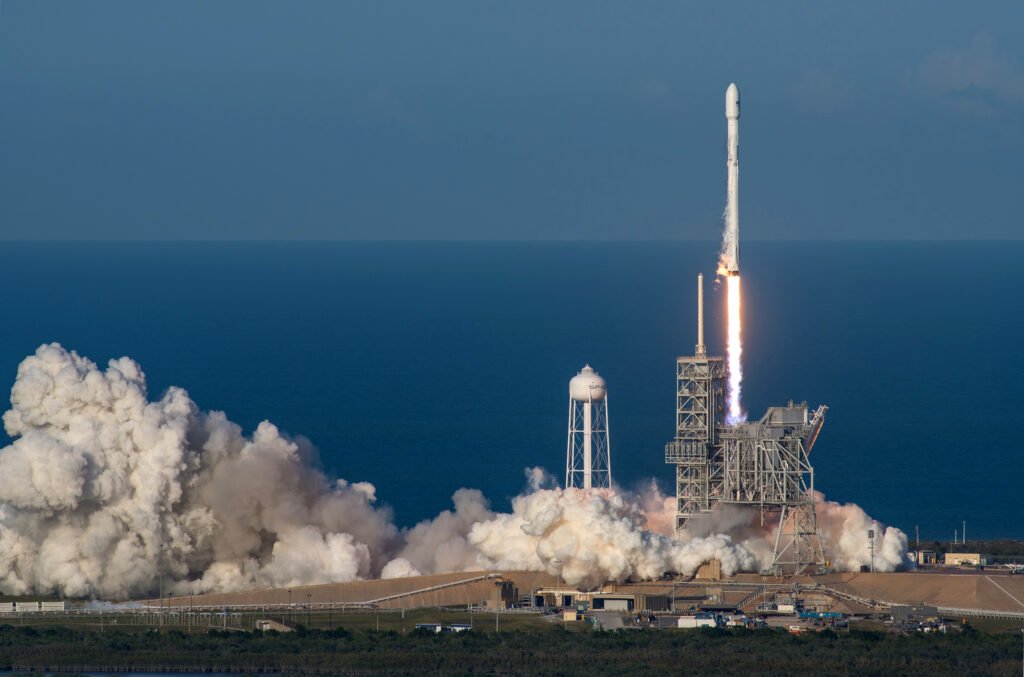
On Thursday, a single SpaceX Falcon 9 will carry two completely different answers to the same question: should AI compute in space? Riding aboard the Transporter-18 rideshare mission from Vandenberg are Google’s Suncatcher prototype — four TPUs testing whether AI chips can survive orbit — and MOI-1A, an Indian startup’s satellite that already has 23 paying customers waiting for it.
One is a moonshot. The other is a business. They’re launching on the same rocket.
The Moonshot: Google’s Suncatcher
Google’s payload is a refrigerator-size prototype satellite called MVP, built with Planet, carrying four of Google’s custom Tensor Processing Units and roughly a kilowatt of solar panels. The mission is deliberately narrow: find out whether commercial AI accelerators survive launch vibration, radiation, and the thermal violence of low Earth orbit over a one-year mission.
The physics case is straightforward. In the right orbit, solar panels can generate power around the clock with no atmosphere or clouds in the way — Google Research has said orbital panels could produce up to eight times more energy than the same panels on the ground. With AI data-center power demand up roughly 50% in 2025 alone and US utilities years behind on new capacity, a data center where the sun never sets looks less like science fiction and more like a hedge. The catch, as one technical breakdown notes: the chips reportedly run about 15 minutes before needing to shut down and cool. This flight is a survival test, not a data center.
The Business: TakeMe2Space’s MOI-1A
The other payload comes from Indian startup TakeMe2Space, and it could hardly be more different. According to Reuters’ exclusive reporting, the sub-50-kilogram MOI-1A carries Nvidia Orin NX edge-computing processors and multispectral imagers — and the company has already signed 23 customers, including GIS firms, educational institutions, and US-based space data analytics firm Little Place Labs.
The pitch: customers upload containerized AI models to the satellite, which processes Earth-observation data as it passes over a target area and downlinks only the analysis — not the raw dataset. “The customer who sees value in our first-generation satellites is the one paying to download a lot of raw data and then do the compute,” founder and CEO Ronak Samantray told Reuters. “The reduction in the cost of not downloading it offsets the premium they pay for compute in orbit.” Commercial users span agriculture, mining, supply-chain management, and insurance. The whole spacecraft runs on about 150 watts — a rounding error next to a terrestrial data center.
Two Philosophies, One Launch Manifest
Put them side by side and the contrast is the story. Google is testing whether the hardware can survive; TakeMe2Space is testing whether the business model works. Google’s path leads to laser-linked constellations (a two-satellite comms test is slated for 2027) and eventually orbital data centers; TakeMe2Space’s leads to larger networked satellites serving multiple customers. Both face the same skeptics — and both share a ride with dozens of other payloads on SpaceX’s workhorse rideshare, which is itself the reason either of them can afford to try.
Longer term, the field is already stratifying: SpaceX’s own Starcloud concept and others plan to fly data-center-class Nvidia chips, a different league from MOI-1A’s edge processors or Suncatcher’s four TPUs.
Why this matters
Every outlet will cover these as two separate launches that happen to share a rocket. The real story is that Thursday is the first head-to-head test of orbital computing’s two competing theories: build the mega-constellation and the economics will follow (Google), or sell the compute before the constellation exists (TakeMe2Space). One of these companies has 23 customers and 150 watts. The other has four TPUs and a moonshot budget. By Friday, both will be in orbit — and the scoreboard for space-based AI starts getting real.
Meanwhile in Space: our deep dive on Google’s Suncatcher announcement — the backstory on Thursday’s launch. And the classified USSF-385 Space Force launch.