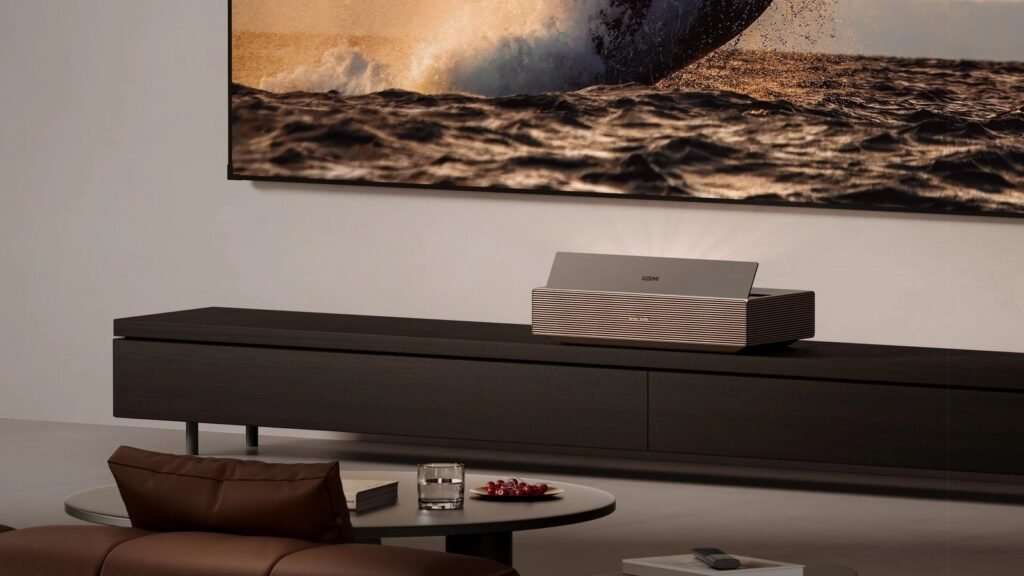
A projector just pulled off one of the fastest crowdfunding runs ever — and the price tag, not the projector, may be the real reason. XGIMI’s AURA 3 Series of ultra-short-throw laser TVs launched on Kickstarter on October 20 and passed $15 million in pledges within 23 hours, from more than 5,800 backers. The campaign hit $10 million in just two hours.
The Fastest $10 Million in Kickstarter History
According to XGIMI’s announcement, the two-hour sprint to $10 million sets a new Kickstarter record for the fastest campaign to reach that milestone. Read the fine print, though: the record is about speed, not size. XGIMI’s own TITAN Noir projector series raised $19.37 million in total on Kickstarter, a figure the company itself cites — so the AURA 3’s achievement is velocity, a stampede of early buyers, rather than the largest projector haul ever.
What those buyers are getting is genuinely serious hardware. The flagship AURA 3 Max outputs 5,700 ISO lumens with an 8,000:1 native contrast ratio, while the AURA 3 Pro manages 4,100 lumens and 7,000:1. Both use an RGB triple-laser light source, and both are the first ultra-short-throw projectors to offer true 4K at 120Hz, enabled by Texas Instruments’ dual-controller architecture. Gaming credentials include variable refresh rate, auto low-latency mode, and AMD FreeSync Premium, alongside Dolby Vision, HDR10+, and IMAX Enhanced support. A 0.163:1 throw ratio throws a 120-inch image from about eight inches away from the wall, scaling up to 200 inches, and an 80-watt Harman Kardon speaker system handles the audio. Google TV is built in, so no streaming dongle is required.
The Discount Is the Product
Here is the part of the story the headline number obscures: the AURA 3 Max costs $2,399 for Kickstarter backers against a $4,999 list price, and the Pro costs $2,199 against $3,999 — savings of up to $2,600. Early deposit holders pay even less, $2,199 and $1,999 respectively. As Notebookcheck reported when U.S. pre-orders opened, the Kickstarter pricing sits at less than half of retail — and bundles stretch the gap further, with a Max plus 120-inch floor-rising screen at $4,999 against an $8,998 list price.
That reframes what this “record” actually is. XGIMI, founded in 2013, is not a startup begging for prototype funding; it is an established brand using Kickstarter as a launch-discount channel, bypassing retail margins to sell direct at a price no store could match. Backers are not really funding a dream — they are pre-ordering a finished product at half price, and the $10 million in two hours is what happens when a known brand offers that deal to a waiting list. The campaign runs through December 4, 2026, with projector shipments expected to begin in December and screens following in January and February 2027 — so backers should remember that Kickstarter pledges are not retail purchases, and delivery dates on crowdfunding campaigns can slip.
Why This Matters
The AURA 3’s stampede matters beyond projectors. A 120-inch to 200-inch image that needs no wall mounting, no ceiling rig, and no separate speakers — now with genuine 4K 120Hz gaming — is a direct challenge to big-screen OLED TVs, which cannot touch that size at anything near this price. And XGIMI’s playbook matters more: if established hardware brands can reliably raise eight figures in a day by selling direct through crowdfunding at half of retail, expect more of them to skip the traditional launch window entirely. The risk for buyers is the flip side of the discount — you are trading retail protections and immediate availability for a price, and a shipping estimate. For the home-theater market, though, the message is clear: the wall-sized screen is no longer a luxury project, and the next price war in the living room may be fought on Kickstarter, not in stores.
Meanwhile in Gadgets:
Big-screen living-room tech is having a moment — see Apple’s HomeView smart-home hub and its household-face-recognition pitch — and if your budget is closer to a hundred dollars than a few thousand, Bose’s $99 noise-cancelling wired earbuds are the opposite end of the gadget spectrum.