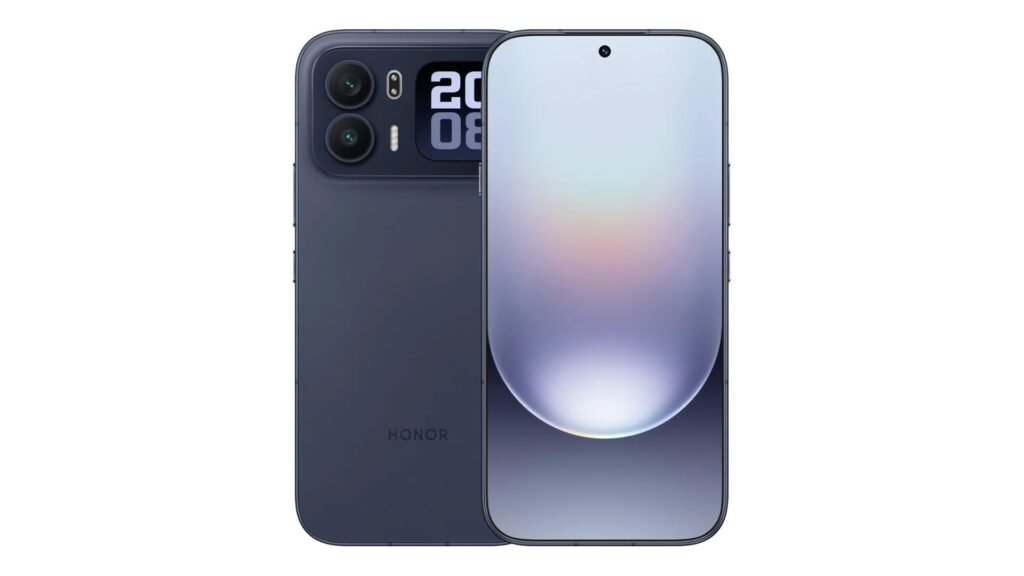
Honor has launched the Honor 700 series in China, and every model in the range carries the same surprise: a small square screen on the back of the phone. The 1.59-inch rear display sits beside the camera module on the Honor 700, Honor 700 Pro and Honor 700S, and unlike the novelty second screens of the past, this one has a job to do. It doubles as a viewfinder for the rear cameras — and as a health sensor that reads your pulse through the back of the phone.
The series was unveiled at a launch event in Wuhan on Sunday, November 23, with sales in China starting on November 27. GSMArena reports that all three phones share the rear screen, a 200MP main camera and a 9,000mAh battery, with prices starting at CNY 3,399 (about $509) for the Honor 700S and CNY 3,699 (about $554) for the Honor 700. Honor has not said when — or whether — the range will reach markets outside China.
A Second Screen With Something to Do
The rear panel, which Honor calls Floating Island, is a square touch display set into the rear camera island, finished with floating glass so it sits flush with the back of the phone. Beyond showing the time and notifications, it can be customised with wallpapers and AI pets, and it works as a fully functional viewfinder, letting you frame selfies with the far stronger rear cameras instead of the front one.
The clever part is what sits underneath it. The Honor 700 and 700 Pro carry a dedicated optical PPG sensor behind the rear display. Press a finger to the panel for about a minute and the phone reports heart rate, blood oxygen and heart-rate variability, along with an assessment of stress and emotional state. It is the first time a mainstream phone has turned its back panel into a health sensor.
9,000mAh and a 200MP Camera for $509
The rest of the specification sheet reads like a flagship that lost its price tag. Both the Honor 700 and 700 Pro pair the 200MP main camera with a 12MP ultrawide and a 50MP periscope telephoto offering 3.5x optical zoom, plus a 50MP selfie camera up front. The 6.57-inch AMOLED display runs at 120Hz with a 1.5K resolution, and all three models ship with MagicOS 11 on Android 17 and IP69K dust and water resistance.
Under the skin, the Honor 700 runs Qualcomm’s Snapdragon 8s Gen 4, the Pro steps up to the Snapdragon 8 Gen 5, and the 700S uses the Snapdragon 7 Gen 4. Every model carries the same 9,000mAh silicon-carbon battery with 80W wired charging — the Pro adds 50W wireless charging — packed into a body just 7.96mm thick. Notebookcheck reports the Honor 700 Pro starts at CNY 4,599 (about $689), putting the whole range well under the price of a conventional flagship.
Why This Matters
Here is what the spec-sheet coverage misses: rear screens have been tried before and mostly failed because they were decoration. Honor’s version earns its place by doing something the main screen cannot — measuring your health from the back of the phone while doubling as a selfie viewfinder. It is a genuinely new use for a phone’s most underused surface, and it arrives at a mid-range price, not a flagship one.
The timing matters too. Xiaomi’s 18 Pro went global this same week with its own rear display, which means two rear-screen phones launched within days of each other. That is no coincidence — it is the start of a design race, and Honor is the first to give the second screen a purpose beyond looking clever. The open question is whether the rear panel becomes a real product category or another curiosity: a 9,000mAh battery and a 200MP camera at $509 suggest Honor is betting the mid-range is where phone design actually moves now, while flagships iterate. If the 700 series ever leaves China, the phones it undercuts will have a problem.
Meanwhile in Mobiles: Xiaomi’s 18 Pro went global this week with a rear display of its own — and the OnePlus 16 also packed in a 9,000mAh battery.