The Charger That Dwarfs Everything Else on the Road
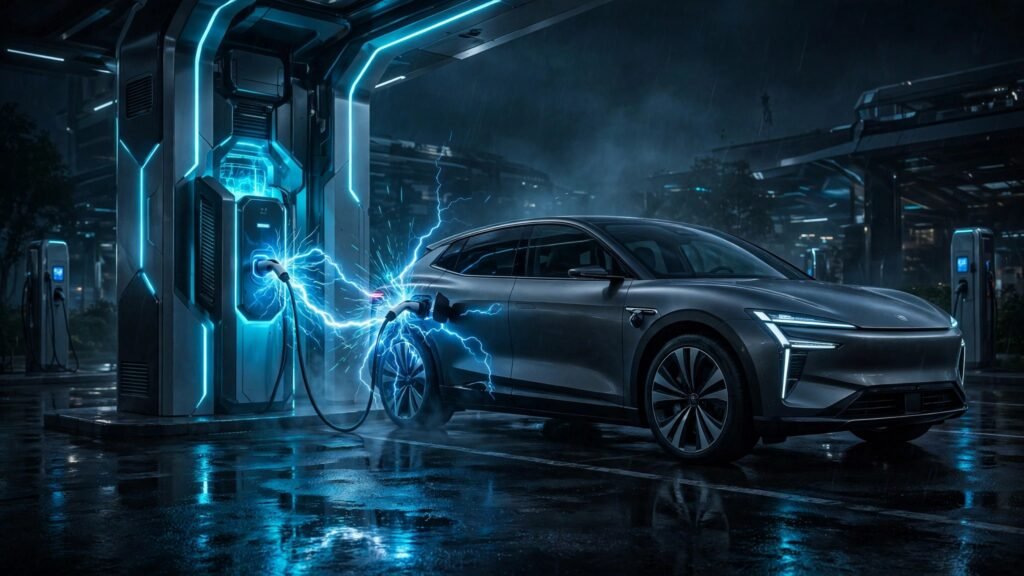
The system was revealed on September 23 at Geely’s Global All-Domain Safety Center in Ningbo, China — the event the company teased over the weekend with the slogan “Charge in four minutes, drive with peace of mind.” According to Electrek, the 2.2 MW peak output is about 50% faster than BYD’s 1.5 MW Flash Charging 2.0 and nearly double Tesla’s 1.2 MW Megacharger — a unit built for trucks, not passenger cars.
For American readers, the gap is even wider. Nothing available in the United States comes close — Geely’s figure is roughly six times faster than the fastest charging any US driver can currently access. The technology stacks three things together: an AI large-model battery management system, an all-domain 800V platform, and 6C ultra-fast charging cells. Geely also claims the setup can survive roughly 3,500 charge cycles with limited degradation, though as with the headline figure, that is the company’s claim, not an independently verified number.
The Four-Minute Claim Is a Promise, Not a Measurement
Here is where the skepticism belongs. Geely has not disclosed which state-of-charge window the “four minutes” refers to — 10–70%? 10–80%? A top-up over a narrow band? It is unspecified. RusSpain, confirming the reveal, frames the four-minute full-charge figure as the company’s own claim, and that is how it should be read until Geely publishes the actual charge curve.
Charging claims in this industry have a history of aggressive framing — peak rates, short windows, and ideal conditions can all make a number look better than the real-world experience. A 2.2 MW peak is a genuine technical achievement, but what matters to drivers is sustained power across a useful charge window. Until Geely answers that question, treat the four minutes as marketing with potential, not a fact.
First Stop: The Updated Galaxy E5
The first vehicle to get the new charging technology is the updated Geely Galaxy E5, which debuted the same day. It rides on an 800V rear-wheel-drive architecture and packs Geely’s new Aegis Short Blade battery in 61.52 and 70.01 kWh capacities, rated for 550–635 km of CLTC range.
The key detail for American readers: this is a China-only product, at least for now. Geely does not sell passenger cars in the US, and there is no indication this charging hardware is coming to American shores. The significance is competitive — the gap between what Chinese drivers are being promised and what the rest of the world can buy keeps getting wider.
Why This Matters
Even with the caveats, a 2.2 MW peak is a serious marker of where EV charging is headed. Ultra-fast charging erases one of the last real friction points of EV ownership — the long road-trip stop — and the company that makes a “gas-station-like” charging stop real first will have a genuine selling advantage.
But the bigger story may be the pressure it puts on everyone else. BYD, Tesla, and the rest of the industry now have to answer Geely’s number, and the next round of the charging race could bring meaningful improvements to cars ordinary buyers actually drive — eventually even outside China.
Meanwhile in Cars & EVs: Saudi Arabia’s Ceer Unveils 1,111-HP Exobot EV Sedan and SUV — the Middle East’s EV ambitions are heating up with a power figure that rivals hypercars.
Meanwhile in Tech News: AMD’s $1 trillion market-cap AI chip rally — the silicon arms race behind everything from AI data centers to next-gen EV compute continues.