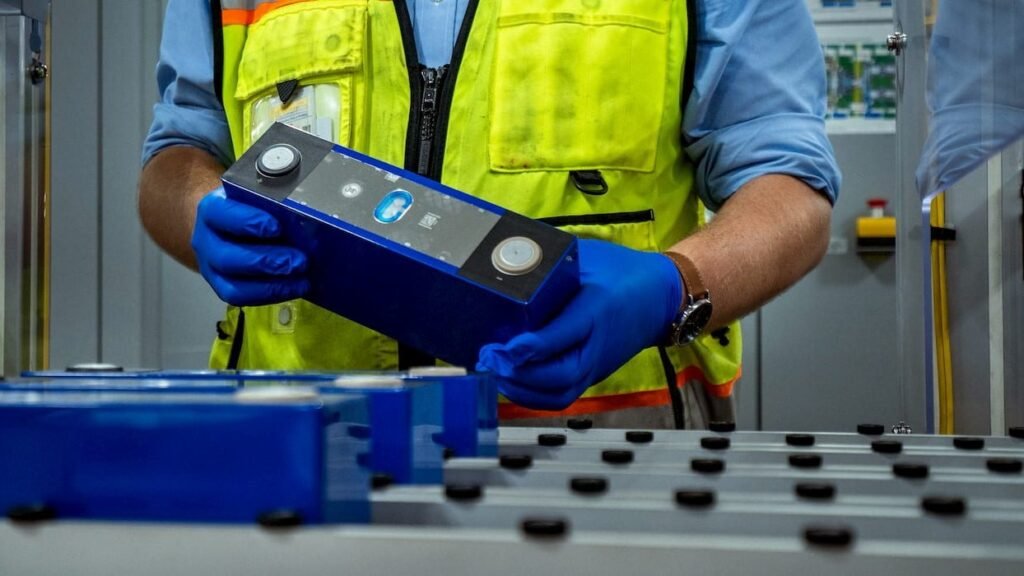
Ford has started producing its first lithium iron phosphate (LFP) battery cells at BlueOval Battery Park Michigan in Marshall, Michigan — and the cells are already on their way to Louisville, Kentucky, to power prototypes of the $28,350 Fathom electric pickup. It is the first time a mainstream American automaker has built LFP cells on US soil.
Electrek reports the cells began rolling off the line on 18 November 2026, at 40 cells every minute — which Ford calls one of the fastest LFP prismatic battery assembly lines outside China. The cells are headed to Ford’s Louisville Assembly Plant, where the first Fathom prototypes are being built.
Made in Michigan — licensed from Beijing
Here is the contradiction at the heart of the milestone. The plant is owned and operated by Ford, but the technology inside it is licensed from China’s CATL, the world’s largest EV battery maker. The cells are American-built; the chemistry and manufacturing know-how are not.
Washington has noticed. Reuters reports that US Transportation Secretary Sean Duffy wrote to CEO Jim Farley in September 2026 saying his agency was “deeply alarmed” by Ford’s reliance on licensed CATL technology. Ford insists the plant is a step toward American battery independence, but its first cells exist only because of a licensing deal with the Chinese company it is supposed to be competing against. That tension — “Made in Michigan” versus “licensed from Beijing” — is the story the straight milestone coverage does not lead with.
The cost math behind the $28,350 price
The Fathom’s headline price is not a marketing trick; it is a chemistry decision. LFP cells use no nickel and no cobalt, two of the most expensive and supply-constrained ingredients in a conventional EV battery. The cells are prismatic — flat, rectangular blocks that slot directly into the chassis — cutting structural parts and assembly costs. Ford says its goal is to make defective cells so rare that it tracks their frequency “per billion cells rather than per million.”
That is the mechanism behind the $28,350 starting price for the standard-range model, with preorders opening in early 2027 and launch on track for the fourth quarter of 2027, according to Farley’s comments on the Q3 earnings call. Ford also says the Fathom will offer more interior space than a Toyota RAV4 and cost less to own over five years than a three-year-old used Tesla Model Y. What Ford has not revealed is the battery capacity, EPA range or charging speed of the production truck — any range claim you see before Ford publishes those numbers is guesswork.
A rebuild from near zero
The stakes for Ford could hardly be higher. TechXova’s own October sales coverage found Ford sold just 1,355 EVs in the US in October 2026, down 71.2% year over year — and not a single F-150 Lightning after production ended. EVs were 0.8% of Ford’s October US sales.
That is the context the Fathom has to be understood in: not another model launch from a healthy EV business, but Ford trying to rebuild its electric operation from almost nothing. The pack plant in Marshall is due up and running in 2027, ahead of the Fathom launch, and Ford says it will use the Michigan know-how for more affordable EVs — and for Ford Energy, its new battery storage business in Kentucky.
Why this matters
Every cheap EV story comes down to the battery, and Ford has bet its EV future on the cheapest proven chemistry there is. If the Marshall plant hits its quality targets at scale — 40 cells a minute, defects measured per billion — the Fathom could genuinely undercut every rival on price. But the bet carries a political risk no engineering target can fix: the cells depend on a Chinese license at the exact moment Washington is questioning that dependence. The first cells are off the line. The harder test — building them at scale, at cost, without the CATL question blowing up — starts now.
Meanwhile in Cars & EVs: Global EV Sales Are Growing Again — But America’s ‘Rebound’ Is a Mirage
Meanwhile in Cars & EVs: Tesla Semi Fire Shuts I-880 for 10 Hours — With No Crash to Blame