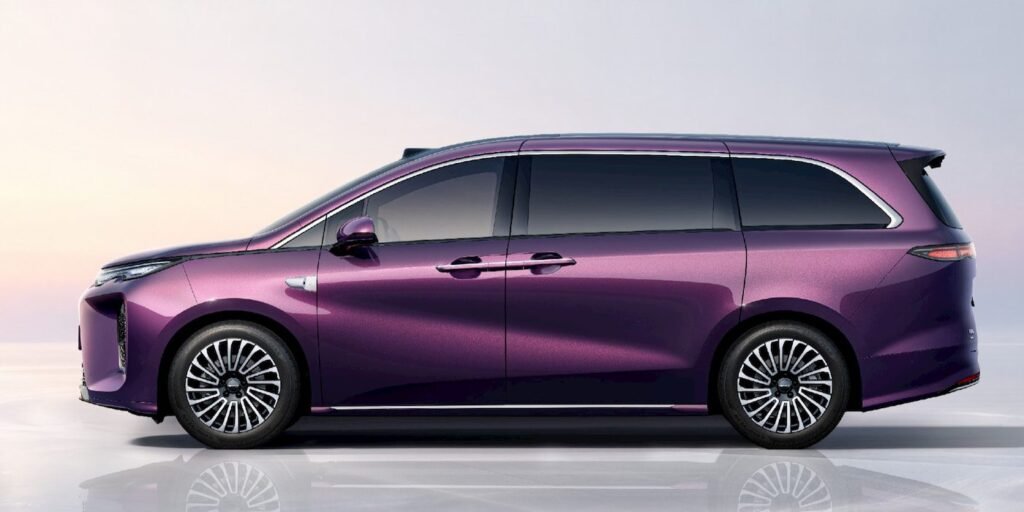
BYD has a new flagship, and it is not a sports car or a luxury sedan. The Chinese automaker unveiled the Whale, a full-size electric minivan, at the Guangzhou Auto Show on November 27 — a seven-seater claiming more than 559 miles (900 km) of range and a five-minute charge. Electrek reports the Whale is the first flagship multi-purpose vehicle in BYD’s Ocean series, and it goes on sale in China in the first quarter of 2027.
On paper, it is the most capable electric family vehicle anyone has announced: a van bigger than a Chrysler Pacifica, seating for seven, a roof-mounted LiDAR sensor, and charging speeds that make a gas station stop look slow. The catch is the obvious one — BYD does not sell passenger cars in the United States, and no American launch was announced. But the Whale still matters here, because it shows exactly what the electric minivan could be, and how far behind the US market is.
Bigger Than a Pacifica, Quicker Than a Coffee Stop
The Whale lives up to its name. At 17.3 feet long, 6.5 feet wide and 6 feet tall, with a 123-inch wheelbase, it is bigger than a Honda Odyssey, bigger than a Chrysler Pacifica and bigger than a Toyota Sienna — and slightly longer than the Pacifica, according to Electrek. BYD’s own materials claim room for seven passengers and seven suitcases at a time, though the company has not shown the interior yet.
Both versions use BYD’s latest Blade Battery 2.0. The pure-electric model claims more than 559 miles of range; the plug-in hybrid offers 248 miles of electric-only driving before its gas engine steps in. With BYD’s Flash Charging, the electric version goes from 10% to 70% in five minutes and 10% to 97% in nine — and even at -22°F, a full recharge takes just 12 minutes. A roof sensor cluster houses LiDAR for BYD’s latest driver-assistance system.
The 559-Mile Number Needs Translating
Before getting carried away, it is worth translating the headline figure. The 559 miles comes from China’s CLTC test cycle, which is far more generous than the US EPA’s testing. Applying the usual roughly 20% discount puts the Whale closer to 450 miles on an EPA-style test — still an enormous number for a vehicle this size, and more than double the real-world range of the only electric minivan Americans can actually buy.
That comparison is the damning one. The Verge noted that VW’s ID. Buzz managed only about 200 miles of real-world driving in 2023 — one figure driven, the other merely announced, but the gap is so large that even a pessimistic reading of the Whale leaves it far ahead. The plug-in hybrid may be the more interesting version for real families: 248 miles of electric-only range covers nearly every daily routine on battery alone, with gas as the backup.
Why This Matters
The minivan is the segment the EV transition forgot. Toyota’s Sienna, Honda’s Odyssey and Chrysler’s Pacifica have no fully electric versions, and the one retro-styled attempt, the ID. Buzz, arrived with a range that made road trips a planning exercise. The Whale shows what happens when a manufacturer treats the minivan as a flagship instead of an afterthought: a huge battery fits easily under a van floor, giving a family vehicle more range than most electric SUVs.
Americans cannot buy one — at least not yet. The Whale is expected to start at around 300,000 yuan, roughly $45,000, at its China launch early next year, and BYD has announced no plans to sell it in the US. But the technology inside it will not stay in China: Blade Battery 2.0 and five-minute charging are the kind of advances that spread across the industry, and US automakers still deciding whether families want electric vans just got their answer. The question is no longer whether a 559-mile electric minivan is possible. It is who will build the American one first.
Meanwhile in Cars & EVs: Suzuki’s new Ignis EV runs on BYD battery cells — the same battery family, shrunk into a city car. And VW is discounting the ID.4 by $12,500 in the US.