What Bezos Actually Said
Jeff Bezos gave his clearest signal yet that Blue Origin is headed for the public markets. Speaking to Fox News’ “Special Report with Bret Baier” on October 7 from Blue Origin’s Florida factory, Bezos said that after the company’s first-ever outside funding round — $10 billion raised — it “probably makes sense for Blue Origin to be a public company at some point.” The caveat: not until “several years from now.” As Reuters reports, it’s the most direct IPO language Bezos has ever used about the company he founded in 2000 and has personally funded to the tune of $28 billion.
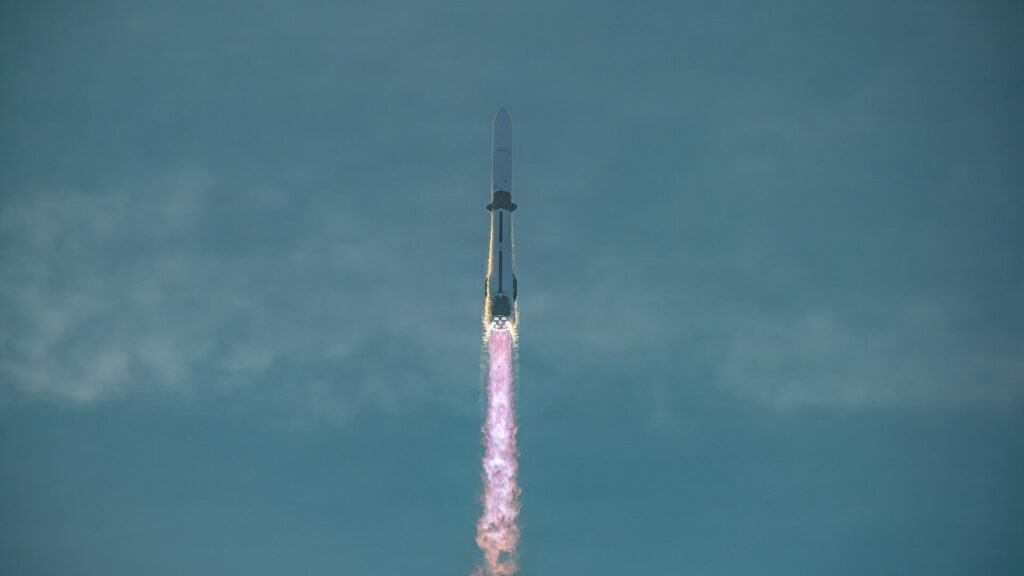
The context is a company finally spending like it means it. Bloomberg reports the September raise valued Blue Origin at $140 billion. Separately, Bezos confirmed New Glenn — the heavy-lift rocket meant to rival SpaceX’s Falcon 9 — is expected to fly again in December 2026, after a May explosion destroyed the rocket and its launchpad. The December return-to-flight isn’t just a technical milestone; it’s the credibility test the IPO narrative depends on.
The Head-to-Head: $140B vs the Public Giant
Here’s the comparison the straight-news rewrites never build. Blue Origin: $140 billion private valuation, one orbital-class rocket still proving itself, first outside capital ever, IPO “several years” out. SpaceX: publicly listed since June 2026, flying Falcon 9 at a cadence no competitor touches, with Starship iterating toward full reusability. New Glenn’s December flight has to go right not just for Blue Origin’s manifest, but because every quarter SpaceX flies and Blue Origin doesn’t, the valuation gap gets harder to defend.
The real contest underneath is contracts. Both companies are chasing the same finite pool: Artemis lunar missions, national-security launches, and the coming wave of commercial megaconstellation deployments. A public Blue Origin — with public financials, public scrutiny, and public-market pressure to show a launch cadence — changes how aggressively it can bid. SpaceX has lived under that pressure for months now. Bezos just told us Blue Origin is preparing to join it.
Cadence is the quiet killer in this comparison. SpaceX’s Falcon 9 flies weekly; Blue Origin’s New Glenn has yet to establish a rhythm. Rockets are a manufacturing business as much as an engineering one, and until New Glenn flies regularly, the $140 billion valuation rests on promise rather than throughput.
Why This Matters: The Space IPO Race Is On
Two fundable, flyable American rocket companies with public-market ambitions is a genuinely new era. For a decade, “commercial space” meant SpaceX plus a field of hopefuls burning private money. A $140 billion Blue Origin heading for an IPO — alongside this week’s other signal, robot-mower maker FireFly’s Nasdaq filing — says the space industry’s public-market chapter is opening all at once.
Watch December. If New Glenn returns to flight cleanly, Bezos walks into the IPO conversation with a proven heavy-lift vehicle and a $10 billion war chest — and the “several years” timeline starts looking conservative. If it doesn’t, the $140 billion valuation gets its first public stress test before a single share is ever sold.
Meanwhile in Space: SpaceX flew astronauts home this week — Crew-12’s 237-day Dragon mission ended with a Pacific splashdown, the 12th straight Dragon rotation.