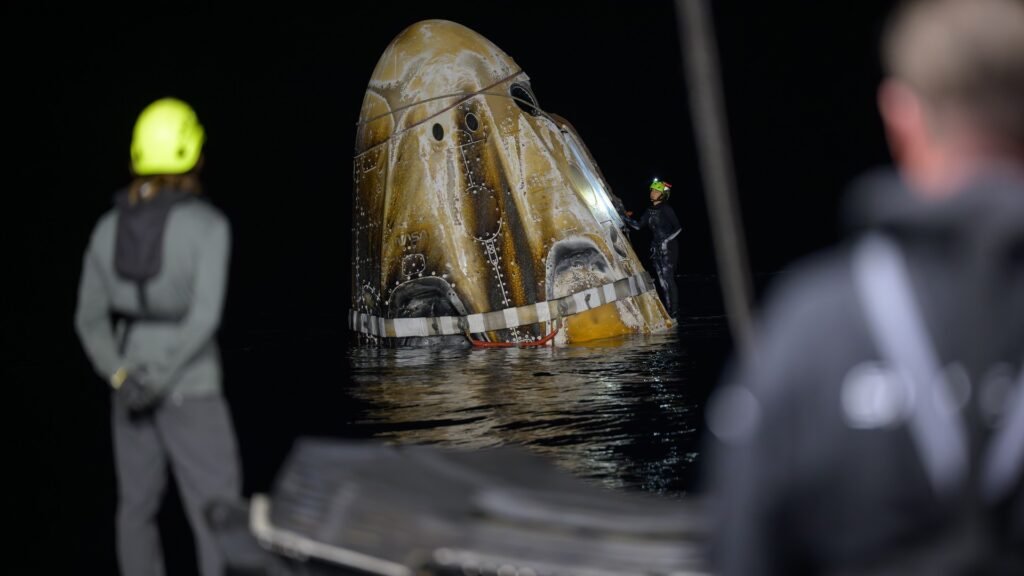
After nearly eight months in orbit, four astronauts are coming home — and when they land, they will touch down somewhere no American crew had landed in decades: off the coast of California.
NASA targeted 8:05 a.m. ET on Wednesday, October 7 for the undocking of SpaceX’s Crew-12 mission from the International Space Station. NASA astronauts Jessica Meir (commander) and Jack Hathaway (pilot), ESA astronaut Sophie Adenot, and Roscosmos cosmonaut Andrey Fedyaev were set to spend roughly 27 and a half hours aboard Crew Dragon Freedom before splashing down in the Pacific Ocean at about 11:34 a.m. ET Thursday, October 8 — weather permitting.
An Eight-Month Mission in One Timeline
The crew launched from Cape Canaveral on February 13, 2026, and docked the next day. Their time aboard included hundreds of science experiments, station maintenance, and four spacewalks between Meir and Adenot. On Sunday, October 4, Meir handed command of the station to Roscosmos cosmonaut Pyotr Dubrov in a change-of-command ceremony — and the station’s population briefly swelled to 11 after Crew-13 arrived on October 1 with their replacements.
Why the West Coast?
Here is the part the “watch live” coverage skips. For years, Crew Dragon splashdowns happened off Florida. SpaceX moved its recovery operations to the West Coast, and Crew-12’s Pacific landing is the new normal: the recovery ship, calmer open-ocean recovery zones, and NASA’s preference for Pacific splashdowns — which also keeps the returning capsule’s flight path over open water rather than populated land. Splashing down at 11:34 a.m. Eastern on a Thursday means the crew goes from orbital mechanics to Pacific swells in just over a day.
The return nearly slipped: NASA had originally targeted an earlier departure but pushed it to October 7 after reviewing splashdown-zone weather off California — the same weather-driven caution that has repeatedly reshaped crew-return schedules.
What the 27-Hour Return Looks Like
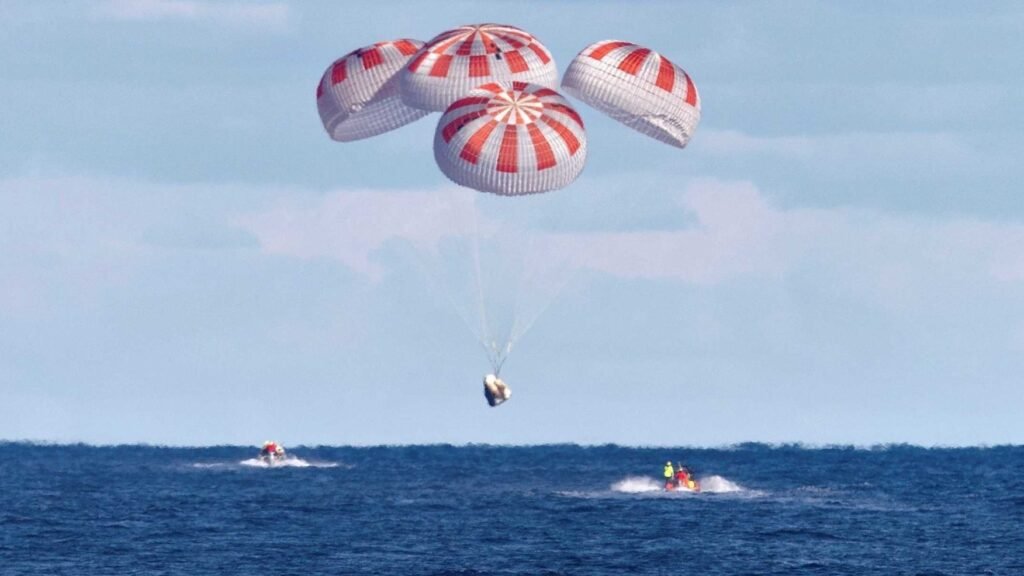
After undocking, Freedom will back away from the station with a series of departure burns, then orbit Earth for just over a day while the crew rests and prepares for reentry. The trunk gets jettisoned, a deorbit burn commits the capsule to the atmosphere, and then comes the familiar violence of reentry — plasma blackout, drogue chutes, then four main parachutes — before a splashdown in the Pacific where a SpaceX recovery ship will be waiting to hoist the capsule aboard and pull the crew out onto the deck.
Why This Matters
The commodity version of this story is a livestream link. The substantive version is about how routine human spaceflight has become — and how its geography is quietly changing. A crew rotation that once dominated global headlines now happens as one of several SpaceX missions in a single busy week, alongside satellite launches and classified payloads. The California splashdown is also a logistics tell: as commercial space stations approach and crew traffic increases, recovery infrastructure is consolidating on the West Coast for the long haul. Crew-12’s return is unremarkable in the best possible way — the machine works, the crew is healthy, and the next rotation is already aboard. That is what a mature space program looks like.
Meanwhile in Space: SpaceX’s latest Pentagon launch is quietly rewiring how America fights from space. Meanwhile in Space: Artemis III could launch by June 2027 — if SpaceX and Blue Origin clear these milestones.