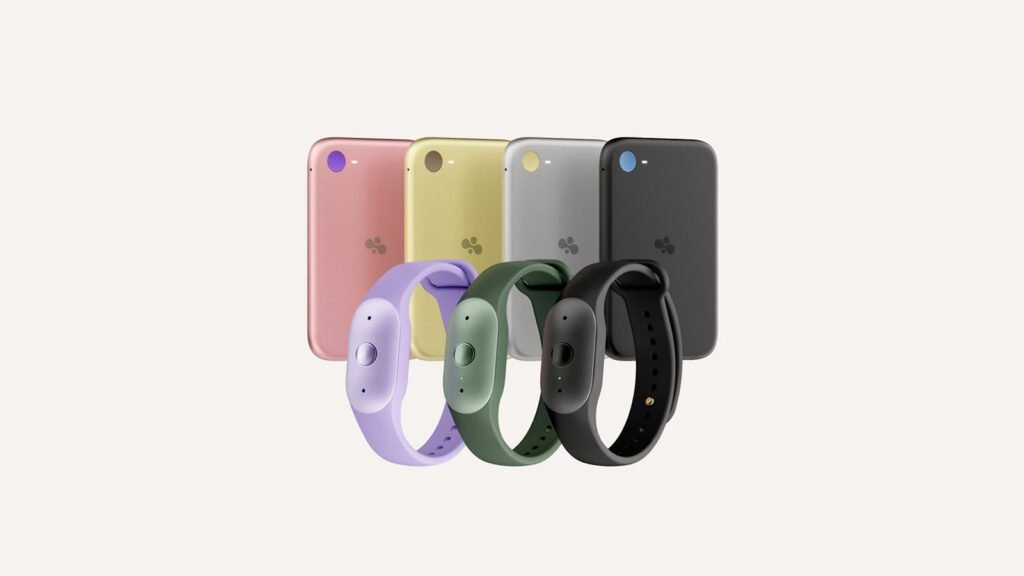
Amazon is betting that you’ll pay $75 for a device whose entire job is listening to your day. On October 15, at the TechCrunch Disrupt conference in San Francisco, devices chief Panos Panay unveiled two always-listening AI wearables under the Bee brand Amazon acquired last year: the $75 Frontier, a bracelet that can also detach and be worn as a pendant, and the $100 Eclipse, a card-sized block that sticks magnetically to the back of a phone.
The pitch is simple. The devices listen to your conversations, pull in data from your calendars and apps, and turn it all into summaries, reminders, and to-do lists. “They listen to your whole day,” Panay said, according to Reuters. “It reminds you of the conversations you had. It reminds you of to-dos that you may have had. It tells you that you have some action items that you committed to other people.” No note-taking, no setting reminders — the idea is you stay present while the device remembers for you.
The $75 Catch
Here’s where the launch gets interesting. The devices work without a subscription — technically. But Bee keeps your data for only 14 days by default, and USA Today reports that extending that window costs $12 a month for Bee Pro. The Pro tier also unlocks unlimited conversation summaries, a desktop app that can record Zoom calls, and integrations with Gmail, Google Calendar, Outlook, and Alexa+, Amazon’s paid generative-AI voice service.
So the real pricing isn’t $75. It’s $75 plus $12 a month if you want the device to actually remember anything beyond two weeks — which is the entire point of a device that listens to your whole day. Amazon learned from Humane’s $699 Ai Pin disaster that AI wearables die at premium prices, but the subscription quietly moves the cost back up. Existing Bee owners keep their old features without the paywall; new buyers face it.
The Trust Question
None of this exists in a vacuum. In 2019, reports revealed that thousands of contractors were listening to Alexa voice recordings, and Amazon still faces a class-action lawsuit over the practice — which it has denied wrongdoing in. Now the same company is asking you to wear a microphone all day.
Amazon knows it. The privacy controls are front and center: users decide when the devices are switched on, individual insights and whole conversations can be deleted, and the company says it doesn’t store audio at all — raw audio is processed in real time and deleted, with transcripts encrypted using keys held by the device itself. Reuters, notably, couldn’t pin down exactly what data the 14-day retention period covers. “You have to give customers that control,” Panay said at Disrupt. Whether buyers believe him after the Alexa years is the launch’s real test.
Why This Matters
The commodity take on this story is “Amazon launches two cheap AI wearables.” The sharper read is that Bee is Amazon’s attempt to build a memory layer that feeds everything else it sells. Connect the devices to Alexa+, and yesterday’s meeting notes become hands-free queries. Mention a book in conversation, and the suggested purchase is one tap away. A device that listens to your whole day doesn’t just sell hardware — it sells a constant, passive stream of purchase intent.
Panay used the same Disrupt stage to argue that ambient devices will eventually replace apps altogether, with AI inferring what you need instead of waiting for commands. That vision is why Bee matters more than the $75 price tag suggests: this is Amazon’s cheapest-ever bet on always-on sensing, aimed at mainstream buyers rather than early adopters, and priced low enough to make the surveillance-for-convenience trade feel casual. The competition — Meta’s Muse Charm pendant, Plaud’s recorders — is already crowded. Amazon’s advantage isn’t the hardware. It’s the 14-day clock that turns a bracelet into a subscription.
Meanwhile in Gadgets: Amazon has been on a hardware tear — it just retired its cheap Fire tablets in favor of pricier models — and the AI-wearable race is heating up abroad too, with Alibaba’s Qwen AI glasses and earbuds entering the fray.