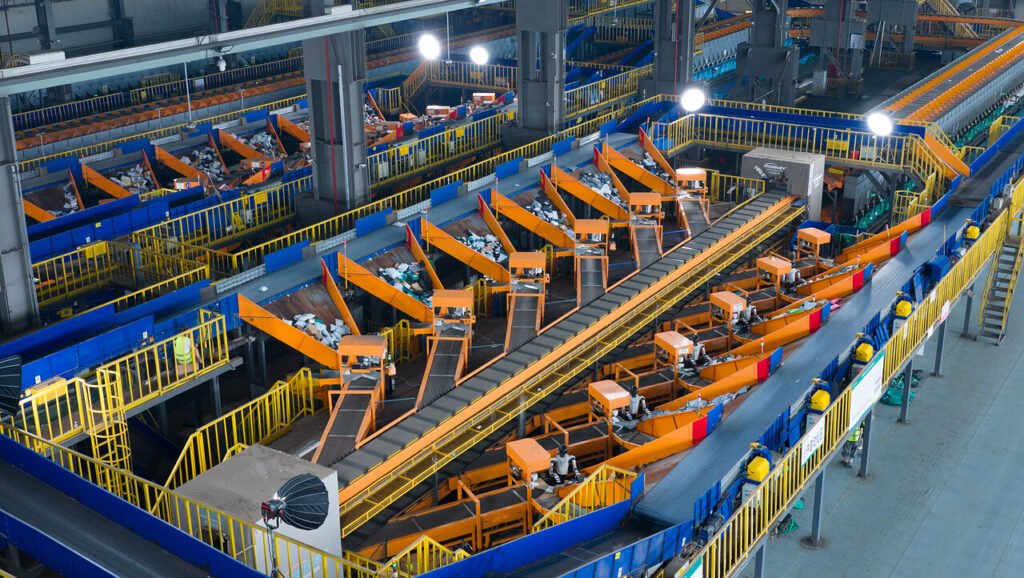
China Post has put 45 humanoid robots to work sorting parcels at its Hangzhou mail center — the largest fleet of its kind ever deployed inside a national postal service. The headline number is striking: roughly 1,200 parcels an hour. Read the fine print, though, and the story gets more interesting than the headline.
According to the announcement from ROBOTERA, the Beijing robotics company behind the machines, testing began in April at China Post’s Hangzhou Postal District Center. The robots pick parcels, flip them into the right orientation, reject odd-shaped items and place them onto induction platforms that feed the sorting lines. Throughput climbed from 500–600 parcels an hour in the early phase to about 1,200 an hour during specific testing periods, with accuracy above 90 percent.
The number everyone is quoting has a footnote
Here is the catch the viral posts skip: ROBOTERA’s English-language release never says whether that 1,200-an-hour figure belongs to one robot or to all 45 working together — a difference of 45 times, TechTimes points out. Chinese-market reports of the same announcement tell a different story again, putting the starting rate at 1,200 and the current throughput above 1,500 an hour. And the release itself is careful to say 1,200 was achieved “during specific testing periods” — not as a sustained, round-the-clock rate.
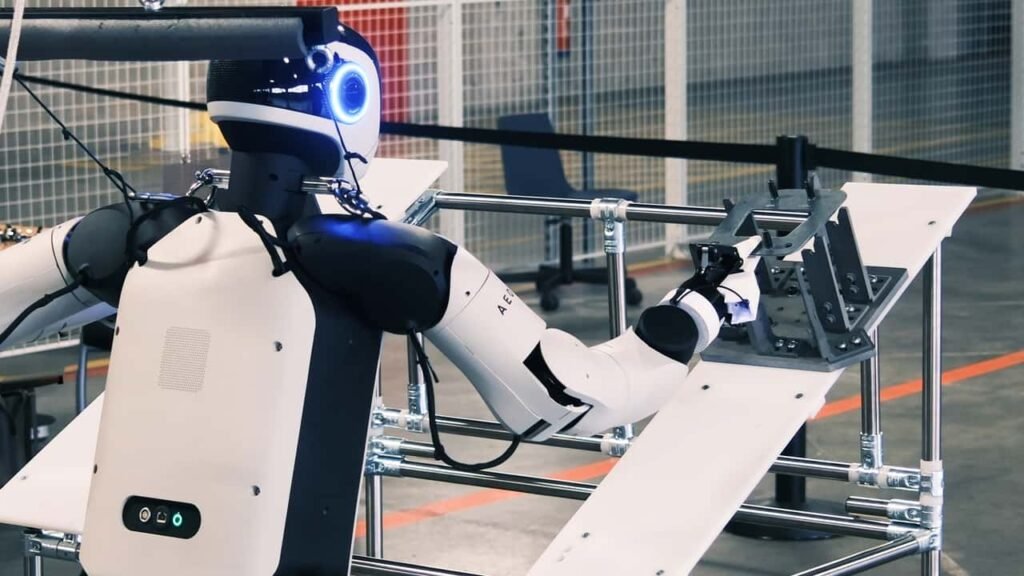
There is a second asterisk. The deployed machine, ROBOTERA’s M7, is not a walking humanoid at all. It is an upper-body torso mounted on a stand beside the conveyor, with two seven-degree-of-freedom arms, twelve-degree-of-freedom hands and 3D LiDAR giving it a 360-degree view of its workstation. For parcel induction — pick, orient, place, repeat — legs would be dead weight. But it means the “humanoid robot” in the photos is closer to a very capable pair of arms than to the walking machines that dominate the headlines.
Why Hangzhou, why now
Hangzhou is not a random test site. The city sits at the heart of China’s e-commerce economy, and its sorting hubs absorb wild swings in package size, weight and fragility. Interesting Engineering notes the deployment is part of a larger push: ROBOTERA’s robots are already running at 11 China Post hubs across eight cities in Guangdong province, after a pilot that began in March. The Hangzhou fleet, though, is the biggest single cluster, and China Post says it plans to extend the automation to sorting and security inspection next.
The company behind the machines is worth a look, too. ROBOTERA grew out of Tsinghua University’s robotics research, and its bet is that the hard problem in logistics is not walking — it is gripping. Its XHAND five-finger dexterous hands, with tactile sensing, are built to handle the awkward reality of parcels: soft bags, taped boxes, tubes, things that arrive dented. A suction cup cannot do that job. A hand can.
Why this matters
The Hangzhou deployment is a useful reality check on the humanoid hype cycle. The industry’s biggest names are racing to show walking robots doing household chores, yet the first genuinely large fleet deployment — 45 machines, in live operation, for months — is a stationary torso doing one repetitive job very well. That is not a failure of the technology; it is the shape of real deployment.
The jobs humanoids get first are the ones where the human form is a tool, not a spectacle: two dexterous hands, good vision, endless patience. The lesson for anyone tracking the sector is to read past the fleet size and the hourly rate and ask the boring questions — per robot or per fleet, test period or sustained shift, walking or bolted to the floor. In Hangzhou, the honest answers are still impressive. They just aren’t the ones going viral.
Meanwhile in Robotics: humanoids are moving into real workplaces on two continents at once — Volvo is training Hexagon’s AEON robots on its Ghent factory floor ahead of a 2027 production pilot. And the production race is heating up, with Tesla ramping Optimus output to hundreds of units per week.