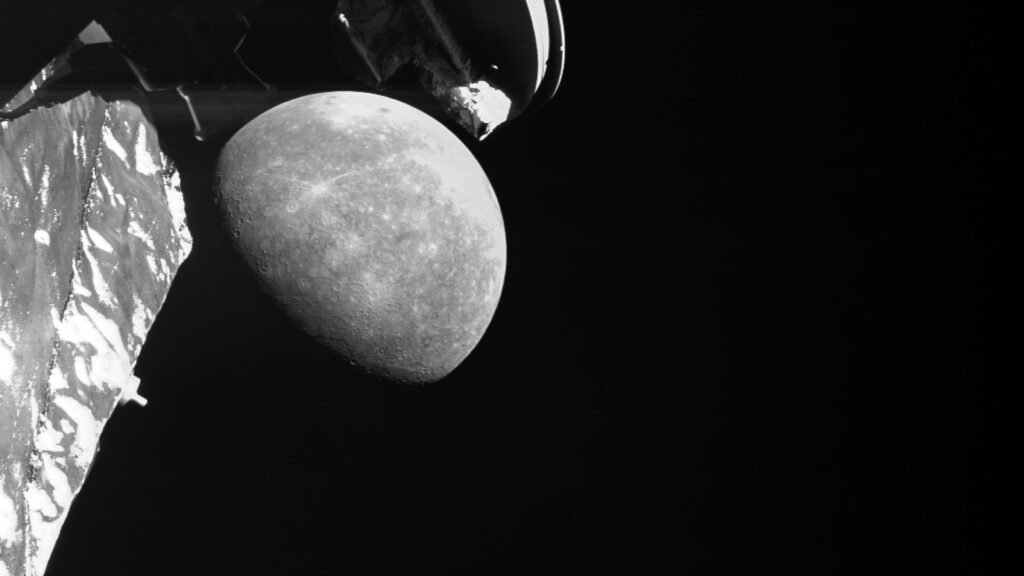
After eight years in space and nine gravity-assist flybys, the European-Japanese BepiColombo spacecraft slipped into orbit around Mercury on Saturday — with a glitch that could easily have ended the mission there.
According to ESA, BepiColombo fired its four axial thrusters at 18:24 UTC on November 21 as it passed just 635 kilometers (395 miles) above Mercury’s surface. The 37-minute burn was supposed to slow the spacecraft enough for the planet’s gravity to capture it. Instead, a software issue cut the maneuver short — and then the spacecraft went quiet.
The Burn That Stopped at 77%
When contact was re-established through ESA’s deep-space antenna in Australia, the mission control team in Darmstadt found the spacecraft in safe mode, a protective state that shuts down non-essential activity. Analysis showed the burn had achieved only around 77% of its planned velocity change, and the fault was traced to a software issue involving attitude guidance and thruster control.
At 01:02 UTC on November 22, the signal came back — and the trajectory data gave the answer the team had been waiting for. “We confirm Mercury orbit capture!” announced ESA flight dynamics manager Frank Budnik.
The shortfall left BepiColombo circling Mercury once every 75 hours instead of the planned 58. ESA says the remaining insertion sequence has already been adapted to the new trajectory, with no additional burns required — the margin built into the flight plan absorbed the error.
A First for Planetary Flight
The arrival also delivered a first: BepiColombo entered orbit around another planet using what ESA calls “weak stability capture,” leaning on the gravitational balance between the Sun and Mercury rather than brute-force braking. It is only the second mission ever to orbit Mercury, after NASA’s MESSENGER, which circled the planet from 2011 to 2015.
BepiColombo launched on October 20, 2018, aboard an Ariane 5, then threaded one flyby of Earth, two of Venus, and six of Mercury to shed enough speed to be caught. Its Mercury Transfer Module separated in early September, leaving the two science orbiters — ESA’s Mercury Planetary Orbiter and JAXA’s Mercury Magnetospheric Orbiter, Mio — to make the final approach together.
What Happens Next
The next test comes fast. The two orbiters are still scheduled to separate on December 9 — December 10 in Japan — using the same thruster and attitude systems that just glitched, so ESA and Airbus must understand the fault before the spacecraft can split in two. More burns will then guide the Mercury Planetary Orbiter toward its final orbit by March 2027, with routine science operations starting in April 2027.
This is not the mission’s first scare. In April 2024, an electrical problem limited power to the transfer module’s thrusters, forcing a revised trajectory that delayed arrival by almost a year, from December 2025. BepiColombo has now survived two serious anomalies on the way to the hardest planet to reach — and, as the Associated Press reports, ESA says the mission remains on track.
Why this matters
The numbers tell the real story. A braking burn delivering only 77% of its planned push should be a mission-ending failure — yet BepiColombo is in a stable orbit, on schedule for separation, because its trajectory was designed with room for exactly this kind of surprise, and weak stability capture gave it a gentler way in. That is the difference between a spacecraft built to survive its own glitches and one built to hope it never has any.
What the two orbiters find will fill a gap no other mission can. Mercury is the least explored of the rocky planets: a world with a magnetic field it should not have and an oversized iron core. MESSENGER mapped it a decade ago, but BepiColombo’s twin orbiters will study the planet and its magnetic environment simultaneously, from complementary orbits. The December 9 separation is the moment that science becomes possible — and the glitch that nearly stole the arrival is now the thing standing between BepiColombo and its real job.
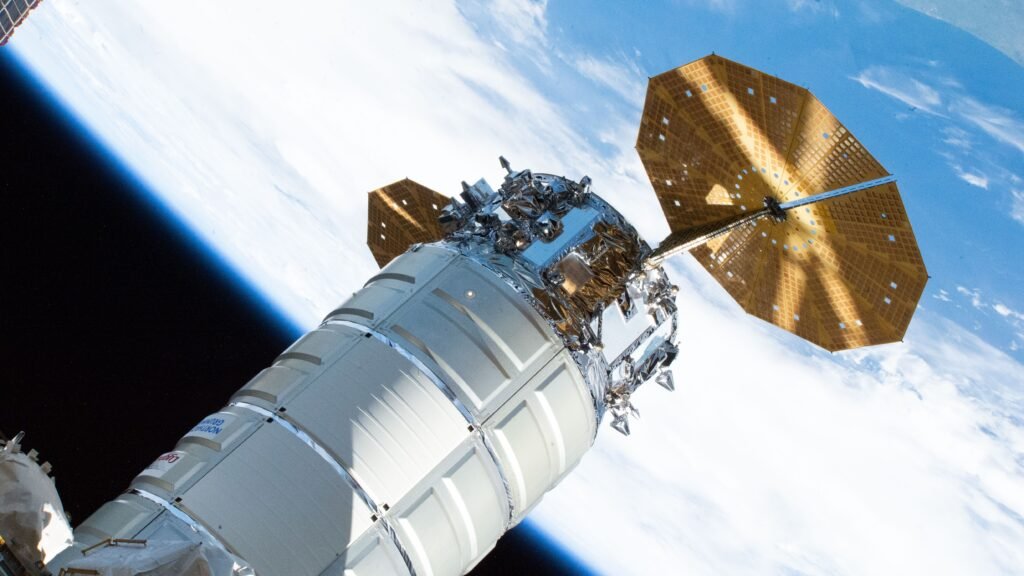
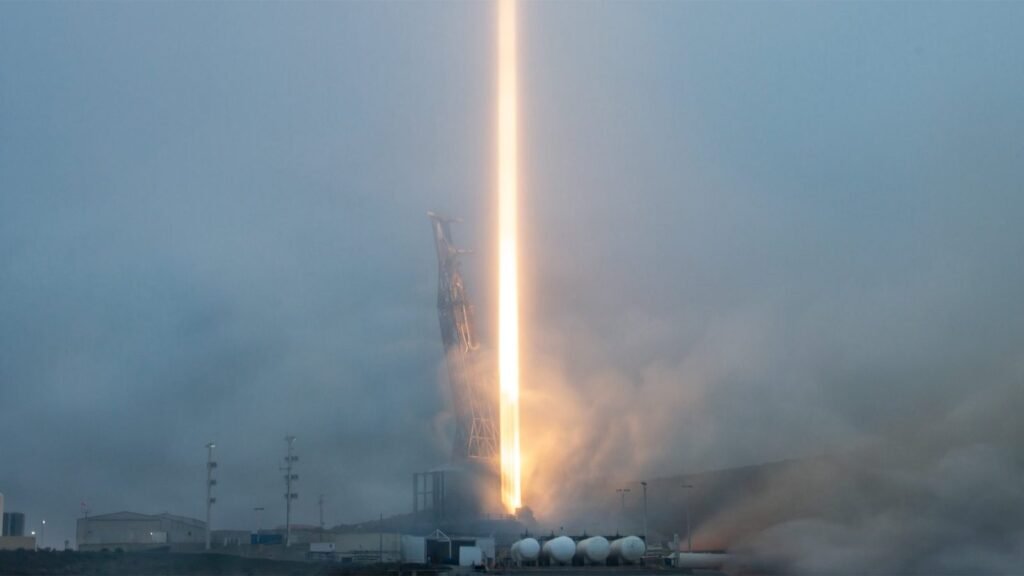
Meanwhile in Space: Northrop Grumman’s Cygnus XL cargo ship is headed for the International Space Station, and SpaceX just pulled off a 32-hour pad turnaround at Vandenberg for a classified NRO launch.